On this page

Key Takeaways
- PMA cybersecurity review sits inside the same statutory framework as 510(k) review under Section 524B, but the depth of evidence expected scales with the higher risk classification of Class III devices.
- A PMA submission requires the full cybersecurity package: SBOM, threat model, security risk management report, penetration testing evidence, and a postmarket surveillance plan, integrated with the device's overall safety and effectiveness case.
- Because PMA devices already carry the most extensive nonclinical and clinical evidence requirements in the FDA's system, cybersecurity gaps are disproportionately costly. A deficiency here can hold up a submission that has already cleared every other technical section.
- Postapproval studies and annual reports for PMA devices increasingly need to address cybersecurity monitoring outcomes, not just clinical performance, extending the security workload well past initial approval.
- PMA supplements for software or connectivity changes trigger a fresh cybersecurity review scoped to the change, so version control and change impact analysis need to be built into the QMS from day one.
A PMA cybersecurity package must satisfy the same Section 524B content expectations as any other pathway: an SBOM, threat model, security risk management report, penetration testing evidence, and a postmarket surveillance plan. Because PMA devices are Class III and often life-sustaining, reviewers hold this evidence to a higher standard and expect it integrated into the overall safety and effectiveness case rather than treated as a standalone appendix. Supplements for software changes trigger fresh cybersecurity review.
Premarket Approval is the pathway for Class III devices, the highest-risk category the FDA regulates, and it requires the most extensive evidence of any premarket route: nonclinical data, clinical data, manufacturing information, and, for any device meeting the Section 524B definition of a cyber device, a complete cybersecurity package. Devices going through PMA are frequently implantable, life-sustaining, or life-supporting, which means a cybersecurity failure has a more direct path to patient harm than in many Class II devices. Reviewers treat the cybersecurity section accordingly.
Why PMA cybersecurity review is different in practice
The statutory cybersecurity requirements under Section 524B do not change based on submission type. What changes is context. A PMA device has already been through, or will go through, extensive clinical evaluation demonstrating safety and effectiveness for its intended use. Cybersecurity has to be shown to not undermine that demonstrated safety and effectiveness, which means the security risk management report needs explicit lines connecting cybersecurity risks to the clinical and physiological consequences established elsewhere in the submission.
This integration requirement is the biggest practical difference from a 510(k) or De Novo cybersecurity package. A security risk that could disable a Class II wearable's data logging is an inconvenience. The equivalent risk in a PMA-reviewed implantable cardiac device is a life-threatening failure mode, and the risk management report needs to say so in terms that connect directly to the clinical risk analysis, not treat cybersecurity as a parallel, separate track.
The core PMA cybersecurity package
Security risk management, integrated with clinical risk analysis
Your ISO 14971-based risk management file needs a documented crosswalk between cybersecurity threats and the clinical hazards already characterized in the PMA's safety and effectiveness data. Where a security failure could plausibly produce or contribute to an adverse clinical event, that pathway needs to be explicit, with the mitigating controls and residual risk decision documented to the same standard as any other safety hazard in the file.
Threat modeling scoped to the device's clinical role
Threat modeling for a PMA device should explicitly account for the device's role in sustaining or supporting life. A denial-of-service condition that is a usability annoyance on a diagnostic device may be a critical safety hazard on a life-sustaining device, and the threat model's severity ratings need to reflect that, not use generic severity bands lifted from a lower-risk product line.
SBOM and supply chain evidence
The SBOM requirement is the same NTIA minimum elements standard used across pathways, but for implantable and life-sustaining devices, component provenance and supply chain integrity carry more weight in review. Reviewers may probe more deeply into how third-party components were vetted, especially any wireless communication stacks, RTOS components, or cloud-connected telemetry modules.
Penetration testing and vulnerability analysis
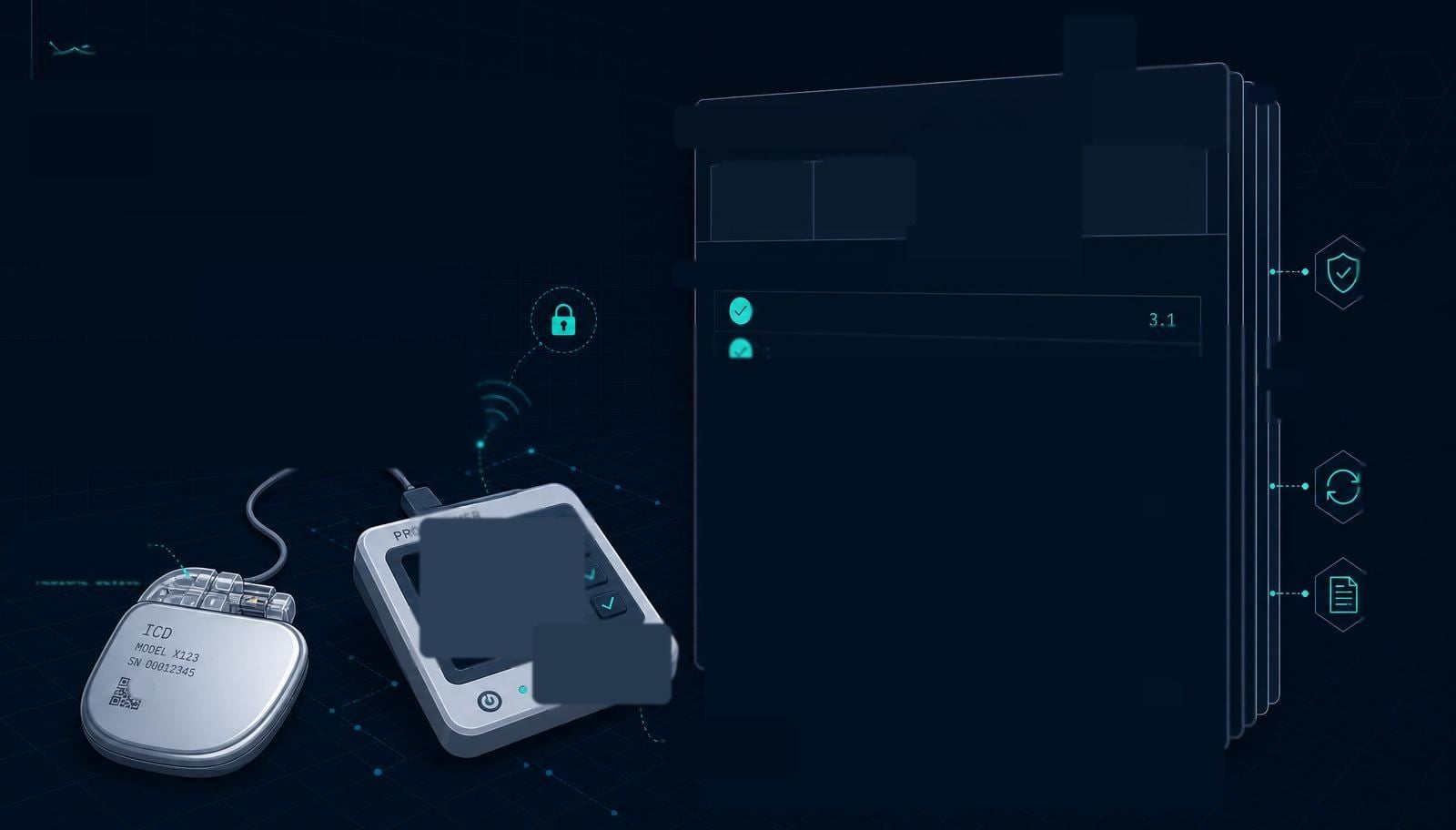
Penetration testing evidence for a PMA device needs to demonstrate testing against the device's actual clinical use environment, including any programmer, home monitor, or clinician-facing interface that can reach the implant or life-sustaining device. Testing scope that stops at the device's own firmware and excludes the ecosystem it depends on is a common source of deficiencies.
Postmarket surveillance integration
PMA devices carry postapproval reporting obligations beyond what a 510(k) device requires, and your postmarket cybersecurity monitoring plan should be built to feed into those existing reporting structures rather than exist as a separate parallel process. Coordinated vulnerability disclosure, SBOM monitoring against CVE feeds, and update mechanisms need to be described with the same operational specificity as your postapproval study protocol, since reviewers now expect these processes to be as auditable as any other postmarket commitment.
How cybersecurity fits into the PMA structure
| PMA section | Cybersecurity integration point |
|---|---|
| Device description | Architecture diagram must show all network, wireless, and interoperable interfaces |
| Nonclinical laboratory studies | Penetration testing and vulnerability analysis reports included or referenced |
| Software documentation | SBOM, threat model, and security risk management report per Section 524B |
| Risk analysis | Cybersecurity risks crosswalked to clinical hazard analysis |
| Labeling | Security-relevant warnings, update procedures, and end-of-support information |
| Postapproval requirements | Postmarket vulnerability monitoring and coordinated disclosure plan |
PMA supplements and the cybersecurity change problem
A PMA approval is not a one-time event. Any change to the device, including software updates, connectivity changes, or new interoperable components, may require a PMA supplement, and cybersecurity-relevant changes trigger their own review scope. This makes configuration management and change impact analysis a continuous requirement rather than a one-time submission exercise. Manufacturers that treat their initial cybersecurity documentation as a closed file, rather than a living set of artifacts tied to the design history file, consistently struggle when a supplement requires updating the SBOM, threat model, and risk analysis to reflect the change.
A well-run SPDF makes this manageable: the threat model, SBOM, and risk management report are maintained as versioned artifacts tied to specific builds, so a supplement only needs a delta analysis against the last approved baseline rather than a ground-up rewrite.
Common pitfalls in PMA cybersecurity submissions
The most damaging pattern we see is cybersecurity documentation that exists as a self-contained appendix, disconnected from the clinical risk analysis that is the heart of the PMA. Reviewers reading a PMA are looking for a coherent safety and effectiveness argument, and a cybersecurity section that reads like it was written by a different team, for a different device, undermines that coherence even when the individual cybersecurity content is technically sound.
The second pattern is testing scope that excludes the clinical use ecosystem. For an implantable device, the programmer, home monitor, and any cloud-connected follow-up system are part of the attack surface a patient is actually exposed to, and testing that stops at the implant's own firmware misses the interfaces most likely to be attacked in practice.
The third pattern is a postmarket plan written in generic terms that does not map to the postapproval reporting structure the device already has. Reviewers now expect the cybersecurity monitoring commitments to be operationally concrete, with a named process owner, a monitoring cadence, and a defined escalation path, not a paragraph restating the SPDF at a high level.
How Blue Goat Cyber approaches PMA cybersecurity requirements
We build the cybersecurity risk management file in direct coordination with the clinical and safety risk analysis so the two read as one argument, which is the single biggest factor in how a PMA reviewer perceives the maturity of a submission's security posture. Our threat modeling accounts explicitly for the device's clinical role, weighting severity against the actual physiological consequence of a security failure rather than applying generic categories. Testing is scoped to the full clinical use ecosystem, including companion programmers and monitoring systems, executed by a team independent of the design engineers. We build the SBOM and postmarket monitoring plan as living artifacts inside your design history file from the start, so that the first PMA supplement you file is a delta exercise rather than a rebuild. For manufacturers preparing a PMA submission, FDA Premarket Cybersecurity Services covers the full package, and FDA Postmarket Cybersecurity Services supports the ongoing surveillance and supplement obligations that follow approval.
FAQ
Are cybersecurity requirements different for PMA versus 510(k) devices?
The statutory requirement is the same under Section 524B: SBOM, threat model, security risk management report, and testing evidence for any cyber device. What differs is depth and integration. PMA devices are Class III, often life-sustaining, so the security risk management report needs to connect directly to the clinical risk analysis, and the standard of evidence reviewers expect is generally higher given the risk classification.
Does an implantable device need cybersecurity testing on its programmer and monitoring system, not just the implant?
Yes. Reviewers expect penetration testing and threat modeling to cover the full clinical use ecosystem, including any external programmer, home monitor, or cloud-connected follow-up system that can communicate with the implanted device. Testing scoped only to the implant's own firmware misses interfaces that are part of the real-world attack surface.
Do PMA supplements require a new cybersecurity submission?
Any change that is cybersecurity-relevant, including software updates or new connectivity, needs a change impact analysis against your existing threat model, SBOM, and risk management file, and depending on the nature of the change, this may need to be reflected in a PMA supplement. Maintaining these artifacts as versioned, living documents rather than one-time deliverables makes this far more manageable.
How does postmarket cybersecurity monitoring interact with PMA postapproval requirements?
Your postmarket cybersecurity monitoring plan, including coordinated vulnerability disclosure and SBOM monitoring against CVE feeds, should be built to feed into the same reporting structures used for postapproval studies and annual reports, rather than run as a separate, disconnected process. Reviewers increasingly expect this integration to be explicit.
What is the biggest cybersecurity mistake manufacturers make in PMA submissions?
Treating the cybersecurity documentation as a standalone appendix rather than integrating it with the clinical and safety risk analysis that anchors the rest of the PMA. A technically sound threat model that does not connect to the device's actual clinical risk profile reads as disconnected from the submission's central safety argument.
Where this fits in the cluster
- FDA Pathway Cybersecurity Differences
- De Novo Cybersecurity Submission Guide
- Section 524B Cybersecurity Requirements Explained
- Postmarket Cybersecurity Monitoring Program
- Full-Service Cybersecurity for PMA Submissions - what an integrated Class III package includes end to end.
Related from Blue Goat Cyber
- FDA Premarket Cybersecurity Services
- FDA Postmarket Cybersecurity Services
- Medical Device Penetration Testing
Sources & primary references
- Cybersecurity in Medical Devices: Quality Management System Considerations and Content of Premarket Submissions (FDA, February 3, 2026 final guidance)
- Premarket Approval (PMA) (FDA)
- Section 524B of the FD&C Act
- ANSI/AAMI SW96:2023, Medical Device Security
- ISO 14971:2019, Application of Risk Management to Medical Devices
If you are preparing a PMA submission and need the cybersecurity package integrated with your clinical risk analysis, our team can build the threat model, SBOM, and testing evidence to support the full safety and effectiveness case. Talk to Blue Goat Cyber about your PMA cybersecurity requirements.
Free tools for this
- Submission Pathway Selector - work out whether the device fits 510(k), De Novo or PMA.
Sources & references
Primary sources cited in this article. Links open in a new tab.