
The “Clipper Chip” controversy is one of the most important moments in modern encryption history—not because of the chip itself, but because of what it represented: the idea that secure communications should include a built-in way for government access through key escrow (sometimes described as a “backdoor,” depending on perspective).
For medical device manufacturers, the Clipper story is still relevant today. Connected devices, cloud services, and remote support workflows all rely on encryption and key management. Any design that adds special access paths—no matter how well-intentioned—can create additional risk if it expands the number of parties, keys, and systems that must be trusted.
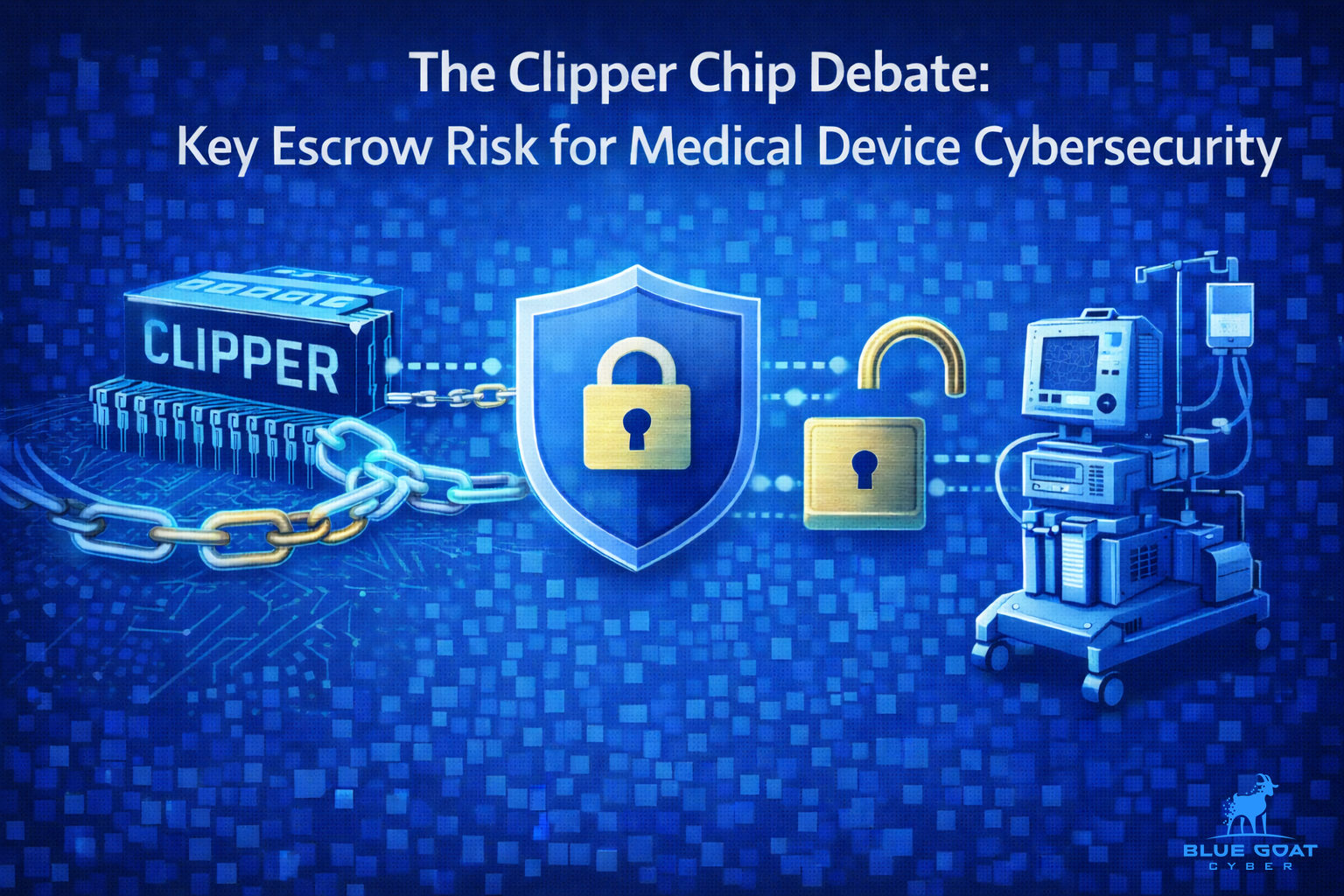
What Was the Clipper Chip?
The Clipper Chip was a U.S. government-backed proposal from the 1990s intended to provide strong encryption for communications while enabling lawful access through a key escrow mechanism. The controversy wasn’t about whether security matters—it was about whether mandated exceptional access could be implemented without undermining privacy, trust, and overall security.
Why the Clipper Chip Sparked a Controversy
The core concerns raised during the debate are the same concerns MedTech teams face when designing secure connected products:
- Trust expansion: more parties and systems become “in the circle of trust.”
- Key management complexity: key escrow increases operational and security complexity.
- Single points of failure: if escrowed keys are stolen or misused, impact can be massive.
- Global acceptance: mandated access in one region can create compliance and market challenges globally.
- Unintended consequences: “special access” paths can become attacker targets.
What This Means for Medical Device Cybersecurity
Medical device ecosystems aren’t just a device anymore. They include:
- embedded software and firmware
- mobile apps and clinician portals
- cloud services and APIs
- manufacturing and service tooling
- remote support access pathways
That ecosystem reality creates a practical question: who holds the keys, who can decrypt what, and under what conditions?
MedTech Lessons: Encryption and “Exceptional Access”
1) Avoid “special” access paths whenever possible
If one class of user/system can bypass normal security controls, attackers will target it. When you need privileged access (e.g., service workflows), design it with strong authentication, least privilege, and monitoring—without creating universal decryption capability.
2) Treat key management as a safety-critical capability
Weak key management can undermine strong encryption. Practical requirements include secure key generation, secure storage, rotation, revocation, and strict access controls.
3) Remote support is often the real “Clipper-like” risk
Many modern incidents don’t break encryption—they abuse remote access, credentials, or privileged tooling. Secure remote support by requiring MFA, using short-lived credentials, limiting scope, and logging all privileged actions.
4) Design for global expectations, not just one market
MedTech products often ship globally. Encryption decisions should consider international expectations for privacy, security, and lawful access requests—without building fragile, one-off mechanisms that increase systemic risk.
5) Make it defensible: document your decisions and evidence
“We use encryption” isn’t enough. A defensible story includes: what you protect, how keys are managed, how privileged access is controlled, and how controls are verified and monitored over time.
Practical Checklist: Secure Encryption in Medical Device Ecosystems
- Define data classes: what data needs encryption (ePHI, credentials, logs, configs, IP)?
- Use modern, standard cryptography: avoid legacy algorithms and weak modes.
- Protect keys: secure storage, access control, rotation, revocation, and auditability.
- Secure remote access: MFA, least privilege, time-bounded access, and full logging.
- Validate implementations: security testing focused on auth, key handling, and update workflows.
- Plan postmarket: vulnerability intake, patching, and incident response tied to crypto dependencies.
How Blue Goat Cyber Helps
Blue Goat Cyber helps medical device manufacturers build defensible encryption and key management strategies across the device ecosystem—paired with threat modeling, verification testing, and postmarket readiness.
- Medical Device Threat Modeling
- Medical Device Vulnerability & Penetration Testing
- Premarket Cybersecurity Services
- Postmarket Cybersecurity Management
- Contact Blue Goat Cyber
Bottom line: The Clipper Chip debate reminds us that “exceptional access” and key escrow can create new security liabilities. In MedTech, strong encryption + strong key management + controlled privileged access is the safer, more defensible path.
Clipper Chip FAQs
Imagine a tiny piece of tech, a chip, proposed by the U.S. Government in 1993, designed to be the heart of secure communication devices. The Clipper Chip was like the government's attempt at having a secure backdoor into encrypted communications—think of it as trying to keep a secret key to everyone's diary, but only for 'national security' reasons. It was supposed to ensure that communications could be encrypted for privacy but still accessible by authorities under certain conditions.
The big "why" here was about balance. On one side, there was this rapidly growing digital world, like the wild west, where data and communications were free to roam. On the other, concerns about criminal activities, threats to national security, and the inability of law enforcement to keep up. The Clipper Chip was like the government's attempt at installing a safety net, ensuring that they could still catch the bad guys in this new digital frontier.
This is where it gets interesting. The plan was to use a method called "key escrow." Basically, when you use a device with a Clipper Chip, the encryption keys would be split and stored securely by two independent agencies. If the authorities had legitimate reasons (like a court order), they could get those keys, put them together, and access the encrypted communication. It's a bit like having a two-key system for a safe, ensuring no single person could open it alone.
Well, there were a few deal-breakers. First, the tech community and privacy advocates went up in arms about the potential for abuse and the inherent risks of creating a backdoor into private communications. It was like opening Pandora's box, with the potential for not just the government but hackers to exploit these vulnerabilities. Then, there was the practical aspect—technology was advancing rapidly, and international users simply wouldn't adopt U.S. tech that they knew was compromised. It was a trust issue, and once that trust was questioned, the Clipper Chip's fate was sealed.
The Clipper Chip saga set the stage for the ongoing encryption, privacy, and government surveillance debate. It's like the origin story for many of today's discussions on digital privacy and the extent of government oversight. The Clipper Chip debate highlighted the need for a delicate balance between securing digital communications and ensuring national security without overstepping into privacy infringement.
Key escrow is an arrangement where encryption keys (or key material) are held by a third party to enable decryption under certain conditions, such as lawful access requests.
No. Secure support can be achieved through controlled, auditable access (strong authentication, least privilege, time-limited sessions) without universal decryption capability.
Expanding trust and adding special access paths can increase risk. Strong encryption is only as good as the key management and privileged-access controls around it.