
Updated December 29, 2025
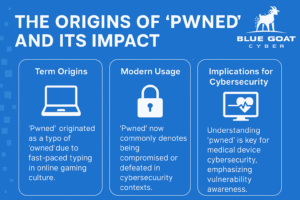
In cybersecurity circles, few words carry as much weight—or cultural baggage—as “pwned.” Born from a simple typo, it quickly evolved into a hacker’s battle cry, signaling domination over a system. But today, it means much more: being “pwned” implies your device, data, or infrastructure has been completely compromised.
For medical device manufacturers, being pwned isn’t just a buzzword—it’s a regulatory, financial, and patient safety disaster. Understanding the roots and implications of the term offers important insight into how attackers think—and how to defend against them.
What Does “Pwned” Mean?
“Pwned” (pronounced poned) is internet slang that originated in gaming and hacker forums. It’s a derivative of “owned,” typically used when someone completely defeats an opponent. The word first appeared as a typo—replacing “o” with the adjacent keyboard letter “p”—but stuck due to its ironic, aggressive tone.
In cybersecurity, “pwned” refers to:
- Unauthorized access to a system
- Full compromise of credentials or control
- Remote execution of commands or deployment of malware
Today, it’s even made its way into formal terminology: services like Have I Been Pwned track compromised email addresses and credentials leaked in breaches.
How Hackers “Pwn” Systems
To “pwn” a system, an attacker needs to exploit one or more vulnerabilities. This could involve:
- Default or weak credentials
- Firmware backdoors
- Unpatched vulnerabilities (e.g., buffer overflows, injection flaws)
- Misconfigured remote access services
The ultimate goal is to achieve complete administrative control over the device—either covertly for long-term persistence or destructively for denial-of-service purposes.
What It Means for Medical Devices
Modern medical devices are increasingly connected, complex, and vulnerable to exposure. Attackers don’t need physical access to “pwn” an infusion pump, ventilator, or cardiac monitor—they need a way in.
Common Entry Points for Pwnage:
- Telnet, FTP, or SSH ports left open in production
- Hardcoded passwords in firmware
- Lack of transport layer encryption (e.g., BLE, MQTT traffic)
- Cloud interfaces with weak access controls
Real-World Example:
In a hospital, a third-party patch management system had access to dozens of diagnostic devices. A misconfigured admin portal allowed a remote attacker to pivot through the network and deploy ransomware on imaging systems. The result? Systems were “pwned,” operations halted, and patient appointments delayed for days.
How to Avoid Getting “Pwned” in Medical Device Environments
✅ 1. Implement Least Privilege
Ensure that internal services, device firmware, and third-party connections operate with minimal access rights. Admin rights should never be the default.
✅ 2. Secure Authentication and Remove Defaults
- Enforce strong password policies
- Disable default credentials in production
- Use certificate-based authentication where feasible
✅ 3. Patch Firmware and Manage SBOMs
Maintain a Software Bill of Materials (SBOM) and regularly scan for CVEs affecting embedded components. Firmware should be updatable, signed, and protected against rollback.
✅ 4. Harden Interfaces
- Disable unused ports and protocols
- Segment medical device networks
- Implement input validation and command filtering
✅ 5. Monitor Logs and Anomalies
Being “pwned” often involves subtle indicators before the breach:
- Failed login attempts
- Unusual memory usage
- Outbound traffic to unknown IPs
Log everything. Correlate anomalies across devices, and build alerting rules into postmarket monitoring programs.
Regulatory Considerations
The FDA’s 2025 Premarket Cybersecurity Guidance emphasizes proactive risk management, threat modeling, and robust access control. If a device is “pwned,” manufacturers must report incidents that:
- Compromise safety or effectiveness
- Affect multiple users or hospitals
- Involve exploit chains or persistent malware
A “pwned” device could lead to product recalls, reputational damage, and significant fines if mitigations aren’t in place or appropriately documented.
The Bigger Lesson: Understanding the Adversary
“Pwned” is more than a word—it represents the attacker’s mindset. It’s not just about access; it’s about control. When building secure medical technology, engineers must anticipate how adversaries operate and think like an attacker.
Understanding slang like “pwned” helps us grasp how threats are discussed, how they evolve, and how we might prevent them from becoming real-world exploits.
Summary
Being “pwned” is a meme in hacker culture—but in medical device cybersecurity, it represents a critical state of compromise with real-world consequences. If attackers can take over a device—whether through outdated firmware, poor access control, or overlooked network paths—they can disrupt patient care, expose PHI, or even cause harm.
Medical device teams must act with urgency, follow secure development practices, and align with FDA requirements to prevent ever being pwned.
Work With Blue Goat Cyber
At Blue Goat Cyber, we help medtech companies anticipate how hackers exploit their systems—and build the necessary protections to stop them. From penetration testing and threat modeling to FDA-aligned documentation and remediation, we’re the trusted name in medical device cybersecurity.
👉 Schedule a consultation before your device ends up on the wrong side of “pwned.”
Pwned FAQs
What does “pwned” mean in cybersecurity?
In cybersecurity, “pwned” refers to an attacker gaining unauthorized access and exercising meaningful control—often administrative control—over a system or account. It’s more than a failed login or a minor issue; it implies a real compromise.
Is “pwned” just gamer slang, or does it have a technical meaning?
It started as internet slang, but security folks use it as shorthand for “compromised.” If a system is “pwned,” assume the attacker can act as a legitimate user (or admin) until proven otherwise.
How do attackers usually “pwn” systems today?
Common paths include weak/default credentials, exposed remote access, unpatched vulnerabilities, and misconfigurations. In connected environments, attackers often seek a single, small opening and then pivot to higher-value systems.
How can we tell if our environment has been pwned?
Look for signs such as repeated failed logins, new accounts/permissions, unusual outbound traffic, unusual process behavior, and unexpected configuration changes. The hard part is that early compromise can be quiet, so logging and alerting matter.
What should we do first if we suspect we’ve been pwned?
Start with containment: limit access, isolate affected systems, rotate credentials (especially privileged ones), and preserve logs/evidence. Then confirm scope (what was accessed, changed, or exfiltrated) before you “clean up,” so you don’t erase what you need to understand the attack.
Does MFA prevent getting pwned?
MFA helps a lot—especially against credential stuffing and stolen passwords—but it’s not a magic shield. For high-impact accounts, stronger options (like phishing-resistant MFA) and good recovery controls make a big difference.
How do SBOMs and patching reduce the chances of getting pwned?
If you don’t know what’s inside your device/software, you can’t reliably track exposure when new vulnerabilities drop. An SBOM, combined with a repeatable patch/remediation process, closes the “known vuln, unpatched system” gap that attackers love.
What’s the FDA angle if a device gets “pwned”?
The FDA’s cybersecurity expectations emphasize proactive risk management, threat modeling, and strong access control as part of an overall lifecycle approach. If an incident affects safety/effectiveness or has a broader impact, you may have reporting and remediation expectations. It is helpful to have your documentation, evidence, and post-market processes ready ahead of time.