
Inter-process communication (IPC) is the “plumbing” that lets software components cooperate—UI apps talking to system services, therapy-control logic exchanging messages with safety monitors, and update agents coordinating with the operating system. In connected medical devices, IPC is often where a low-privilege foothold turns into a high-impact safety issue.
The problem isn’t that IPC exists—it’s that many implementations assume “anything local is trusted.” Attackers don’t. Once an adversary gets code running on a device (or inside a companion gateway), abusing IPC can become a fast path to privilege escalation, command injection, or denial of service. MITRE explicitly calls out IPC abuse as a technique for local execution. See MITRE ATT&CK: Inter-Process Communication (T1559).
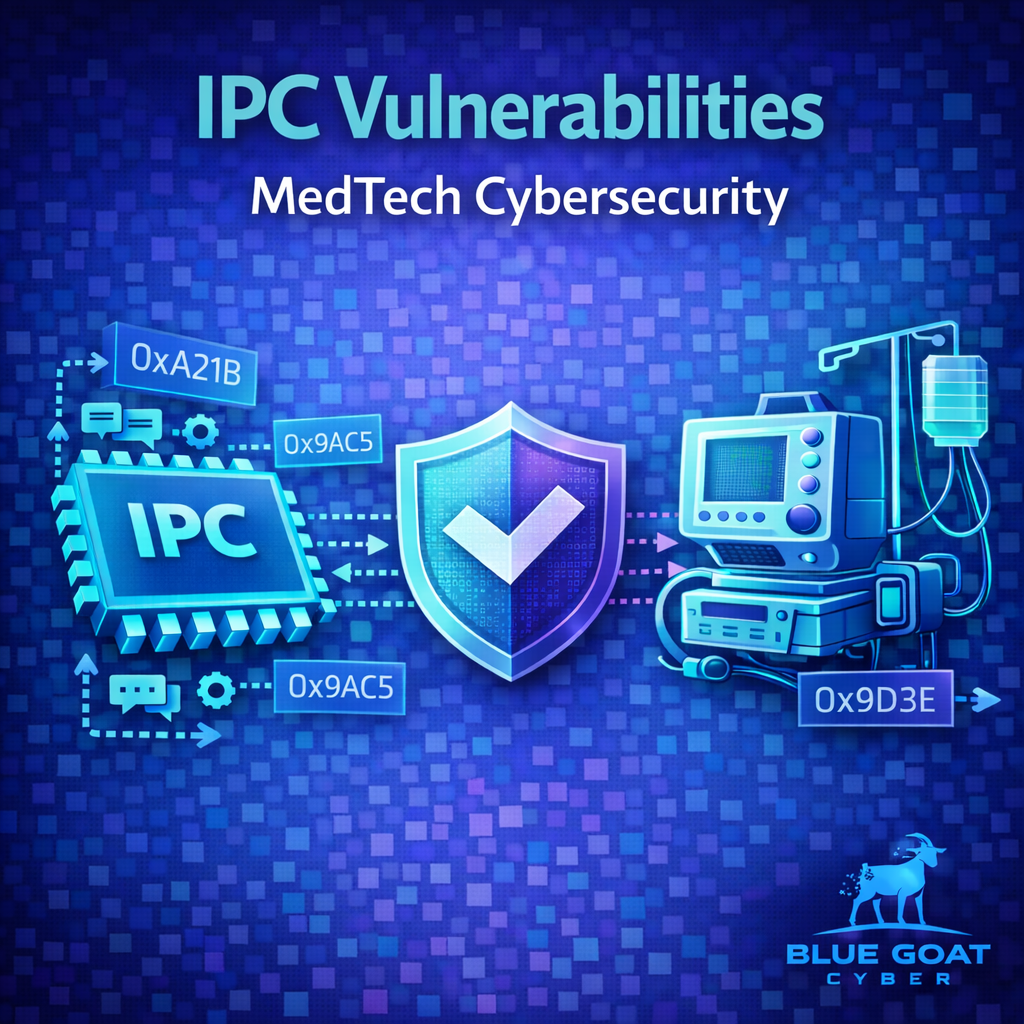
What IPC looks like in real medical device software
IPC comes in different forms depending on the platform:
- Embedded Linux: Unix domain sockets, D-Bus, shared memory, pipes, and custom daemons.
- RTOS: message queues, mailboxes, shared buffers, event flags, and task notifications.
- Microkernel designs: heavy reliance on message passing/RPC between user-space servers and the minimal kernel.
In many architectures, the most safety-critical functions run in higher-privilege services. That’s exactly why IPC needs to be treated as a trust boundary—especially when a UI process, network-facing process, or third-party component can send messages “upstream.”
If you’re working with embedded operating systems, you may also find these related reads useful:
Cybersecurity with RTOS and Microkernels Explained.
Common IPC vulnerability patterns that show up in devices
IPC issues usually fall into a few repeatable buckets:
- No authentication of the sender: any local process can call a privileged service method.
- Weak authorization: the service authenticates “someone,” but doesn’t enforce least privilege per command.
- Confused deputy: a privileged service performs sensitive actions on behalf of an untrusted caller.
- Insecure permissions: world-writable sockets, pipes, shared memory segments, or message queues.
- Input validation & parsing bugs: unsafe deserialization, malformed message handling, buffer overflows.
- Race conditions / TOCTOU: state changes between “check” and “use,” especially around file/handle passing.
- Denial of service: message floods, resource starvation, deadlocks, or priority inversion in real-time systems.
In a medical device context, these translate into concrete hazards: stopping a monitoring function, degrading therapy timing, triggering unintended mode changes, or blocking alarms. That’s why IPC hardening belongs in your safety and security risk management—not as an “IT-only” concern.
Practical controls to harden IPC
Start with design controls that reduce blast radius, then add implementation and verification rigor.
Architecture and design controls
- Define IPC trust boundaries explicitly: document which processes are trusted, which aren’t, and why.
- Least privilege by default: split “read-only status” from “therapy control” APIs; separate roles and capabilities.
- Minimize the IPC surface area: fewer endpoints, fewer methods, and simpler message schemas.
- Strong identity for callers: use OS primitives (UID/GID, SELinux/AppArmor labels, capabilities) and enforce them.
- Secure defaults: restrictive socket permissions, explicit allowlists, and denial of unknown methods/messages.
Implementation controls
- Validate inputs like they’re hostile: length checks, strict schemas, safe parsing, and defensive error handling.
- Rate limiting and backpressure: prevent message floods from starving real-time or safety-critical tasks.
- Memory-safety where feasible: prioritize safer libraries and patterns for message parsing/serialization.
- Crypto where it makes sense: if IPC crosses hosts (or behaves like a network protocol), use mutual authentication and modern TLS.
Verification and testing controls
- Threat model the IPC flows: focus on entry points, trust boundaries, and “what happens if a low-privilege process lies?”
- Static analysis + manual review: catch parsing bugs, unsafe memory operations, and authorization gaps early.
- Fuzz and robustness testing: feed malformed and unexpected messages to IPC endpoints and validate safe failure modes.
- Penetration testing: validate real exploitability and privilege escalation pathways end-to-end.
If you want help operationalizing this, these services map directly to IPC risk reduction:
Threat Modeling,
Medical Device SAST, and
FDA-Compliant Vulnerability & Penetration Testing.
How to document IPC risk for FDA (and reduce reviewer friction)
FDA’s current premarket cybersecurity guidance expects manufacturers to treat cybersecurity as part of device safety and the quality system, using structured processes across the total product lifecycle. FDA: Cybersecurity in Medical Devices (June 2025).
For IPC specifically, reviewer-friendly evidence typically includes:
- Architecture views and data flows that show IPC trust boundaries (who can call what, with what privileges).
- Threat modeling output covering IPC abuse cases (spoofing, injection, DoS, privilege escalation).
- Security requirements (authentication, authorization, logging, resiliency) traced to design and verification.
- Verification evidence (SAST results, fuzzing/robustness tests, penetration test findings and remediation).
- Secure development practices aligned to a recognized framework such as NIST SSDF. NIST SP 800-218 (SSDF).
This is also where strong premarket cybersecurity documentation & testing support can save weeks of rework—because IPC issues often show up as “design gaps,” not just code defects.
Don’t forget postmarket: IPC bugs rarely stay “fixed”
IPC vulnerabilities often live in third-party components (OS services, middleware, serialization libraries). That makes them a supply-chain and patch-management problem too. Your SBOM and vulnerability response process should be prepared to detect new CVEs, evaluate exploitability in your IPC context, and ship validated updates.
Relevant resources:
FDA-compliant SBOM services and
FDA postmarket cybersecurity management.
IPC security checklist (quick-start)
- Inventory IPC endpoints and classify them by privilege and safety impact.
- Mark IPC trust boundaries and enforce caller identity/authorization at the receiver.
- Reduce attack surface: fewer methods, stricter schemas, safer defaults.
- Harden parsing and add fuzz/robustness testing for malformed messages.
- Validate resilience: rate limits, watchdogs, and safe failure modes.
- Trace controls into your SPDF artifacts and premarket submission documentation.
- Monitor postmarket vulnerabilities and update dependencies quickly.
Conclusion
IPC is essential—and it’s a frequent choke point for escalation in embedded systems. Treat IPC like a security boundary, back it with least privilege and robust validation, and generate the evidence FDA expects. You’ll reduce both real-world risk and regulatory friction.
Book a Discovery Session
Want help finding and fixing IPC risks (and documenting them cleanly for reviewers)?