
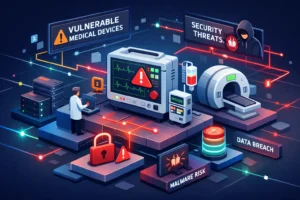
What are the cybersecurity risks of legacy medical devices in hospitals? It’s a question more hospital security teams are asking, and not finding easy answers to. Hospitals operate some of the most sophisticated care environments in the world: robotic surgery systems, real-time patient monitoring networks, AI-assisted diagnostics. And underneath all of it, many run Windows XP, long-dated firmware, and network protocols that were never designed to touch the internet.
This is not a future problem. Research from Claroty and RunSafe Security documents significant exposure across U.S. hospital networks, and the structural mismatch driving it is straightforward: medical devices are built to last 15 to 20 years, but vendor software support runs three to five. Everything in between is a security gap that grows wider every year. Blue Goat Cyber works directly with medical device manufacturers on FDA cybersecurity compliance and postmarket security programs, and that manufacturer-side work makes the depth of these vulnerabilities plain, often years before they appear on a hospital’s radar. For more on practical manufacturer-side challenges and device lifecycle issues, see our post on Navigating Cybersecurity Challenges for MedTech Legacy Devices, Blue Goat Cyber.
By the end of this article, you will know how to identify the specific cybersecurity risks of legacy medical devices on your clinical network, score your most exposed assets, apply immediate compensating controls, and build a realistic 90-day remediation roadmap aligned with FDA and IMDRF guidance.
Why Legacy Medical Devices Create Outsized Risk on Clinical Networks
Legacy devices are not simply unsupported enterprise laptops dropped into a clinical setting. They are fundamentally different, and the risk calculus is different too. You cannot take a cardiac monitor offline to run a security scan the way an IT team can reboot a server at 2 a.m. Clinical criticality and security maintenance are in direct tension, and that tension has no clean resolution in most hospital environments.
The Lifecycle Mismatch That Nobody Planned For
The structural problem is straightforward. Devices are designed to last 15 to 20 years. Vendors support the underlying software for three to five. Hospitals use them for everything in between. The result: clinical equipment running unsupported OS versions, firmware that hasn’t received a security update in years, and legacy communication protocols originally designed for air-gapped environments now sitting on connected clinical networks. According to Claroty’s 2023 State of CPS Security Report, 14% of medical devices in U.S. hospitals run an unsupported or end-of-life operating system while actively connected to clinical networks, and 53% of networked devices carry at least one known critical vulnerability. The cybersecurity risks of legacy medical devices in hospitals are, in large part, a direct product of this mismatch.
What “End of Support” Actually Means for Your Network
End-of-support does not mean the device stops working. It means no more security patches, no vulnerability advisories, and no vendor-supplied fixes. Any exploit discovered after that date stays open indefinitely. There is no patch coming. Every day a device stays on your network after end-of-support, the exposure window grows. Attackers actively scan for these devices. They know exactly which CVEs apply to which unsupported platforms, and they use that knowledge.
What Risks Do Legacy Medical Devices Pose? The Specific Vulnerabilities
Once you understand the structural problem, you need to know what you are actually looking for when you audit your environment. The vulnerabilities in aging medical equipment fall into a few consistent categories, and they compound each other.
Unpatched Operating Systems and Outdated Firmware
Legacy commercial OS versions, Windows 7, Windows XP, and embedded variants, remain common in clinical environments across imaging systems, patient monitors, and infusion management platforms. The Contec CMS8000 patient monitor case makes the stakes concrete. In January 2025, the FDA issued an alert revealing a backdoor in the device’s firmware that allowed unauthorized remote access and patient data exfiltration. According to the FDA advisory, the backdoor had been present for over 13 years, undetected. The agency’s published mitigation required disabling networking functions, not a patch restoring full capability, but a control that limited further exposure. These devices are currently deployed in U.S. hospitals. This is not a hypothetical scenario. See the FDA safety communication on Contec and Epsimed patient monitors for details.
Default Credentials, Insecure Protocols, and Poor Segmentation
Twenty-one percent of connected medical devices still use default or weak credentials (Claroty, 2023). Layer in legacy communication protocols never designed for networked environments, minimal authentication requirements, and flat network architectures, and you have a direct path from an internet-facing entry point to clinical equipment. Ninety-nine percent of hospitals are managing Internet of Medical Things (IoMT) devices with at least one known exploited vulnerability listed on CISA’s KEV catalog. That figure is not a projection. It is the documented current state, and it illustrates precisely what risks legacy medical devices pose on any connected clinical network. Recent analyses of exploited vulnerabilities in hospital networks provide additional context on how widespread active exploitation has become; see reporting on known exploited vulnerabilities in hospital networks.
What Happens When These Vulnerabilities Get Exploited
The technical vulnerabilities are real. So are the outcomes when they get exploited. Consider three documented cases before moving to the patient-level implications, these illustrate where theoretical risk becomes operational harm.
Operational Disruptions Hospitals Have Reported
RunSafe Security’s 2025 survey of 605 healthcare executives found that 22% of organizations experienced a medical device cyberattack in the past year, and 75% of those attacks directly affected patient care. Among organizations that reported device downtime, 43% experienced one to four hours of unavailability, while 7% faced more than three days offline, forcing manual backup procedures that carry their own patient care risks. WannaCry in 2017 infected over 1,200 diagnostic devices and forced five UK hospital emergency departments to close. The CommonSpirit Health ransomware attack in 2022 pushed 140 hospitals to paper charting for over a month at an estimated cost of $160 million. Los Angeles-area incidents involving diagnostic equipment failures triggered ambulance rerouting, a direct operational consequence of compromised aging medical equipment.
Patient Safety Implications the Data Reveals
Beyond operational disruptions, the documented clinical risks include altered data displayed on patient monitors, inaccurate readings on implanted devices, and denial-of-service conditions that crash devices mid-use. The FDA’s 2025 alert on the Contec CMS8000 specifically cited risks of device crashes, data corruption, and unauthorized access to patient PHI. A 2022 FBI report documented vulnerabilities in unpatched insulin pumps, pacemakers, and defibrillators with potential for inaccurate readings and health endangerment. Regulators, including the FDA, IMDRF, and the FBI, treat these as patient safety risks, not just IT incidents, even where specific documented patient-harm cases remain limited in public reporting. That framing matters when you are making the case for resource allocation and board-level attention.
How to Identify and Rank Your Highest-Risk Assets
You cannot fix what you cannot see. Most hospitals are working from incomplete, outdated, or siloed asset inventories. That is the first problem to solve, and it has to be solved before any controls are worth deploying.
Starting with a Complete Clinical Device Inventory
A useful asset inventory captures device type, manufacturer, OS and firmware version, network connectivity, end-of-support date, and clinical criticality. Automated network discovery tools purpose-built for healthcare environments close gaps that manual methods miss. Claroty’s research suggests a meaningful share of hospital devices go untracked at any given time, a gap that makes compensating controls difficult to deploy consistently. Clinical engineering and IT security need to own this inventory together. When those teams operate in silos, visibility breaks down at exactly the seam between biomedical management and network security, which is precisely where attackers look for gaps. Practical guidance on why and how to inventory medical devices for confident cybersecurity can help operationalize discovery efforts, and our analysis of the Two Medical Device Cybersecurity Gaps: Dispersed Responsibility and a Scarcity of Asset Inventory, Blue Goat Cyber explains the organizational friction that typically undermines those programs.
A Scoring Approach That Cuts Through the Noise
Once your inventory exists, prioritization needs a clear framework rather than gut instinct or vendor pressure. Score each device on three dimensions: known exploitability (is there a public CVE or active KEV?), network exposure (is the device internet-accessible or on a flat network?), and clinical criticality (what happens to patient care if this device goes down?). Devices that score high on all three get attention first, regardless of replacement cost or vendor relationship. A mid-tier imaging system running an unsupported OS on a flat network with a public CVE ranks ahead of a newer device with no known vulnerabilities. The score drives the priority, not the price tag.
Compensating Controls That Reduce Exposure Without Replacing Devices
Most hospitals cannot replace legacy devices on short notice. Budget cycles, clinical dependencies, and procurement timelines make immediate replacement unrealistic. Compensating controls are the practical middle ground, and they work when implemented with discipline and layering.
Network Segmentation and Isolation
Segmentation is the single highest-impact control for legacy device risk. Isolating clinical devices in dedicated VLANs, blocking unnecessary outbound traffic, and applying micro-segmentation for the highest-risk assets directly limits an attacker’s ability to move laterally from an initial entry point to critical equipment. Virtual segmentation approaches are less disruptive than physical network redesigns and can be deployed in weeks rather than months. Both FDA guidance and the IMDRF N70 framework explicitly endorse network segmentation as a primary compensating control for devices that cannot be patched, making this approach well-documented for regulatory purposes.
Virtual Patching, Monitoring, and Access Controls
Virtual patching via WAFs or protocol proxies blocks known exploits at the network layer without touching the device itself. Passive monitoring tools built specifically for medical IoT, not generic SIEM platforms, provide behavioral baselines and anomaly detection tuned for clinical device traffic. Access controls, including role-based access, credential rotation, and removal of remote access where it is not clinically required, address the default credential problem directly. No single control is sufficient. These measures work through layering, and each layer needs documentation to satisfy internal audit and regulatory review.
A 90-Day Roadmap Aligned with FDA and IMDRF Guidance
Neither the FDA nor IMDRF mandates immediate replacement of legacy devices. What they do expect is documented risk assessments, active compensating controls, transparent communication with device manufacturers, and ongoing monitoring. The IMDRF N70 framework establishes clear roles for both manufacturers and healthcare delivery organizations at each lifecycle stage, including post-end-of-support. Hospitals operating legacy devices are expected to demonstrate active risk management, not passive tolerance.
Steps to Execute in the Next 90 Days
Structure your response in three phases. In days one through 30, begin automated discovery of your clinical asset inventory and prioritize identification of every device carrying an active KEV from CISA’s catalog, recognizing that a complete picture may develop iteratively as discovery tools surface previously untracked assets. In days 31 through 60, implement network segmentation for your highest-risk assets, enable passive monitoring on clinical network segments, and formally document initial compensating controls. In days 61 through 90, initiate direct manufacturer conversations about risk-sharing and available mitigations, identify devices for replacement prioritization based on your scoring model, and finalize your compensating control documentation in a format that supports both internal review and regulatory interaction.
Blue Goat Cyber works directly with device makers on legacy security remediation and postmarket compliance programs. That manufacturer-side experience can accelerate conversations considerably, particularly when a hospital needs technical documentation or risk-sharing agreements that manufacturers are not proactively providing. For practical guidance on how manufacturers can support operational cybersecurity, see How Can Medical Device Manufacturers Support Operational Cybersecurity?, Blue Goat Cyber.
The Cybersecurity Risks of Legacy Medical Devices Are on Your Network Today
The cybersecurity risks of legacy medical devices in hospitals are not abstract. They are on your network right now, carrying known vulnerabilities, and in many cases lacking any path to a vendor-supplied fix. That is the reality most hospital security teams are managing, even if the full scope is not yet visible in their asset data.
The path forward does not require a full replacement budget or a multi-year transformation. It requires honest visibility, disciplined prioritization, layered compensating controls, and a documented plan that regulators and auditors can evaluate. Virtual segmentation and virtual patching can be deployed in weeks. Full remediation and procurement timelines run longer, but meaningful progress is achievable in 90 days with the right focus.
If your hospital needs to engage device manufacturers on legacy security posture or postmarket compliance, Blue Goat Cyber can help. The work sits at the intersection of FDA cybersecurity requirements and real-world device security, exactly where these conversations need to happen.
Related: The Rising Tide of Cyber Threats in Medical Devices: Understanding the Risks