
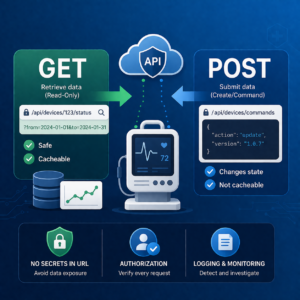
GET and POST are two of the most common HTTP methods—and one of the easiest places to accidentally create security and safety risk in connected medical device ecosystems. The difference isn’t just “where the data goes.” HTTP methods have defined semantics (like safe, idempotent, and cacheable) that affect how browsers, proxies, scanners, and middleboxes treat your traffic. If your API ignores those semantics, you can end up with hard-to-debug vulnerabilities and surprising behavior in hospital networks.
This guide reframes GET vs POST specifically for medical device cybersecurity, including practical design rules and what to capture as evidence for FDA-facing documentation.
Why HTTP method choice matters in medical device cybersecurity
In MedTech, APIs are everywhere: device-to-cloud telemetry, mobile apps, clinician dashboards, service tooling, update infrastructure, and integrations with customer networks. The wrong HTTP method can create risk in at least four ways:
- Information exposure: Query strings can land in logs, browser history, analytics, and referrers—bad news if you ever include secrets or sensitive identifiers.
- Unexpected execution: Safe methods like GET may be prefetched, cached, or replayed by intermediaries. If GET changes state, the “accidentally unsafe” behavior can have real operational consequences.
- Retry and duplicate action issues: POST isn’t idempotent by default; retries can duplicate actions unless you design for it.
- Authorization blind spots: Method choice doesn’t solve authorization. Many API breaches are access-control failures, like OWASP’s Broken Object Level Authorization (BOLA).
The FDA’s 2026 premarket cybersecurity guidance reinforces secure-by-design expectations, including appropriate security controls, documentation, and verification evidence throughout the lifecycle. That includes the APIs and services that support your device ecosystem. FDA: Cybersecurity in Medical Devices (Feb 2026)
GET vs POST at a glance (the MedTech lens)
- GET: Retrieve a representation of a resource. Intended to be safe (no side effects) and commonly cacheable. Great for read-only queries.
- POST: Submit data to be processed—often to create a resource or trigger an action. Not idempotent by default and typically not cacheable.
HTTP method semantics are defined in standards like RFC 9110, and most developer references summarize the same “safe/idempotent/cacheable” expectations. RFC 9110: HTTP Semantics and MDN: HTTP request methods
When to use GET in medical device ecosystems
Use GET when you are only retrieving data and you can tolerate caching behavior (or you explicitly control it via cache headers).
Good GET examples
- Retrieve device status (read-only): /devices/{id}/status
- Query historical telemetry (read-only): /devices/{id}/telemetry?from=…&to=…
- Retrieve SBOM or documentation (read-only): /devices/{id}/sbom
GET security rules (do these every time)
- Never put secrets in the URL (tokens, passwords, API keys). URLs are routinely logged and shared.
- Be intentional about caching (especially in customer networks). Set appropriate Cache-Control headers for sensitive resources.
- Don’t leak identifiers unnecessarily. If an identifier is sensitive, avoid exposing it broadly in query strings.
- Authorization still applies: authenticate and authorize every request, even “read-only” endpoints.
Remember: “POST hides data” is a myth. POST simply moves data from the URL to the body. You still need TLS, strong authentication, robust authorization, and logging controls.
When to use POST in medical device ecosystems
Use POST when the request creates, changes, or triggers something. This includes “commands,” workflow actions, uploads, and server-side processing that shouldn’t be cached or bookmarked.
Good POST examples
- Create a new resource: /devices (provisioning workflows)
- Upload logs or artifacts: /devices/{id}/logs
- Trigger a server-side action: /devices/{id}/commands
POST security rules (where teams get burned)
- Design for retries. If clients might retry due to network timeouts, add idempotency controls (e.g., idempotency keys) for “create/command” operations where duplicates are unacceptable.
- Validate content types and schemas. Enforce strict JSON schema validation or equivalent to reduce injection and parsing issues.
- Protect state-changing endpoints from abuse: rate limit, detect anomalies, and enforce authorization at the object level.
Many API incidents are authorization failures rather than “HTTP method problems.” OWASP calls out BOLA as a top API risk: if your endpoint takes an object ID, you must verify the caller is allowed to access that object. OWASP API1:2023 Broken Object Level Authorization
Don’t stop at GET and POST: choose the right method for the action
In regulated environments, clear semantics help engineering teams, testers, and auditors understand intent. Consider:
- PUT for full replacement updates (often idempotent when designed correctly)
- PATCH for partial updates
- DELETE for deletion
- HEAD for metadata-only checks
Sticking to standard semantics reduces surprises from caches, proxies, security scanners, and “helpful” network devices common in enterprise and hospital environments. RFC 9110
Common mistakes we see in connected device and cloud APIs
- State changes via GET (e.g., GET /device/{id}/reboot). This violates “safe method” expectations and can be triggered accidentally by prefetching, scanning, or caching layers.
- Sensitive data in query strings (tokens, session IDs, PHI-adjacent identifiers).
- Assuming POST is “secure” without solid authn/authz and TLS.
- Weak object-level authorization on endpoints that accept IDs (classic BOLA).
- No evidence: controls exist “in theory,” but teams can’t produce test results or traceability.
How to document GET/POST decisions in an FDA-friendly way
For FDA-facing cybersecurity documentation, aim for a clean thread from risk → requirement → design → verification. For APIs, that usually means:
- Architecture diagrams showing API boundaries, trust boundaries, and data flows (device, cloud, mobile, service tooling).
- Threat modeling for API entry points (auth bypass, replay, IDOR/BOLA, injection, logging exposure).
- Security requirements that explicitly define allowed methods per endpoint (and why).
- Verification evidence: negative tests (prove denial), authz tests (object-level), and security testing results.
If you need help building the evidence package, these are the most direct next steps:
- FDA Premarket Cybersecurity Services
- Medical Device Threat Modeling Services
- API Penetration Testing
Related reading: ACLs in Cybersecurity and Permissions vs Rights for Medical Device Access Control.
Key takeaways
- GET should be safe (no side effects) and is commonly cacheable—don’t use it for commands or state changes.
- POST is appropriate for create/command actions, but it’s not “secure by default.” You still need TLS, authn/authz, and validation.
- Method choice doesn’t replace authorization—BOLA-style failures remain a top API risk.
- In MedTech environments, intermediaries (proxies, scanners, caches) make correct HTTP semantics even more important.
- For FDA-facing documentation, capture traceability from API risks to requirements, design decisions, and verification evidence.
FAQs
Can GET ever change server state?
It shouldn’t. Standards define GET as a “safe” method, meaning clients can expect no unsafe side effects. If GET triggers actions (like reboot/config changes), you create safety and security risk from caching, prefetching, and scanning behavior.
Is POST secure because the data is not in the URL?
No. POST hides data from the URL, but the data still exists on the wire and on the server side. Use TLS, strong authentication, object-level authorization, and strict validation.
When should I use PUT or PATCH instead of POST?
Use PUT for full replacement updates and PATCH for partial updates. When designed correctly, PUT can be idempotent and easier to reason about in retry scenarios.
What’s the biggest risk with query strings in GET requests?
Exposure. Query strings can appear in logs, browser history, analytics tooling, referrers, and screenshots. Never place secrets or sensitive identifiers there.
How do I test GET/POST misuse in an API security assessment?
Test for state-changing GET endpoints, missing object-level authorization, replay/duplicate actions on POST, and validation weaknesses. Also validate that logging doesn’t capture secrets and that caching headers are appropriate for sensitive responses.
Book a Discovery Session
If you want help tightening API design, documenting it cleanly for FDA review, and validating controls with testing, we can help.
Conclusion
GET vs POST isn’t a style preference—it’s a security and reliability decision. When you align method semantics with real intent, you reduce accidental exposure, avoid unsafe replays, and make your API easier to secure and test. For connected medical devices, that’s one of the simplest wins you can bake into your secure product development lifecycle.