
Remote Code Execution (RCE) is one of the fastest ways to turn a “software bug” into a full compromise. If an attacker can execute arbitrary code on a server or device component, they can often pivot to data theft, credential access, ransomware, or persistent control.
In MedTech, JavaScript isn’t just “front-end code.” It shows up in:
- Cloud backends and APIs (often Node.js)
- Web portals used by clinicians, patients, or service teams
- Remote support tooling and gateways
- Build pipelines and update packaging scripts
That’s why JavaScript RCE belongs in your threat model, your secure development lifecycle, and your FDA-ready cybersecurity evidence. FDA’s current premarket cybersecurity guidance emphasizes security-by-design, strong risk management, and lifecycle processes that reduce exploitability. FDA premarket cybersecurity guidance
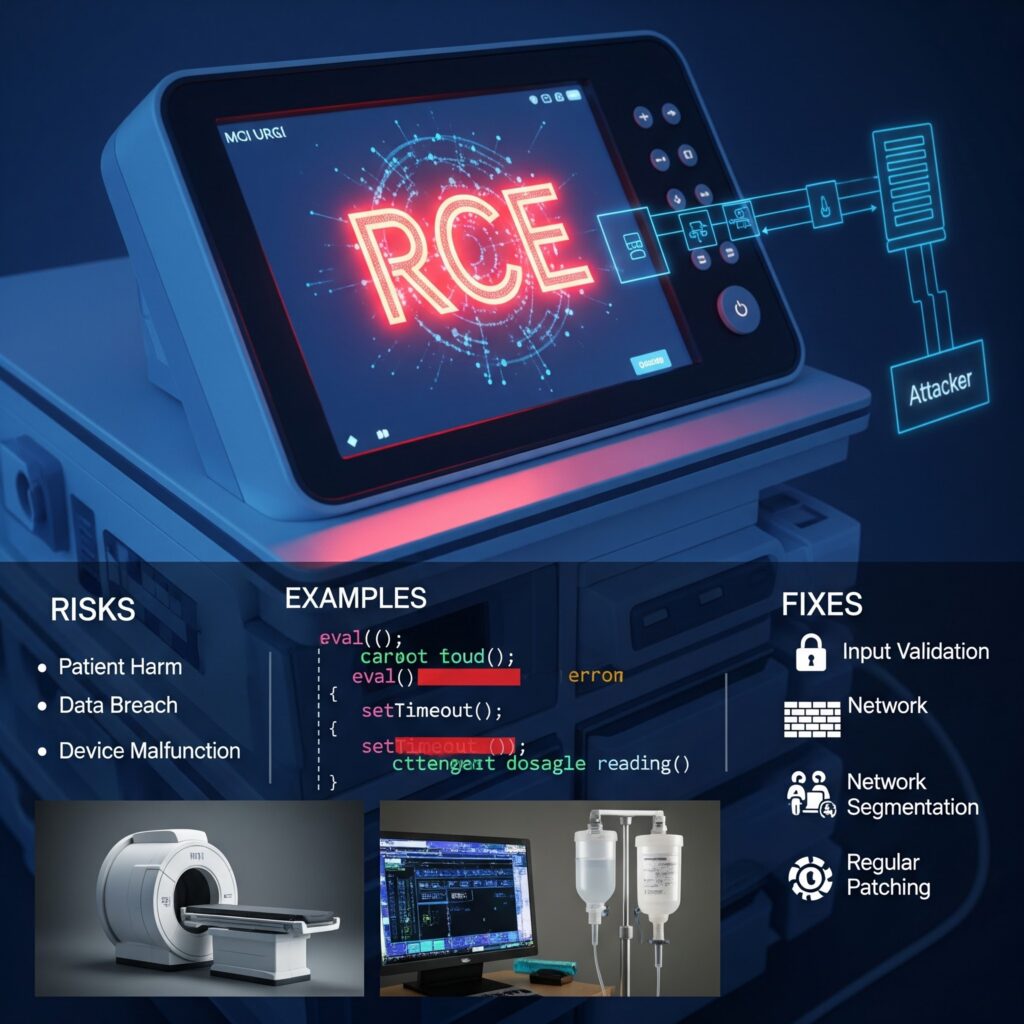
What is Remote Code Execution (RCE)?
RCE means an attacker can run code of their choosing on a target system from a remote location—typically by exploiting a software flaw or insecure configuration. NIST uses the term “arbitrary code execution” to describe this outcome. NIST glossary: Arbitrary Code Execution
Practically, “RCE” often becomes “game over” because it can enable:
- Data compromise (PHI/PII, credentials, device logs, keys)
- Service disruption (DoS, ransomware, destructive actions)
- Persistence (backdoors, scheduled tasks, modified containers)
- Lateral movement into hospital networks or cloud environments
Why JavaScript RCE is a MedTech problem (not just a web problem)
Even if your “device software” isn’t JavaScript, your product ecosystem might be. Many connected device architectures rely on Node.js services, web dashboards, and vendor-managed cloud components. If those components are compromised, attackers may:
- Push malicious configuration or commands via legitimate management APIs
- Harvest credentials/tokens used for device communication
- Manipulate update delivery pipelines
- Exfiltrate sensitive telemetry or clinical workflow data
From a regulatory standpoint, this is exactly why FDA focuses on lifecycle cybersecurity and secure-by-design evidence—not just “a pentest report.” FDA guidance
How JavaScript RCE happens (common root causes)
1) Code injection (CWE-94) and unsafe dynamic execution
One classic path is treating untrusted input as code. MITRE’s CWE-94 (“Code Injection”) describes situations where externally influenced input alters code generation or execution, often resulting in arbitrary code execution. CWE-94
In JavaScript, red flags include:
eval(),new Function(), or dynamic template compilation with untrusted input- Building shell commands from user input (especially in build/update tooling)
- Template injection risks (server-side template engines, misused render functions)
2) Insecure deserialization
Deserialization vulnerabilities are a frequent RCE driver. OWASP warns that unsafe deserialization of untrusted data can lead to denial of service, access control bypass, and remote code execution. OWASP Deserialization Cheat Sheet
MedTech-relevant example: A cloud service or gateway accepts “state” objects (or tokens) and deserializes them without strict validation—allowing a crafted payload to trigger execution.
3) Prototype pollution that chains into RCE
Prototype pollution is a JavaScript-specific weakness where attackers manipulate object prototypes and can trigger serious impacts—sometimes including RCE. OWASP highlights this risk and provides prevention guidance. OWASP Prototype Pollution Prevention
In practice, prototype pollution often becomes dangerous when it can be chained with “gadgets” in application logic or dependencies.
4) Vulnerable dependencies (the npm reality)
Many Node.js services depend on dozens—or hundreds—of packages. A single vulnerable dependency can introduce an RCE path. OWASP’s Node.js Security Cheat Sheet emphasizes Node-specific defensive practices, including hardening and dependency hygiene. OWASP Node.js Security Cheat Sheet
What “good” looks like: FDA-aligned controls that reduce RCE risk
You can’t “policy” your way out of RCE. You reduce risk by designing away dangerous patterns, constraining execution, and proving it with evidence.
1) Remove dangerous execution primitives
- Avoid
eval(),new Function(), and dynamic code generation with untrusted inputs. - Prefer safe parsing libraries and strict schema validation for all inbound data.
- Ban “deserialize arbitrary objects” patterns; use whitelists and typed decoding.
2) Constrain blast radius (assume something will break)
- Run services with least privilege (no admin/root unless absolutely required).
- Use container hardening: read-only filesystems where feasible, dropped capabilities, minimal base images.
- Segment networks and restrict egress so a compromised service can’t freely beacon out.
3) Make dependency risk measurable: SBOM + vulnerability management
- Maintain an SBOM for your device ecosystem components (device, gateway, cloud, and supporting apps).
- Track known vulnerabilities and patch timelines; document rationale for any deferrals.
If you need hands-on support here, see FDA-compliant SBOM services for MedTech.
4) Build evidence with SAST + targeted testing
- SAST to catch injection patterns, dangerous APIs, and insecure deserialization earlier.
- Penetration testing that validates exploitability and compensating controls.
Related services:
- Medical Device Static Application Security Testing (SAST)
- FDA-compliant vulnerability & penetration testing
- Medical device threat modeling
How to talk about JavaScript RCE in your threat model
If you want this to stand up in real security reviews (and reduce avoidable FDA questions), document:
- Entry points: APIs, portals, upload features, remote support interfaces, message brokers
- Trust boundaries: device ↔ gateway ↔ cloud ↔ third parties
- Abuse cases: crafted payloads for deserialization, template injection, dependency exploit chains
- Controls + verification: coding standards, SAST results, dependency scanning, pentest outcomes, runtime hardening
Key takeaways
- JavaScript RCE often impacts MedTech ecosystems via Node.js services, portals, or support tooling—not only the embedded device.
- Common causes include code injection (CWE-94), insecure deserialization, prototype pollution chains, and vulnerable dependencies.
- Strong controls are layered: remove dangerous patterns, limit privilege, control egress, maintain SBOM + vuln response, and verify with SAST/pentesting.
- Documenting these items cleanly supports FDA-aligned, lifecycle cybersecurity evidence.
FAQs
What is Remote Code Execution (RCE) in JavaScript?
RCE means an attacker can execute code on your server or service remotely by exploiting a flaw—often via unsafe input handling, insecure deserialization, or vulnerable dependencies.
Is RCE only a server-side risk (Node.js), or can it affect front-end JavaScript too?
Most “true RCE” impacts server-side components (Node.js APIs, portals, gateways). Client-side issues can still be severe (account takeover, data theft), but they’re typically categorized differently (e.g., XSS) unless they lead to native code execution through another chain.
What are the most common JavaScript paths to RCE?
Common paths include unsafe dynamic execution (eval() / new Function()), insecure deserialization of untrusted data, prototype pollution chains, and exploitable third-party packages.
How does insecure deserialization lead to RCE?
If an application deserializes untrusted input into objects that can trigger dangerous behavior (“gadgets”), an attacker can craft payloads that execute code during or after deserialization. OWASP specifically calls out RCE as a possible outcome. OWASP Deserialization Cheat Sheet
What should medical device manufacturers do first to reduce RCE risk?
Start with (1) banning dangerous execution primitives, (2) strict input validation and safe parsing, (3) least privilege + container hardening, and (4) SBOM-driven vulnerability management for the full product ecosystem.
How does this connect to FDA cybersecurity expectations?
FDA expects secure-by-design development and lifecycle risk management, with documentation and evidence that vulnerabilities are identified, mitigated, and maintained over time—including software supply chain and testing artifacts. FDA premarket cybersecurity guidance
Conclusion
RCE is rarely “just one bug.” It’s usually a combination of unsafe patterns, permissive runtime environments, and weak dependency governance. For MedTech teams, the goal isn’t panic—it’s disciplined engineering: design away risky primitives, constrain blast radius, and build evidence through SBOM, SAST, and targeted testing.
Book a Discovery Session
If you want help reducing RCE risk across your device ecosystem (cloud, portals, gateways) and turning it into FDA-ready evidence, we can help.