
Contactless skimming is often associated with credit cards and ATMs. But the real lesson isn’t financial — it’s architectural.
Payment systems solved large-scale skimming not by abandoning proximity technology, but by enforcing strong cryptography, strict authentication, and continuous fraud monitoring. Medical devices using NFC, Bluetooth (BLE), or service ports face similar exposure — but often without the same ecosystem maturity.
Short-range does not mean low risk. For medical devices, proximity interfaces must be treated as full attack surfaces.
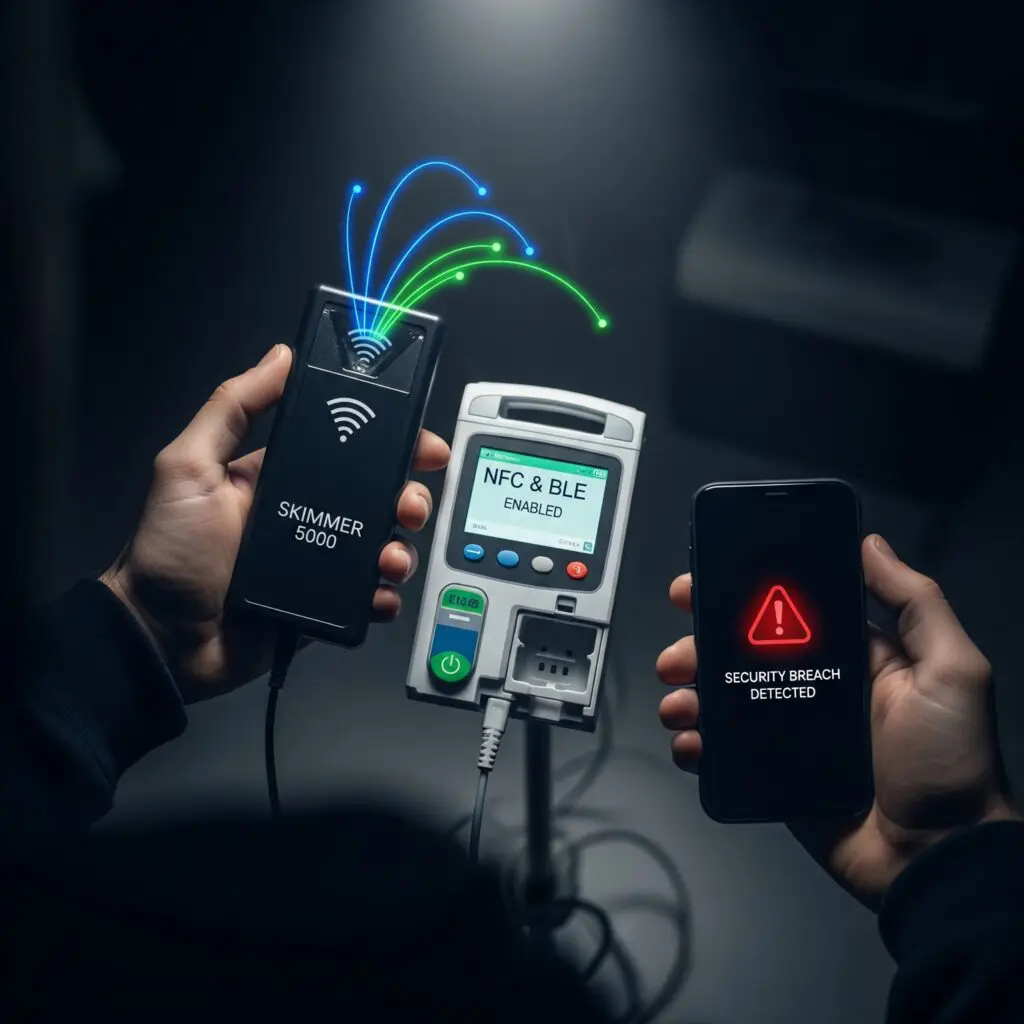
How Contactless Payments Actually Prevent Skimming
Modern credit cards use EMV technology. Whether inserted (chip) or tapped (contactless NFC), transactions rely on:
- Dynamic cryptographic challenge-response
- Transaction-specific cryptograms that prevent replay
- Tokenization in mobile wallets (Apple Pay, Google Pay)
- Continuous fraud monitoring at the financial institution level
EMV contactless operates over NFC (Near Field Communication), a short-range protocol. The radio technology is similar to what many medical devices use for pairing or provisioning. The difference is enforcement and monitoring.
For reference, EMVCo provides an overview of contactless architecture here: EMV Contactless Specifications Overview.
Why Skimming Still Happens
Today’s ATM fraud rarely involves “wireless drive-by theft.” It typically involves:
- Physical overlays or inline hardware
- PIN capture mechanisms
- Compromised terminals
The payments industry learned an important lesson: physical access plus weak detection equals fraud.
The same architectural lesson applies to medical devices.
Where Medical Devices Mirror This Risk
Medical devices increasingly rely on proximity interfaces:
- NFC for pairing, authentication, configuration
- BLE for mobile app connectivity
- USB or maintenance ports for servicing
- Badge or tap workflows in hospital environments
These interfaces improve usability — but they expand the threat surface.
Unlike EMV, medical device implementations are not universally standardized. Security rigor depends on design decisions.
Common Proximity Risks in Medical Devices
1. Weak Pairing or Authentication
If NFC or BLE pairing relies on static identifiers, predictable secrets, or unauthenticated discovery modes, proximity becomes opportunity.
2. Service Mode Exposure
Diagnostic and maintenance functions triggered locally can create high-value escalation paths if not strongly authenticated and logged.
3. Rogue Accessories or Inline Devices
Just as ATM skimmers disguise themselves as legitimate hardware, modified cradles, cables, or third-party accessories can introduce risk into medical ecosystems.
4. Detection Gaps
The largest blind spot is not prevention — it is visibility. Without logging and anomaly detection, organizations assume safety.
What Payments Do Well That MedTech Often Doesn’t
- Dynamic cryptography is mandatory.
- Tokenization reduces identifier exposure.
- Fraud monitoring is continuous and centralized.
- Standards enforcement is ecosystem-wide.
Medical device manufacturers can apply the same discipline to proximity interfaces.
Design Controls That Reduce Proximity Risk
Harden the Interface
- Require mutual authentication
- Avoid shared static secrets
- Rate-limit pairing attempts
- Disable debug features in production firmware
Assume Physical Access
- Design for tamper resistance or tamper evidence
- Restrict service functionality to authenticated sessions
- Apply least privilege to maintenance workflows
Operationalize Detection
- Log pairing attempts and authentication failures
- Monitor unexpected mode transitions
- Integrate telemetry into postmarket processes
Regulatory Alignment: FDA Expectations
FDA’s cybersecurity guidance emphasizes a Secure Product Development Framework (SPDF), threat modeling, verification testing, and postmarket monitoring.
External interfaces — including NFC and BLE — must be:
- Included in threat modeling activities
- Documented in architecture and data flow diagrams
- Covered by security verification testing
- Addressed in postmarket monitoring plans
See FDA’s current cybersecurity guidance here: FDA Cybersecurity in Medical Devices Guidance.
Many manufacturers align implementation practices with NIST SP 800-218 (SSDF) and IEC 81001-5-1 to demonstrate lifecycle rigor.
Key Takeaways
- NFC and BLE are not inherently insecure — weak implementation is.
- Short-range communication expands risk when physical access is common.
- Dynamic authentication and strong key management matter.
- Detection and postmarket monitoring are as important as prevention.
- Proximity interfaces must be explicitly addressed in FDA-aligned documentation.
FAQs
Is NFC in medical devices the same technology used in contactless credit cards?
The radio protocol is similar. The difference lies in cryptographic enforcement, ecosystem standardization, and monitoring maturity.
Can proximity attacks realistically affect medical devices?
Yes, particularly where authentication is weak, service modes are exposed, or logging is limited.
Does encryption alone eliminate proximity risk?
No. Key management, authentication design, privilege boundaries, and monitoring determine real-world resilience.
Should proximity interfaces be included in threat models?
Absolutely. They represent external attack surfaces and must be evaluated like APIs or cloud endpoints.
Need Help Validating Proximity Security Controls?
If your device uses NFC, BLE, or service interfaces, validating those controls through structured threat modeling and security testing can reduce regulatory and operational risk.