
Software-defined radio (SDR) sounds intimidating until you realize it’s basically this: instead of buying a different “radio” for every protocol, an SDR lets you use software to tune, analyze, and work with radio signals using a flexible piece of hardware.
For medical device teams, SDR becomes especially relevant once a product includes wireless—Wi-Fi, Bluetooth Low Energy (BLE), cellular, or proprietary RF. SDR is often used defensively to validate what’s actually happening “over the air,” support wireless security testing, and reduce surprises in premarket and postmarket cybersecurity work.
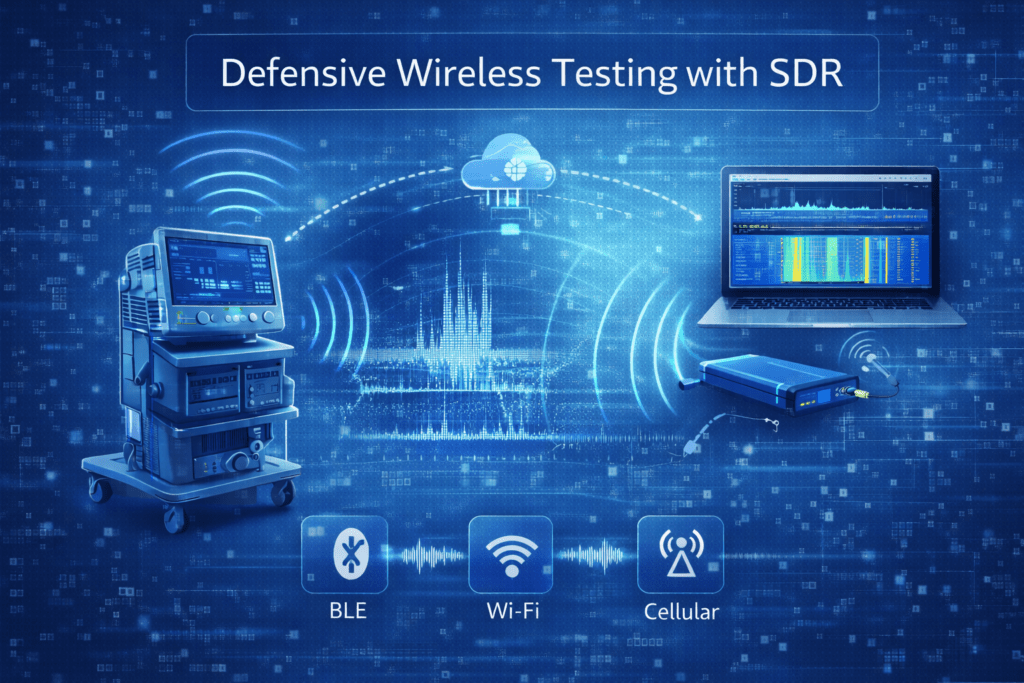
What Is a Software-Defined Radio?
A software-defined radio is a radio communication system where components that were traditionally implemented in hardware—filters, modulators/demodulators, signal processing—are implemented in software instead.
In practical terms, SDR gives you a flexible way to:
- receive and analyze RF signals across frequency bands
- transmit signals (with the right hardware and authorization)
- record, visualize, and troubleshoot wireless behavior
- validate assumptions about protocols, pairing, and telemetry links
Why SDR Matters in Medical Device Ecosystems
Wireless medical devices don’t just “connect.” They pair, reconnect, roam, retry, fall back, and sometimes behave differently under interference or edge conditions. Those edge conditions are where security and safety issues tend to hide.
SDR is useful because it helps teams answer basic but critical questions:
- What is the device transmitting, and when?
- Is the radio behavior consistent with the design requirements and threat model?
- Are we leaking identifiers or operational details over the air?
- How does the device behave under noisy or hostile RF conditions?
Important note: SDR can be used offensively, but this article focuses on authorized, defensive testing of your own products and environments.
Core Components of an SDR System
RF front end (hardware)
This is the “radio” part that handles receiving and transmitting signals. Different SDR devices support different frequency ranges, bandwidths, and capabilities.
Analog-to-digital and digital-to-analog conversion (ADC/DAC)
Signals in the real world are analog. SDR relies on ADC/DAC to convert signals into digital samples that software can process—and convert digital signals back into RF when transmitting.
Signal processing software
This is where SDR becomes powerful. Software handles demodulation, filtering, decoding, visualization (waterfall/spectrum views), and sometimes higher-level protocol analysis.
Antennas and environment
Antennas, cabling, shielding, and test environment design matter more than people expect. In regulated testing, controlling the RF environment helps you produce repeatable, defensible results.
How Software-Defined Radio Works
Traditional radios are built to do one job well: a fixed set of frequencies and a specific modulation/protocol. SDR replaces much of that fixed function with software. You tune the SDR to a band, capture samples, then software interprets those samples.
That flexibility is the point: one platform can support many workflows—troubleshooting, validation, and security testing—without needing a different hardware radio for each scenario.
Benefits of SDR (Especially for Connected Devices)
- Flexibility: adapt to multiple protocols and bands with a single toolchain
- Visibility: understand what’s actually happening on air—not what the spec says should happen
- Faster debugging: isolate wireless issues that are hard to reproduce with standard logs
- Better validation: verify pairing, encryption assumptions, and behavior under stress
- Lifecycle support: useful during development, verification, and postmarket investigations
Common Applications of SDR
Wireless research and development
SDR is widely used to prototype, test, and validate wireless designs. For product teams, it’s a way to shorten learning curves and reduce “unknown unknowns” when adopting new radio stacks or modules.
Spectrum monitoring and interference troubleshooting
Healthcare environments are noisy. SDR can help detect interference, unexpected transmissions, or congestion that affects reliability and performance—especially with BLE and Wi-Fi in crowded clinical settings.
Defensive wireless security testing (authorized)
SDR can help validate security controls by confirming what’s observable and what’s not. Examples include verifying that sensitive information is not transmitted in cleartext, or that pairing and connection flows behave as intended under realistic conditions.
SDR for Wireless Medical Device Security Testing (Defensive Use)
Wireless security issues are often “invisible” if you only review code or only test at the network layer. SDR provides a view of the RF layer that can support defensive testing and evidence generation.
Where SDR adds practical value
- Protocol behavior validation: confirm expected connection and pairing behavior (especially under edge cases)
- Data exposure checks: verify that identifiers, telemetry, or operational details aren’t unintentionally broadcast
- Resilience testing support: observe how the device behaves during interference, retries, reconnects, and dropouts
- “What’s really on-air” verification: confirm your threat model matches reality
In a medical device context, the goal isn’t “cool RF tricks.” The goal is to reduce risk and produce defensible outcomes: findings, mitigations, and verification evidence.
Common Wireless Failure Modes in Connected Medical Devices
If you’re trying to connect SDR to cybersecurity risk, it helps to think in failure modes (what can go wrong) rather than hype. A few common themes include:
- Weak onboarding or pairing flows: unclear trust establishment and inconsistent authentication steps
- Device identity issues: shared secrets, predictable identifiers, or overly permissive pairing policies
- Unexpected RF exposure: debug/service behavior left enabled, or broadcasts that reveal too much
- Insufficient detection: limited logs/telemetry around wireless security-relevant events
- Update assumptions: treating wireless channels as “trusted” without enforcing integrity and authenticity end-to-end
These issues are not unique to MedTech—but the consequences can be higher because wireless problems can affect reliability, clinical workflow, and patient trust.
How to Document SDR-Based Testing Results (So They’re Useful)
If you use SDR during development or validation, write results in a way that’s actually reusable later. A simple structure that works well:
- Scope: interface, band, protocol, environment, and test setup (what you did and did not test)
- Assumptions: device configuration, pairing state, and any lab constraints
- Observations: what was seen over the air (high-level, no sensitive details)
- Findings: risks framed as failure modes and impacts
- Mitigations: design or configuration changes
- Verification: re-test evidence showing the issue is addressed
This approach also makes it easier to connect wireless testing outputs to your threat model and to postmarket workflows when new vulnerabilities or field issues arise.
Challenges and Limitations of SDR
- Learning curve: SDR takes practice—especially when you move beyond basic spectrum views
- Environmental complexity: RF conditions can make testing noisy without good lab discipline
- Repeatability: regulated teams should control variables and document setups clearly
- Legal/ethical boundaries: transmitting or testing must be authorized and appropriately scoped
The Future of SDR in Healthcare and MedTech
As devices rely more on wireless connectivity, SDR’s role becomes more practical than “researchy.” It’s increasingly a standard tool for verifying wireless behavior, supporting troubleshooting, and improving confidence in security claims—especially when devices must operate reliably in messy, real-world RF environments.
FAQs
What’s the difference between SDR and a traditional radio?
A traditional radio is largely hardware-defined and fixed-function. An SDR moves much of the signal processing into software, so one platform can support many frequencies and protocols.
Can SDR help test BLE or Wi-Fi used by medical devices?
Yes. SDR can support visibility and validation work around wireless behavior. For some protocols, teams combine SDR with higher-layer tooling to build a complete picture from RF to application behavior.
Is SDR testing the same as penetration testing?
Not exactly. SDR is a tool that can support parts of wireless security evaluation. Pen testing typically includes broader attack-surface evaluation, architecture review, and end-to-end validation across device, app, cloud, and workflows.
How often should wireless security be revisited postmarket?
Any time the wireless stack changes (firmware updates, module changes, configuration changes), or when new vulnerability intelligence affects your components. Connected products benefit from recurring validation rather than one-and-done testing.
How Blue Goat Cyber Helps
If your device includes wireless interfaces and you need a defensible security story—premarket or postmarket—Blue Goat Cyber can help you tie together threat modeling, test evidence, and lifecycle readiness.
- FDA Premarket Cybersecurity Services
- Medical Device Threat Modeling
- Medical Device Vulnerability & Penetration Testing
- FDA Postmarket Cybersecurity Management
- Contact Blue Goat Cyber
Bottom line: SDR is a flexible tool for understanding wireless reality. Used responsibly, it helps medical device teams validate assumptions, reduce exposure, and produce testing evidence that holds up over the device lifecycle.