

Published: June 25, 2024 · Last reviewed: May 1, 2026

The February 3, 2026, FDA guidance on medical device cybersecurity emphasizes authentication and authorization as critical security controls. Authentication ensures data originates from a trusted source and verifies entity identities, while authorization grants specific access permissions based on the principle of least privilege. Implementing these controls helps maintain data integrity, protect against unauthorized access, and is essential for FDA premarket clearance.
The Federal Drug Administration (FDA) wants medical device manufacturers to follow its recommendations for security controls. This “advice” is part of the updated regulations for premarket submissions and postmarket monitoring. The document defines security control categories and how they can improve medical device cybersecurity.
The list of security controls is long, so we’ll break them up in a series of posts. The first two to review are authentication and authorization.
Let’s review these categories and their impact on FDA clearances.
Key Takeaways
- FDA guidance requires authentication and authorization controls.
- Authentication verifies data origin and entity identity.
- Authorization establishes access permissions (least privilege).
- Both controls are critical for data integrity and security.
- Effective implementation supports FDA premarket clearance.
- Consider multi-factor authentication and role-based access.
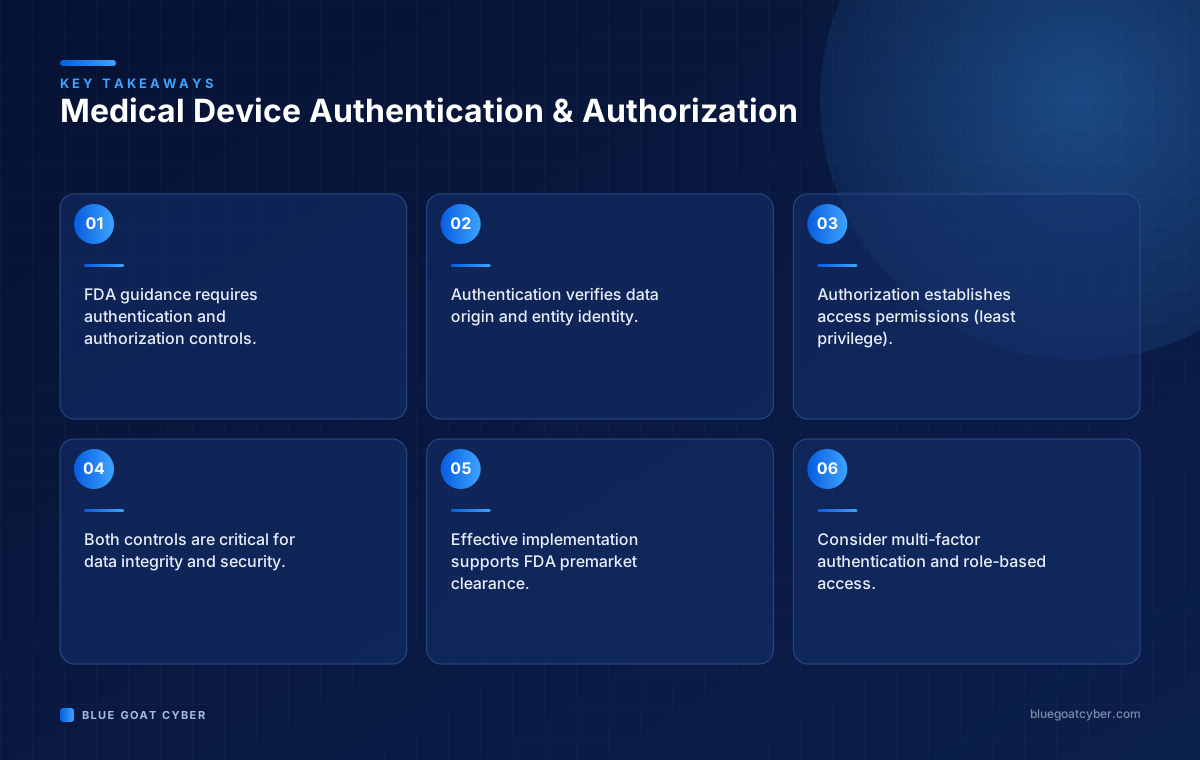
Table of Contents
- Key Takeaways
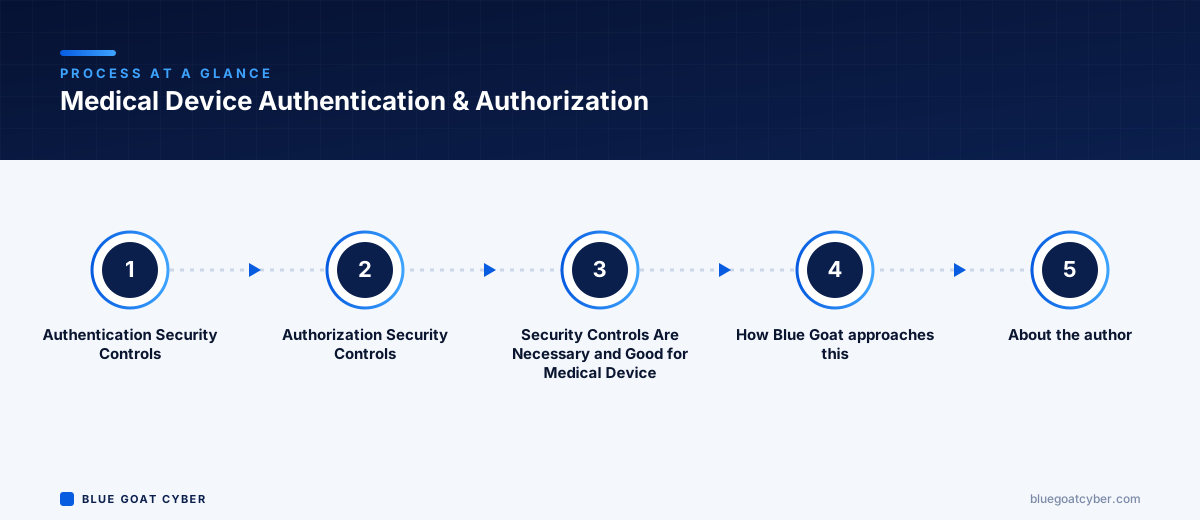
- Authentication Security Controls
- Authorization Security Controls
- Security Controls Are Necessary and Good for Medical Device Cybersecurity
Why this matters
The FDA's Cybersecurity in Medical Devices: Quality System Considerations and Content of Premarket Submissions (Feb 3, 2026 final guidance) made cybersecurity documentation a gating criterion for clearance under Section 524B of the FD&C Act. Reviewers now apply this guidance to medical device authentication & authorization the same way they apply software lifecycle expectations from IEC 62304 and security risk-management expectations from AAMI TIR57 and ANSI/AAMI SW96:2023.
Gaps in this area are the single most common driver of first-cycle cybersecurity Additional Information (AI) requests. The FDA's FY2024 CDRH performance reports show cybersecurity is among the top deficiency categories cited in 510(k) and PMA AI letters, behind only software documentation and clinical evidence. Treating it as a checklist exercise rather than a design-controlled engineering artifact is what creates the gap.
Authentication Security Controls
Two classifications of authentication are part of security controls-information and entities.
- Information authentication describes the situation wherein the device and system it operates can prove that data originated at a known, trusted source. Further, there is confirmation that there’s been no alteration to the information.
- Entities authentication refers to when a device and the system in which it resides can prove the identity of an endpoint from which it sends or receives information.
Combining these authentication security controls upholds accuracy, integrity, and validation. Your medical device system should have checks and balances to control information at rest and transit, software binaries, and endpoint authentication.
The guidance offers specific recommendations to build comprehensive authentication schemes. These can quickly become complex, depending on the breadth of software and endpoints. When applying a scheme, you’ll need to keep several technical considerations in mind around cryptographic and non-cryptographic protocols.
In addition, there are action items to take to make part of your medical device cybersecurity program. You can employ strong cryptographic authentication, make multifactor authentication mandatory, improve password security protections, institute mechanisms for authenticity verification from the devices, and much more.
Your core competencies involve the development of medical devices, understanding the unique use cases and how patients and providers will use them. While you may have cybersecurity knowledge on your team, the complexities around these security controls are deep, so you can benefit from working with firms that specialize in medical device cybersecurity.
Authorization Security Controls
See also: SweynTooth in Medical Devices, Medical Device Cybersecurity, and De Novo Cybersecurity Requirements: What the FDA Expects.
The FDA defines authorization in this context as “the right or permission granted to a system entity to access a system resource.” The document further clarifies this as a defensive measure, and authorization schemes enforce privileges. They either allow or deny actions to ensure that access to system resources follows acceptable use cases.
In the recommendations, the FDA discusses the notion of least privilege and universally applying it. Thus, every user should only have the minimum level of access in accordance with their job duties.
Least privilege can be one of the last defenses for a cyber-attack. If there’s a credential breach, the threat actor may realize they have minimal access and cannot infiltrate the medical device’s software or network.
The FDA suggests these practices for authorization security controls:
- Follow least privilege rules and ensure any user authenticates in multiple ways.
- Establish automatic timed-out thresholds that terminate sessions after there’s no activity.
- Differentiate privileges based on user roles.
- Build medical devices that align with “deny by default” so that they automatically reject any unauthorized connections or requests.
Developing an authorization scheme takes into consideration many standard cybersecurity best practices. The tricky part can be scaling it across your enterprise. It’s another security control that requires a strategy and constant auditing. Pen testing would be essential in evaluating its resiliency and identifying any exploitable areas.
Security Controls Are Necessary and Good for Medical Device Cybersecurity
Security controls elevate your cybersecurity program for medical devices. The FDA urges you to use them, but they are worthwhile in keeping your devices compliant and secure. If you realize these are areas of deficiency in your plans, we can help. Contact our experts today for a discovery session.
How Blue Goat approaches this
Blue Goat Cyber's medical device practice is led by engineers with CISSP, OSCP, and prior military red-team backgrounds. We treat cybersecurity documentation as design-controlled engineering output, not a submission template, every artifact (threat model, SBOM, security risk assessment, penetration test, labeling) traces back to a controlled requirement and a verified result.
Our engagements deliver the full Feb 3, 2026 guidance documentation set scoped to the device's risk profile, integrated with the existing IEC 62304 software lifecycle and ISO 14971 risk file. See our medical device cybersecurity services for the full scope. If the FDA raises cybersecurity deficiencies after our submission, we resolve them at no additional cost.
FAQ
What is authentication in medical device cybersecurity?
Authentication in medical device cybersecurity refers to verifying the origin of data from a known, trusted source and confirming the identity of an endpoint. This ensures data integrity and confirms that information has not been altered.
How does the FDA define authorization for medical devices?
The FDA defines authorization as the permission granted to a system entity to access a system resource. It is a defensive measure to enforce privileges, allowing or denying actions based on acceptable use cases.
Why is 'least privilege' important for medical devices?
Least privilege mandates that every user or system entity has only the minimum level of access necessary for their job duties. This limits the potential damage if a credential breach occurs, acting as a critical defense against cyber-attacks.
Does the FDA recommend multi-factor authentication for medical devices?
Yes, the FDA guidance recommends making multi-factor authentication mandatory. This enhances security by requiring multiple forms of verification before granting access, reducing unauthorized entry risks.
What are some FDA recommendations for authorization controls?
The FDA suggests practices like following least privilege rules, establishing automatic timed-out sessions, differentiating privileges based on user roles, and implementing a "deny by default" approach for unauthorized connections.
Related: Medical Device Cybersecurity: A Complete Lifecycle Guide
About the author
Christian Espinosa, CISSP, Founder, Blue Goat Cyber. Christian leads a team focused exclusively on medical device cybersecurity for FDA premarket submissions and postmarket compliance. Read more about Christian.
Sources & references
Primary sources cited in this article. Links open in a new tab.
- U.S. FDA- U.S. FDA