

Reviewed by Christian Espinosa, MBA, CISSP · Founder & CEO
Published April 2026 · Last reviewed May 2026
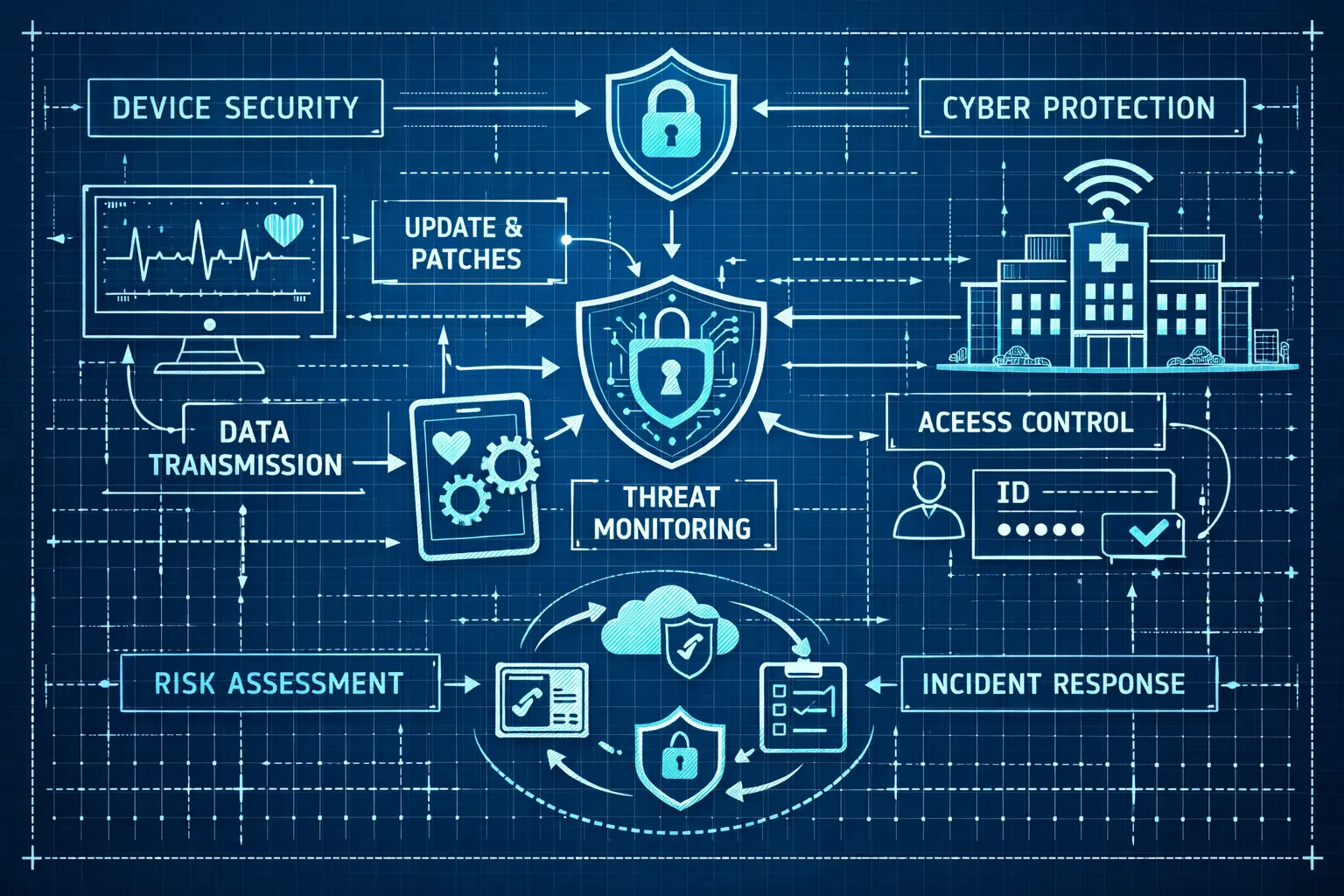
Medical device cybersecurity is not a documentation exercise you complete before submission. It is a full lifecycle commitment that starts at the first design decision and runs through decommissioning, spanning every team that touches the product. The stakes are real: 53% of networked medical devices carry at least one known critical vulnerability, and the FDA now treats cybersecurity as a mandatory quality system element under the February 2026 QMSR-aligned guidance. This is not a checkbox added late in development. It is a core engineering and regulatory obligation. Many manufacturers who struggle with it share the same gaps: cybersecurity integrated too late, documentation that does not hold up to FDA scrutiny, and postmarket plans that exist on paper but not in practice. This guide maps the full lifecycle: regulatory expectations, core frameworks, international standards, and postmarket obligations.
What Medical Device Cybersecurity Actually Covers
It’s a patient safety issue, not just a data protection issue
Medical device cybersecurity is the set of technical and process controls that protect connected devices from unauthorized access, manipulation, or disruption, and by extension, protect the patients who depend on those devices. This distinction matters because it fundamentally separates the device security context from enterprise IT security. In an IT environment, the primary concern is data confidentiality. In a device context, a compromised infusion pump or ventilator is a direct clinical risk. The threat model is categorically different, and the controls must reflect that.
The full scope: from design through end-of-support
The FDA and IMDRF both treat cybersecurity as a total product lifecycle obligation. It begins at design conception and does not end at clearance. IMDRF organizes this into four distinct phases: development, support, limited support, and end of support. Each phase carries distinct manufacturer responsibilities:
- Development: Security must be designed in from the start.
- Support: Vulnerabilities must be actively monitored and patched.
- Limited support: Residual risks must be documented and communicated to healthcare providers.
- End of support: Manufacturers must transfer responsibility with complete lifecycle documentation.
Understanding which phase you are in tells you exactly what regulators expect from you right now.
Premarket and Postmarket Medical Device Cybersecurity Requirements
The FDA’s 2026 guidance and the QMSR shift
The FDA’s February 2026 guidance document made a structural change: cybersecurity is now embedded directly into the Quality Management System Regulation, aligned with ISO 13485:2016. Security testing maps to Clause 7.3.7 as part of design validation. Cybersecurity events and vulnerabilities flow into corrective and preventive actions under Clause 8.5. The practical consequence is that cybersecurity risk assessments must happen at the same stage and with the same rigor as safety risk assessments, not as an afterthought staged before submission. See the FDA’s premarket cybersecurity guidance for details on how these expectations map into submission content.
Section 524B and what it requires for cyber devices
Section 524B of the FD&C Act defines what qualifies as a “cyber device” and sets binding requirements for manufacturers of those devices. Premarket submissions must include a cybersecurity management plan that covers ongoing vulnerability monitoring, a coordinated vulnerability disclosure process, and timely patching commitments. The timelines are specific and non-negotiable: critical uncontrolled risks must be addressed within 60 days, and customers must be notified of uncontrolled vulnerabilities within 30 days of identification. Per the February 2026 FDA guidance, manufacturers who meet these timelines under a formal CVD program are generally exempt from additional FDA reporting requirements, provided the program is fully documented and operational before an incident occurs.
What IMDRF adds beyond FDA requirements
IMDRF reinforces shared responsibility between device manufacturers and healthcare providers across every lifecycle phase. Manufacturers do not simply hand off responsibility at sale. During limited support and end-of-support phases, they must document residual risks, provide transition guidance, and communicate end-of-support milestones proactively, ideally with at least two years of advance notice. This is particularly important for legacy devices that continue operating in clinical environments long after active support ends. IMDRF’s final guidance makes clear that cybersecurity obligations do not expire when the product line does.
Core Premarket Frameworks the FDA Expects in Your Submission
Secure Product Development Framework (SPDF)
The SPDF is the documented process structure that demonstrates cybersecurity was built into development, not bolted on before filing. FDA expects submissions to include evidence of an SPDF covering threat identification, risk mitigation, security testing, and lifecycle processes. It complements existing QMS standards like ISO 13485 and IEC 62304 rather than replacing them. Blue Goat Cyber develops SPDF documentation tailored to eSTAR submission requirements, structured to give reviewers the evidence they need and minimize the gaps that commonly trigger deficiency letters. For a detailed breakdown of industry expectations across premarket and postmarket phases, see our Guide to Medical Device Cybersecurity Standards.
Software Bill of Materials (SBOM)
An SBOM is a structured inventory of every software component, library, and dependency in the device. The FDA requires it to support ongoing vulnerability monitoring, because you cannot track vulnerabilities in components you have not inventoried. Incomplete or inaccurate SBOM documentation is among the most frequently cited reasons cybersecurity deficiencies arise during 510(k) reviews. The SBOM must cover commercial, open-source, and off-the-shelf components, and it must be paired with exploitability scores and patching plans to be submission-ready.
Threat modeling and penetration testing
Threat modeling is the structured process of identifying attack surfaces and likely threat actors based on the device’s operating environment: hospital networks, Bluetooth connections, Wi-Fi routers, cloud components, and the clinical staff who interact with the device. Penetration testing validates that threat model by actively probing device defenses against real attack techniques. Both are required evidence in premarket submissions. Both must be documented with sufficient rigor to hold up under FDA scrutiny, and penetration testing must be conducted on final, production-equivalent devices, not development builds.
International Standards That Govern Secure Device Development
IEC 62443 and IEC 81001-5-1: the secure development stack
IEC 62443, particularly Parts 4-1 and 4-2, defines the secure product development lifecycle for device components and systems. It introduces security levels (SL 0 through SL 4) matched to threat severity: SL 1 addresses protection against casual misuse, while SL 4 addresses protection against advanced attacks with extensive resources. Security levels are applied per technical requirement and component rather than as a single product-wide rating. The standard requires defense-in-depth controls including encryption, least privilege, network segmentation, and access control. IEC 81001-5-1 adapts IEC 62443-4-1 specifically for health software and medical devices, requiring evidence of threat modeling, secure coding practices, and vulnerability management as part of the device lifecycle. Together, these two standards form the technical backbone of a defensible security architecture. If you need practical guidance on aligning device programs with evolving regulatory and standards expectations, read our piece on Navigating the Evolving Cybersecurity Landscape for Medical Devices.
IEC 62304, ISO 14971, and ISO/IEC 27001: the supporting layer
IEC 62304 governs software lifecycle processes, covering planning, development, validation, and maintenance, with cybersecurity integrated into each phase through secure coding and change management requirements. ISO 14971 extends risk management to cover cyber hazards directly. It requires iterative risk assessments that link security weaknesses to safety impacts, not just safety risks to device failure modes. ISO/IEC 27001 applies at the organizational level, particularly for managing protected health information and supply chain security. These three standards do not operate independently; they form an interlocking layer that regulators expect to see addressed coherently across the submission package.
Postmarket Vulnerability Management and Incident Response
Continuous monitoring and coordinated disclosure
After clearance, manufacturers must actively monitor for vulnerabilities using sources including ICS-CERT, H-ISAC, and third-party software monitoring services. A formal CVD process must be in place before a vulnerability is discovered, not after. That process needs documented evaluation protocols, legal protections for security researchers who report vulnerabilities, defined response timelines, and clear communication pathways to healthcare facilities. Per FDA guidance expectations, a CVD program that exists only as a policy document, without the operational infrastructure to act on disclosures, will not satisfy regulators or protect patients when a real vulnerability surfaces.
Remediation timelines and the 60-day rule
The FDA’s expectation is clear: critical uncontrolled risks require a fix or compensating control within 60 days. All patches must be validated under the Quality System Regulation before deployment. This applies to every cyber device covered by the Section 524B management plan submitted at clearance. For manufacturers without a defined patching and validation workflow already built into their QMS, meeting that timeline under pressure is extremely difficult. Building the process before it is needed is the only practical approach.
What real incidents reveal about preparedness gaps
The incident data is specific. When medical device cybersecurity events occur, 31% of affected healthcare organizations face up to 12 hours without critical systems (per HIMSS cybersecurity survey data). Ransomware has disabled entire fleets of electronic fetal monitors, creating immediate clinical emergencies. In early 2026, CISA issued urgent warnings about remote access vulnerabilities in patient monitors that exposed administrative controls. These are not edge cases: according to the HHS 2025 threat report, 77% of healthcare organizations were targeted by ransomware in 2025, and healthcare reported more cyberthreats than any other critical infrastructure sector in 2024. Incident response plans built before a device ships are what separate recoverable events from clinical emergencies.
Why Specialized Expertise Makes the Difference
What generalist security firms miss in the device context
General IT security firms understand enterprise environments. As a rule, they are not versed in FDA submission workflows, eSTAR templates, AAMI TIR57, or how a threat model maps to a 510(k) review. That gap tends to surface in deficiency letters, delayed clearances, and documentation that does not survive scrutiny. Medical device cybersecurity requires simultaneous fluency in clinical context, regulatory process, and technical security controls. A firm that brings only two of those three to an engagement will cost you time and clearance cycles.
How Blue Goat Cyber approaches this differently
Blue Goat Cyber works exclusively with medical device manufacturers and MedTech companies. Every engagement is a device cybersecurity engagement. That means the team handling your SPDF documentation, SBOM creation, threat modeling, penetration testing, and FDA-ready submission artifacts is focused entirely on this regulatory domain, not splitting attention across unrelated industries or learning healthcare device cybersecurity standards on the job. For companies preparing a first submission or resolving a deficiency letter under deadline, that depth of focus is the differentiator. Learn more about our approach and expert perspectives in Navigating the Cybersecurity Landscape for MedTech Innovators.
Build It In from the Beginning
Medical device cybersecurity is not a point-in-time deliverable. It runs from the first design decision through end-of-support communications, across every team and every product iteration. The FDA’s 2026 guidance makes this explicit by embedding cybersecurity into QMSR. IMDRF reinforces shared responsibility at every lifecycle phase. The frameworks, SPDF, SBOM, threat modeling, and penetration testing, are not optional documentation exercises. They are the evidence base that supports both FDA clearance and ongoing patient safety.
Manufacturers who build cybersecurity in from the beginning clear faster and respond to postmarket threats with less disruption. Those who treat it as a submission formality tend to find out the hard way: through deficiency letters, clearance delays, and incident response situations they are not equipped to manage.
Medical device cybersecurity demands more than general security knowledge, it requires deep familiarity with FDA submission workflows, international standards, and the clinical stakes involved. If your team is preparing a premarket submission, navigating a deficiency response, or building out a postmarket vulnerability management program, Blue Goat Cyber provides specialized end-to-end support across every phase of that work. That combination of regulatory fluency and technical depth is exactly what we offer. For a practical roadmap to aligning your program with current regulatory expectations, see our piece on navigating the evolving cybersecurity landscape for medical devices.