Medical Device Penetration TestingWhite-Box, FDA-Ready Reports, & Letter of Attestation.
Struggling to meet the FDA's cybersecurity testing requirements? We identify vulnerabilities and deliver FDA-ready reports - fast, accurate, and aligned with current guidance. We recommend white-box testing for medical devices, and so does the FDA.
The short answer
What is medical device penetration testing, and what does the FDA need from it?
Medical device penetration testing is white-box security testing of a device and everything it connects to - firmware, hardware debug interfaces, wireless radios, the companion app, the APIs, and the cloud back end - run against your source code, architecture, and threat model. For an FDA submission it has to do four things the 2026 premarket guidance calls out: verify security requirements, verify threat mitigations, run vulnerability testing, and run true penetration testing. The deliverable is an FDA-formatted report with CVSS and ISO 14971 patient-harm ratings, threat-model traceability, and a signed Letter of Attestation.
Generic penetration testing firms lack the understanding of unique device architecture, patient risks, and regulatory demands. Their reports may be thorough, but not FDA-compliant - and they almost always default to black-box only.
Black-box-only testing
The FDA expects testers to leverage source code, threat models, and architecture (white-box). Black-box-only engagements miss the deep flaws reviewers ask about - and lead to deficiencies.
Incomplete Testing
Generic vendors miss firmware, wireless, and embedded paths unique to medical devices.
Wrong Reporting Format
Reports without FDA-aligned structure, traceability, and evidence get rejected by reviewers.
In their words
Backed by MedTech leaders.
HT
"Blue Goat Cyber's depth of expertise was impressive. We had no in-house cybersecurity experience, and their team guided us through every step of the FDA process. The penetration testing and SBOM testing were thorough and gave us complete confidence."
Hank Tucker
CEO · MedTech Manufacturer
"Blue Goat's niche expertise in FDA-facing cybersecurity made all the difference. Their reports were built with the FDA's expectations in mind; it gave us confidence that we were submitting exactly what reviewers want to see."
Scott Odland
Solutions Architect · Rhaeos
"The timeliness of this project exceeded my expectations - this was not my experience with other vendors. Blue Goat Cyber delivered a thorough, detailed report and complete testing faster than I anticipated, without compromising quality."
Tim Sandberg
VP of IT Operations · Matrix One
Attack surface
The four types of testing the FDA expects - and the full attack surface
FDA's Feb 3, 2026 premarket cybersecurity guidance asks for security requirement verification, threat mitigation verification, vulnerability testing, and penetration testing. Every engagement covers all four, mapped to the interfaces a real attacker can reach.
1. Security requirement verification
Authentication and session management against the stated design
Authorization, role separation, and privilege boundaries
Cryptography in transit and at rest, plus key storage and rotation
Secure boot, code signing, and firmware update integrity
Audit logging, event forensics, and tamper evidence
Every requirement traced back to the threat model and design inputs
2. Threat mitigation verification
Each STRIDE threat from your model exercised against its stated control
Abuse cases and misuse cases run to failure, not just happy-path checks
Residual risk documented where a mitigation is only partial
Patient-harm impact rated under ISO 14971, not just CVSS
Multi-patient harm and network-of-devices scenarios
Traceability matrix reviewers can audit line by line
3. Vulnerability testing, SAST and DAST
Static application security testing (SAST) and secure code review across firmware and application source
Dynamic application security testing (DAST) against running services and web interfaces
Software composition analysis and SBOM-driven CVE triage with VEX statements
Protocol and input fuzzing across BLE, serial, USB, REST, MQTT, and gRPC
Known-vulnerability checks against chipsets, RTOS, kernels, and third-party libraries
Malformed input, robustness, and error-handling testing
4. Penetration testing across the real attack surface
Hardware teardown, JTAG/UART/SPI access, firmware extraction and reverse engineering
Wireless: BLE pairing and GATT abuse, Wi-Fi (WPA2/WPA3), cellular/NB-IoT, and NFC
Mobile companion apps on iOS and Android, including OWASP MASVS coverage
Web apps and APIs against OWASP ASVS and the OWASP API Top 10
Cloud back end, IAM, tenant isolation, containers, and Kubernetes workloads
Interoperability surfaces: DICOM, HL7/FHIR, and hospital network integration
Attack surface
What we test in a medical-device pen test
The full stack a connected medical device exposes - from the clinician portal down to the implant firmware. Every layer is in scope when it matters to patient safety or regulatory submission.
01Clinician / hospital portal
02Cloud APIs and data plane
03Cellular / Wi-Fi backhaul
04Mobile companion app
05BLE / RF / wireless telemetry
06Service / maintenance interfaces
07Device firmware + OS
08Internal buses (CAN, EtherCAT, I2C, SPI)
09Microcontroller boot chain
Layers shown outermost (top) to innermost (bottom). Dashed rows are part of the surrounding system but out of scope for this view.
How it works
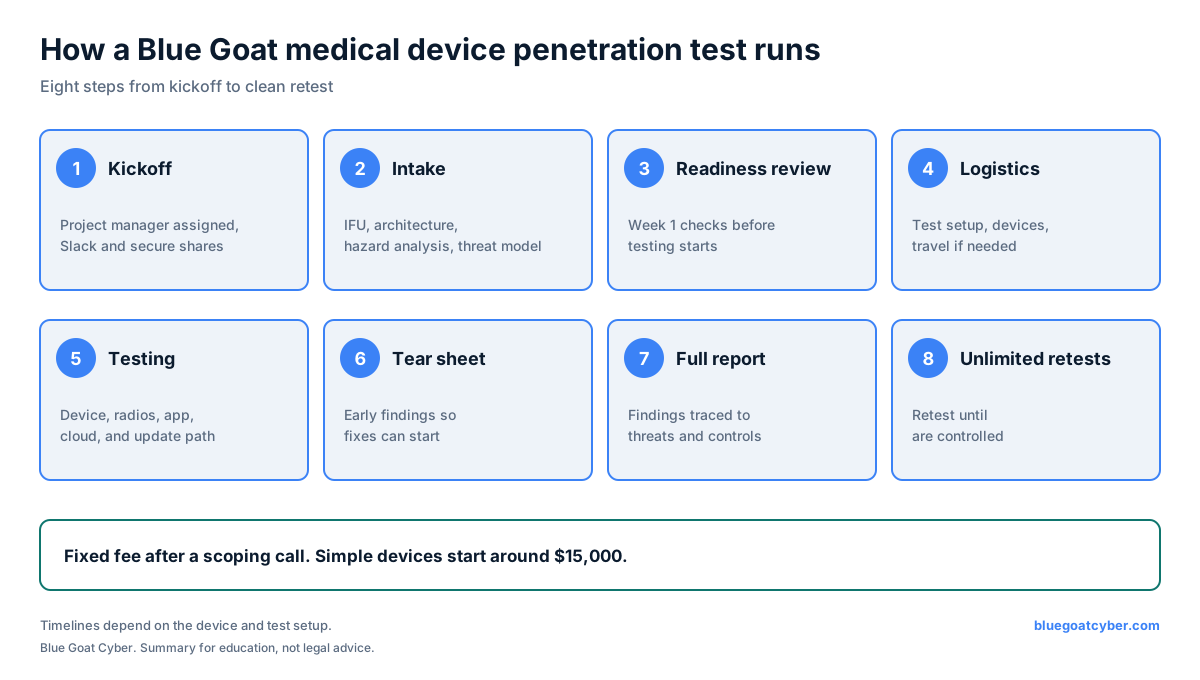
How an FDA pen test engagement runs
Every project gets a dedicated project manager from kickoff to final report, so you always know what is happening and what we need from you.
01
Kickoff
Once the contract is signed, we assign your project manager and hold a kickoff call to confirm scope, dates and contacts.
02
Shared workspace
We set up a private Slack channel for day-to-day questions and secure shares for exchanging documents.
03
Intake
We collect the Instructions for Use (IFU), Software Architecture Document (SAD), hazard analysis and threat model. Testing starts only once a threat model and hazard analysis exist. No threat model or hazard analysis yet? We can build them. Already have them? We can run a gap assessment of both.
04
Logistics
We confirm whether devices ship to our lab or we travel to you, and that units, accounts, tools and the test setup are ready.
05
First round of testing
We run the test plan against the exact device version you plan to submit.
06
Tear sheet
You get a short findings summary right after testing, so engineering can start fixing before the full report is done.
07
Full report
Test Plan, Test Cases and Test Report, with every finding traced to a threat and a patient harm, plus the Letter of Attestation.
08
Retest until risks are controlled
After each fix we retest and confirm, then update the report so it is ready to submit.
What's included
Reviewer-ready deliverables in one engagement
Every medical device penetration testing engagement ships with the artifacts FDA reviewers expect to see - traceable, complete, and aligned with current guidance.
Device, firmware, and embedded testing - hardware teardown, JTAG/UART/SPI bus access, firmware extraction and reverse engineering, and exploitation of the secure boot, debug, and update paths. Done by operators who have tested infusion pumps, monitors, surgical robots, and implantables.
Companion app and cloud API coverage - iOS/Android binary analysis, BLE pairing/GATT attacks, REST/MQTT/gRPC fuzzing, authentication and authorization testing, and tenant-isolation checks. We test the device as patients and clinicians actually use it, not in isolation.
FDA-ready penetration test reports - executive summary, methodology, CVSS-scored findings tied to your threat model, reproduction steps, and a signed Letter of Attestation covering tester independence, scope, methods, and results. Reviewer-ready, not a generic IT security PDF.
Remediation guidance and re-test included - written fix recommendations per finding, engineer-to-engineer support during remediation, and unlimited re-tests of fixed issues inside the fixed fee. You leave with a clean report, not a list of open items.
Pricing guidance
Fixed-fee penetration testing pricing
One fixed fee per engagement. It includes the FDA-formatted report, the signed Letter of Attestation, and retesting of every high and critical finding. You get the exact number in writing within 24 hours of the scoping call.
Scoped / single surface
From $15k
One attack surface: firmware and hardware only, BLE only, or the cloud API only. Best for postmarket validation, closing a specific deficiency, or pre-submission risk reduction.
One interface tested to full depth
SAST or DAST as the surface requires
CVSS and ISO 14971 rated findings
Retest of high and critical fixes
Letter of Attestation with scope stated
Connected device (most common)
Fixed fee after scoping
Typical Class II connected device: firmware, hardware interfaces, BLE or Wi-Fi, companion app, REST APIs, and cloud back end. Full-attack-surface coverage for a 510(k) or De Novo.
All four FDA testing types
Firmware, wireless, mobile, API, and cloud
SBOM-driven CVE triage and VEX
Threat-model traceability matrix
Retests of high and critical items
eSTAR-ready report and Letter of Attestation
Platform / PMA ecosystem
Fixed fee after scoping
Class III and PMA submissions, implantables, surgical platforms, multi-device ecosystems, AI/ML inference services, or several products tested in parallel.
Everything in connected device
Multi-device and hospital-network scenarios
Kubernetes and multi-tenant cloud depth
DICOM and HL7/FHIR interoperability testing
AI/ML model and inference-service abuse cases
Coordinated multi-report submission package
Estimate your starting price
A rough starting point before the scoping call. Your exact fixed fee comes in writing within 24 hours of scoping.
Number of distinct interfaces in scope (each radio, app, and API counts)
Whether source code, architecture docs, and a threat model are available for white-box depth
Hardware sample availability and how many units we can destructively test
Cloud complexity: single tenant versus multi-tenant, container and Kubernetes footprint
Regulatory pathway - PMA and De Novo submissions carry deeper evidence expectations than 510(k)
Larger scopes are priced after the scoping call. The $15k starting point assumes a simple device, a reasonable timeline and no travel. Timeline is 3 to 5 weeks for most engagements and 6 to 8 weeks for large ecosystems.
Standards medical device penetration testing maps to
Every medical device penetration testing engagement produces evidence aligned to the regulatory and consensus standards FDA reviewers and notified bodies expect to see - traceable, complete, and ready to drop into your ISO 13485 quality system.
Featured site-wide
FDA 2026 Guidance Featured
FDA Premarket Cybersecurity Guidance (Feb 3, 2026)
Defines the SPDF, Section 524B submission package, threat modeling, SBOM, security architecture views, and cybersecurity testing every cyber device submission must include.
ANSI/AAMI SW96 Featured
Medical Device Security Risk Management
The consensus standard for medical device security risk management - asset, threat, vulnerability, likelihood, severity, and residual risk acceptability.
ISO 14971 Featured
Medical Device Risk Management
Foundational risk management standard. Cybersecurity risk is tied directly to patient-safety risk in the 14971 file.
IEC 62443-4-1
Secure Product Development Lifecycle
Industrial-strength secure-development-lifecycle requirements applied to connected medical devices.
NIST SP 800-115
Technical Guide to Information Security Testing
Reference methodology for planning, executing, and reporting security testing.
Notable incidents
Public premarket cybersecurity history
Recalls, CISA ICS-MA advisories, and disclosed research that shape what reviewers ask about - and what this engagement is built to cover.
Imaging device, PACS, or viewer? Answer these and get a one-page scoping sheet for your DICOM security test. Takes about two minutes.
Which DICOM services does it expose?
Pick everything the device answers on its DICOM port.
Which transfer syntaxes does it support?
What role does it play on the imaging network?
What sits in front of the DICOM port?
What test environment can you give us?
Please don't enter confidential details here.
We'll email you a link to book a free discovery call; the fixed-fee proposal follows the call. Want to try the protocol yourself first? Download the DICOM seed corpus and read the DICOM fuzzing guide.
Ready to start Medical Device Penetration Testing?
Medical Device Penetration Testing - scoped, fixed-fee, FDA-ready.
Struggling to meet the FDA's cybersecurity testing requirements? We identify vulnerabilities and deliver FDA-ready reports - fast, accurate, and aligned with current guidance. We recommend white-box testing for medical devices, and so does the FDA.
For medical devices, both Blue Goat and the FDA recommend white-box testing. Reviewers expect testers to leverage source, firmware, and threat models - black-box alone routinely leads to deficiencies.
Capability
Black-box
Gray-box
White-box
Source code access
Firmware / binaries
Threat model & architecture
Authenticated test paths
Deep logic + business-flow flaws
Aligned with FDA expectations
Scope coverage per test-day
Yes Partial No
References
Why the FDA and AAMI point to white-box
Premarket guidance and consensus standards both expect testers to leverage source code, design artifacts, and threat models, not just an external view of the device.
Calls for security testing that demonstrates device resilience using design documentation, threat models, and source-level analysis, not black-box probing alone.
Requires sponsors to provide reasonable assurance that the device and related systems are cybersecure - which reviewers read as evidence-backed, white-box-informed testing.
Postmarket monitoring and vulnerability handling assume testers have access to internals - the same access white-box pen testing uses premarket.
How an engagement runs
From kickoff to a clean retest in 7 steps
Every project gets a named project manager. The intake documents in step 2 let us trace each finding to your threat model and rate its risk in terms of patient harm, which is what FDA reviewers look for.
1
Kickoff
Contract signed, project manager assigned, shared Slack channel and secure file shares set up.
2
Intake documents
You send the documents below so every finding traces to a threat and a hazard.
3
Logistics
Test setup, device shipping or on-site travel agreed.
4
Testing
Mostly manual, white-box testing of device, firmware, radios, app and cloud.
5
Tear sheet
Early summary of findings so your engineers can start fixing right away.
6
Full report
FDA-formatted report with CVSS and patient-harm ratings, plus a signed Letter of Attestation.
7
Retest
We retest your fixes until the findings are closed.
Step 2: what we ask for before testing
Instructions for Use (IFU)
How the device is used and by whom
System architecture
What connects to what
Threat model
What we test against. We can build it if you don't have one.
A CVSS score says how easy an attack is. It doesn't say whether a patient could be hurt. We link every finding to your threat model and hazard analysis, so its risk is rated in terms of patient harm and FDA reviewers can follow the chain from threat to fix.
A
Threat model
Names the threats and attack paths. Each test case traces back to a threat.
Threat: an attacker nearby sends commands over Bluetooth without pairing.
B
Hazard analysis
Names what could hurt a patient if the device misbehaves (ISO 14971).
Hazard: the device delivers the wrong therapy setting.
1
Pen test finding
What we proved during testing, tied to the threat it came from.
Finding: therapy settings can be changed over Bluetooth without authentication.
2
Exploitability
How easy the attack is, scored with CVSS.
Low skill needed, attacker must be within Bluetooth range.
3
Patient-harm risk
Exploitability combined with the linked hazard's severity. This rating, not CVSS alone, sets priority.
Rated high: a wrong therapy setting can harm the patient.
4
Fix and retest
The fix is verified in a retest, and the full chain goes into your FDA report.
Pairing and command authentication added, retest passes.
The example lines show an illustrative case, not a specific client engagement.
Our recommended approach
Why we lead with white-box for FDA submissions
White-box is our default for premarket cyber devices - it's the only depth that gives FDA reviewers full coverage evidence. Gray-box adds credentialed ecosystem testing where it matters. Black-box is reserved for specific post-market or adversary-simulation scenarios.
Most pen test firms ship a report. The FDA's premarket guidance asks that penetration testing evidence show who did the testing, how independent and qualified they were, what was in scope, the methods used, and the results. Every Blue Goat engagement includes a signed Letter of Attestation that summarizes exactly that, alongside the full report, with no additional request required.
What it is
A signed regulatory artifact
A signed document from the pen testing firm that names the testers and their independence, states the scope covered (firmware, hardware interfaces, wireless, mobile, APIs, cloud), and summarizes the methods, findings, and the status of each finding.
Why it helps review
Easy for reviewers to verify
The FDA's guidance does not prescribe a specific attestation format, but reviewers regularly ask about tester independence, scope, and methods. A one-page signed summary puts those answers in one place and points to the full report for detail.
Why most reports don't include one
Generic IT firms ≠ MedTech
Generic IT security reports are written for IT audits and often leave out what a medical device submission needs, such as tester independence, threat model traceability, and patient-safety impact. Every Blue Goat Letter of Attestation is signed by the senior engineer who led the test.
How we stack up
Blue Goat Cyber vs. typical pen test vendors
A transparent, side-by-side look at what you actually get - no vague promises.
Capability
Blue Goat Cyber
Typical Vendor
Technical Capabilities
12+ Years Exclusively Testing Medical Devices
Included
Not offered
Medical Protocol Testing (DICOM, HL7/FHIR, BLE Medical)
Anonymized engagements, from kickoff to FDA clearance
Class II · 510(k)
Wearable Cardiac Monitor
The Problem
Pre-submission penetration test required, with a tight 6-week window before FDA filing. Prior vendor returned a generic scan report that wouldn't satisfy 2026 guidance.
Our Testing
Firmware extraction and binary analysis
BLE pairing and protocol fuzzing
Mobile companion app reverse engineering
Cloud telemetry API authentication review
FDA Outcome
11 findings surfaced, 2 critical pre-filing
FDA-ready report delivered in 4 weeks
510(k) cleared on first review, no cyber deficiencies
Class III · PMA
Implantable Neurostimulator Platform
The Problem
Complex multi-component system (implant, programmer, clinician portal) with PMA filing under FDA 2026 guidance. Needed full SBOM, threat model, and pen test evidence.
Our Testing
Hardware-level analysis of implant and programmer
Proprietary RF protocol security review
Full threat modeling against eSTAR template
Cloud and clinician portal application testing
FDA Outcome
23 findings across 4 components, all remediated pre-filing
SBOM and cybersecurity documentation accepted as filed
PMA reviewed without a single cybersecurity deficiency letter
Real findings
Vulnerabilities we've caught - before the FDA did
A sample of the kinds of issues we surface during medical device penetration tests. Devices and identifiers are redacted.
CriticalWearable cardiac monitor
Hardcoded credentials in BLE pairing
Allowed any nearby attacker to pair and exfiltrate ECG telemetry without user consent.
CriticalClass II infusion pump
Unauthenticated firmware update endpoint
Remote attacker on hospital network could push unsigned firmware, altering dosing logic.
HighContinuous glucose monitor
Plaintext PHI in mobile companion app cache
Patient identifiers and readings recoverable from a lost or stolen phone with no jailbreak.
HighRemote patient monitoring platform
Predictable session tokens on cloud API
Session prediction allowed cross-tenant access to clinician dashboards.
MediumSurgical robotics controller
Debug interface enabled in production firmware
JTAG/UART left open allowed local code extraction and reverse engineering.
MediumConnected diagnostic imaging device
Outdated TLS configuration on telemetry channel
TLS 1.0 fallback exposed device-to-cloud channel to downgrade attacks.
Over 200 FDA and global premarket clearances - from startups to global leaders
Robotic Surgical SystemsIoT-Enabled DiagnosticsImplantable DevicesWearable Health TechComplex IVD SystemsAI-Enabled SaMD
Cost of an FDA cyber deficiency
What does a rejection actually cost?
Plug in your monthly burn, expected launch revenue, and delay window. Most manufacturers see $1M+ exposure on a single cyber hold. Most engagements are a small fraction of that.
Answer a few quick questions about your device classification, connectivity, and FDA path. We'll suggest the right testing track and surface the fastest wins for your submission.
Class I, Class II (510(k)/De Novo), or Class III (PMA)
The certifications that actually break into devices
Our team holds the offensive security certifications real attackers respect, backed by hands-on U.S. government red team and military cyber operations experience.
CISSP
Certified Information Systems Security Professional
CSSLP
Certified Secure Software Lifecycle Professional
OSWE
Offensive Security Web Expert
CRTE
Certified Red Team Expert
CRTL
Certified Red Team Lead
CARTP
Certified Azure Red Team Professional
CBBH
Certified Bug Bounty Hunter
U.S. Government Red Team Experience Military Cyber Operations Manual Business Logic Testing
Industry recognition
Award-winning. Globally recognized.
Our work has been honored by the leading voices in medical device cybersecurity.
2026
Medical Device Cybersecurity Solution of the Year
Medical Tech Outlook
Cover story profiling Blue Goat Cyber as a top industry leader
2025
MedTech Service Provider Excellence Award of the Year
MedTech World Malta 2025
Sponsored by the Malta Medicines Authority
2026
Medical Device Cybersecurity Partner of the Year
MedTech World North America
Inaugural North America Awards, in collaboration with CS Lifesciences