
On this page
Published: · Updated:
Key Takeaways
- All four frameworks are acceptable to the FDA; the choice is about fit, not compliance.
- SPDF is the FDA's own model and the lowest-friction path for a US-only submission.
- IEC 81001-5-1 is the international convergence point and the right spine for dual FDA/EU submissions.
- JSP2 is healthcare-authored, procurement-aware, and the strongest choice when hospital contracts drive as much of the roadmap as the FDA does.
- ISA/IEC 62443-4-1 is overkill for most Class II devices and appropriate mostly for industrial-scale medical systems.
- Whichever spine you pick, you still owe the FDA the same artifacts: threat model, [SBOM](/services/fda-compliant-sbom-services-for-medtech "FDA-compliant SBOM services") and vulnerability analysis (optionally documented using VEX), security risk file, postmarket plan, CVD process, and labeling.
The FDA's Feb 3, 2026 final guidance recommends an SPDF and discusses frameworks such as HSCC’s Joint Security Plan, IEC 81001-5-1, and ISA/IEC 62443-4-1, rather than establishing an exclusive list of accepted frameworks, and the right choice depends on context, not compliance. SPDF fits US-only submissions with no existing framework, JSP2 suits companies where hospital procurement drives the roadmap, IEC 81001-5-1 works best for dual FDA/EU submissions, and ISA/IEC 62443-4-1 is generally reserved for industrial-scale devices. Whichever spine is chosen, the same artifacts, threat model, SBOM, risk file, and postmarket plan, are still required.
The February 3, 2026 final guidance made this a real question. The September 2023 version treated SPDF as the default. The 2026 final explicitly recognizes JSP2, IEC 81001-5-1, and ISA/IEC 62443-4-1 as acceptable alternatives, provided the manufacturer demonstrates equivalent coverage. That opened a decision that many medtech teams did not previously have to make and are now making poorly.
This post is the framework-selection guide the guidance itself does not provide.
Why This Matters
New to the standard? Start with our IEC 81001-5-1 explainer, which covers what it requires and how the FDA treats it.
Framework choice is not a documentation exercise. It determines which artifacts your engineering team produces for the next three to five years, which audits you pass without rework, and which procurement questionnaires you can answer without a translation layer. Picking the wrong spine costs six to twelve months of retrofit work when the first mismatched audit or RFP arrives.
The 2026 final guidance is also more explicit than the draft about equivalence: if you use another framework to implement your SPDF, map its outputs to the FDA's expected artifacts.[^fda2026] Reviewers do not learn your framework, they check your artifacts. A JSP2 or 81001-5-1 submission that skips the mapping reads as an incomplete SPDF submission and draws the same deficiency letters.
What this post is not
To keep the decision clean, a few things this post is explicitly not about:
- Not ISO 27001 or SOC 2. Enterprise information-security frameworks. Useful for the company, but the FDA does not accept them as substitutes for a product-development framework.
- Not HIPAA. HIPAA governs covered entities and business associates handling PHI, not device development. A HIPAA program does not satisfy Section 524B.
- Not the NIST Cybersecurity Framework (CSF 2.0). CSF is an organizational risk-management framework, not a product-development lifecycle. It complements SPDF or 81001-5-1; it does not replace either.
- NIST SSDF (SP 800-218) can inform secure development. FDA does not establish an exclusive list of four permissible frameworks; any approach still needs device-specific evidence addressing applicable requirements and recommendations.
- Not a shortcut around the artifacts. Whichever framework you pick, you still owe the same threat model, SBOM and vulnerability analysis (optionally documented using VEX), security risk file, postmarket plan, CVD process, and labeling.
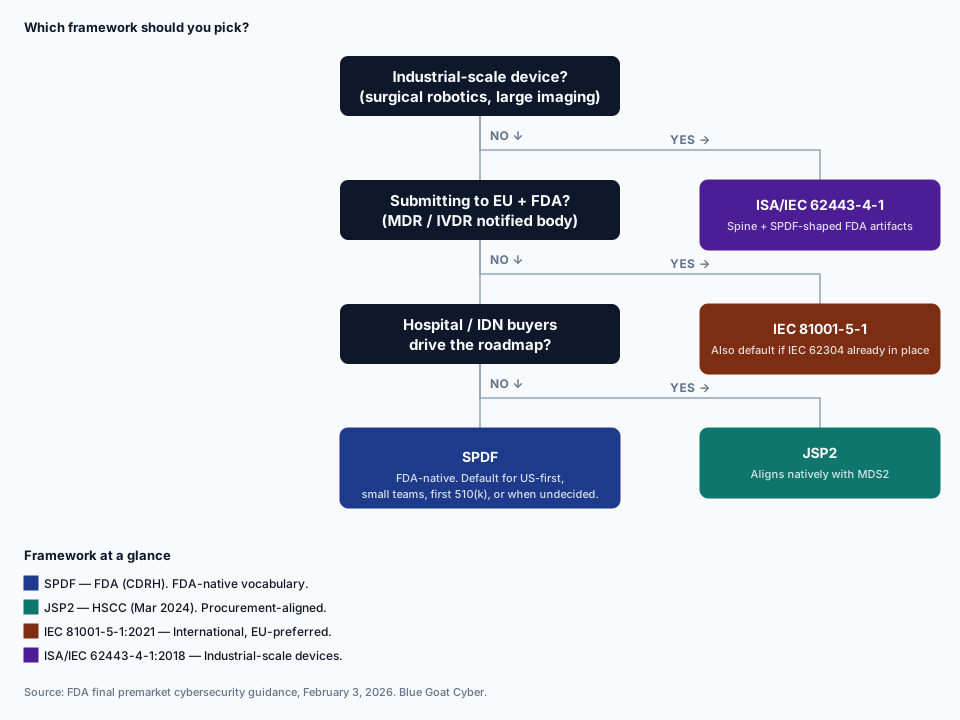
Decision tree
What the FDA actually said in the 2026 final guidance
The final Cybersecurity in Medical Devices: Quality Management System Considerations and Content of Premarket Submissions guidance (February 3, 2026) states that manufacturers should implement a secure product development framework and lists the following as acceptable:[^fda2026]
- The FDA's own SPDF, as described in the guidance.
- HSCC's Joint Security Plan v2 (JSP2), published March 2024.[^jsp2]
- IEC 81001-5-1:2021, Health software and health IT systems safety, effectiveness and security, Part 5-1: Security, Activities in the product life cycle.[^iec81001]
- ISA/IEC 62443-4-1:2018, Security for industrial automation and control systems, Part 4-1: Secure product development lifecycle requirements.[^iec62443]
The guidance is clear that the choice is the manufacturer's, and that any of the four is acceptable if the resulting submission contains the expected content: security risk management, threat modeling with the required architecture views, SBOM and vulnerability analysis (optionally documented using VEX), interoperability considerations, security testing, labeling, and a postmarket cybersecurity management plan.
The four frameworks at a glance
| Framework | Author | Best fit | Regulatory fit | Effort to adopt from scratch |
|---|---|---|---|---|
| SPDF | FDA (CDRH) | US-first medtech | FDA-native | Medium |
| JSP2 | HSCC (industry consortium) | Companies with heavy hospital-procurement exposure | FDA-accepted, procurement-aligned | Medium |
| IEC 81001-5-1 | IEC / ISO joint | Dual US/EU submissions, IVDR/MDR devices | FDA-accepted, EU-preferred | Medium-High |
| ISA/IEC 62443-4-1 | ISA/IEC | Industrial-scale devices, orgs already running 62443 | FDA-accepted, uncommon in medtech | High |
Quick pick: SPDF vs JSP2 vs IEC 81001-5-1
For the three frameworks most medtech teams actually weigh, use this as the one-line answer:
| Your context | Choose | Why |
|---|---|---|
| US-only submission, no existing framework | SPDF | FDA-native vocabulary, shortest path to a clean 510(k) |
| US-only, hospital-procurement is the harder audience | JSP2 | Co-authored by health-delivery orgs, aligns with MDS2 |
| Dual FDA + EU MDR/IVDR submission | IEC 81001-5-1 | Notified-body expectation, harmonizes with IEC 62304 |
| Already run IEC 62304 and ISO 13485 | IEC 81001-5-1 | Slots onto existing QMS with least overhead |
| Small team (< 10 engineers), US-first | SPDF | Lowest per-artifact overhead |
| Large IDN contracts drive the roadmap | JSP2 | Speaks procurement's language natively |
| Genuinely undecided | SPDF | Never wrong for an FDA submission |
SPDF: the FDA's default
SPDF is the framework the FDA wrote for itself. It is the least ambiguous mapping to the artifacts reviewers expect, because it is the source of those artifacts. See our companion piece on the SPDF vs SSDLC gap for what SPDF adds over a general secure SDLC.
Pick SPDF when:
- The device is US-first or US-only.
- The team does not already have an established framework running.
- You want the shortest path from artifacts to a clean submission.
SPDF's weakness: it is not recognized as a standard outside the US. EU notified bodies do not evaluate against SPDF, and hospital procurement rarely asks about it by name.
JSP2: the healthcare-industry framework
The Health Sector Coordinating Council's Joint Security Plan v2 (March 2024) is a healthcare-industry-authored total-product-lifecycle framework. It was written by manufacturers, health-delivery organizations, and government partners together, which is why it aligns unusually well with the questions hospital security and procurement teams actually ask.
JSP2 covers the same lifecycle stages as SPDF but adds explicit sections on customer-facing security documentation, procurement enablement (including alignment with the MDS2 disclosure form), and coordinated deployment guidance. Our deep-dive on JSP is here.
Pick JSP2 when:
- Hospital contracts and IDN security reviews drive as much of your roadmap as the FDA does.
- You want a framework that reads naturally to both regulators and customers.
- You already produce MDS2 forms and want the underlying development framework to align with them.
JSP2's limitation: its outputs still need to be mapped to the FDA's recommended submission content; reviewer familiarity should not be assumed.
Picking a security lifecycle framework?
Blue Goat Cyber is a medical-device-only cybersecurity firm. Our team runs the threat modeling, penetration testing, and FDA-facing documentation MedTech submissions live or die on. → Secure MedTech product design consulting
IEC 81001-5-1: the international spine
IEC 81001-5-1:2021 addresses health-software security lifecycle activities and can complement IEC 62304 and IEC 82304-1. EU legal harmonisation requires the specific EN standard and edition to be cited in the Official Journal for the applicable MDR or IVDR requirements; technical compatibility and notified-body practice do not establish that status.
See also: IEC 81001-5-1: Secure Lifecycle Rules, AAMI TIR57 vs TIR97 vs SW96, and MedTech Cyber Standards Every Device Team Must Know.
Pick IEC 81001-5-1 when:
- You submit to both the FDA and EU notified bodies.
- The device is regulated in multiple jurisdictions where ISO/IEC standards carry more weight than US-specific frameworks.
- The engineering org already runs IEC 62304 and wants the security framework to sit natively on top of it.
IEC 81001-5-1's weakness: it costs more to adopt cleanly, and the language is denser than SPDF or JSP2. Small teams shipping US-only will find the overhead disproportionate.
Talk to a MedTech cybersecurity expert about framework selection
ISA/IEC 62443-4-1: the industrial option
ISA/IEC 62443-4-1 comes from the industrial automation world. It is the secure development lifecycle standard for control-system vendors, and it is exceptionally rigorous, arguably more rigorous than any of the other three on pure development-process discipline.
Pick 62443-4-1 when:
- The device is genuinely industrial in scale: surgical robotics, large imaging platforms, radiation therapy systems, hospital automation.
- The parent company already runs 62443 across other product lines and wants a single framework.
- The customer base includes non-clinical industrial buyers alongside hospitals.
62443-4-1's weakness: it is overkill for most Class II devices, and its vocabulary (zones, conduits, security levels) does not translate naturally to FDA reviewer expectations without heavy mapping.
Decision matrix: which framework fits which company
| Situation | Recommended spine |
|---|---|
| US-only Class II SaMD, small team, no existing framework | SPDF |
| US Class II hardware device, moderate procurement exposure | SPDF or JSP2 |
| Heavy hospital-IDN customer base, MDS2 already in play | JSP2 |
| Dual FDA + EU MDR/IVDR submission | IEC 81001-5-1 |
| Surgical robotics, large imaging, or industrial-scale medical system | ISA/IEC 62443-4-1 (with SPDF mapping) |
| Startup pre-first-submission | SPDF (fastest to a clean 510(k)) |
| Established manufacturer with a mature IEC 62304 QMS | IEC 81001-5-1 |
How to mix frameworks without confusing reviewers
Real submissions often use more than one framework. A common pattern: IEC 81001-5-1 as the international spine, with SPDF-shaped artifacts (four architecture views, VEX-paired SBOM, FDA-format postmarket plan) presented in the submission. Another: JSP2 as the internal operating framework, with an SPDF-labeled artifact package for the FDA and JSP2-labeled documentation for hospital procurement.
Two rules keep this readable:
- Name the spine once, in the cybersecurity management plan. Do not describe the device as "SPDF and JSP2 and 81001-5-1 aligned" in a submission cover letter. Pick one, and describe the others as mappings.
- Produce artifacts in the FDA's expected shape regardless of spine. Reviewers grade the artifacts, not the framework. Threat model with four views, SBOM and vulnerability analysis (optionally documented using VEX), integrated ISO 14971 / AAMI SW96 risk file, postmarket plan, CVD process, labeling. Every framework can produce these; the wrapper is the manufacturer's choice.
How Blue Goat Cyber Approaches This
Blue Goat Cyber runs a framework-selection workshop before the first submission of a device family. The output is a one-page decision memo naming the spine, the mapping to FDA artifacts, and the sequence of internal work needed to stand it up. For teams already committed to a framework, we run gap assessments against the 2026 final guidance and produce a remediation backlog ordered by deficiency-letter likelihood.
Blue Goat Cyber has supported more than 275 device submissions. Framework selection should be based on the device and the evidence needed, not an implication that the founder personally cleared devices or holds privileged standards-working-group access.
Frequently Asked Questions
Does the FDA prefer SPDF over the others?
FDA discusses secure-development approaches as examples, not formally equivalent frameworks. Choose a suitable approach and assess its outputs against applicable FDA recommendations; framework selection alone does not establish acceptance.
Which should I choose for a first-ever 510(k)?
SPDF. It is the FDA's own vocabulary and the shortest path from artifacts to a clean submission. Adopt a different framework only if a specific driver (EU submission, existing 62443 program, hospital-procurement pressure) is already on the table.
Which should I choose if my main buyer is a large IDN or hospital system?
JSP2. It was co-authored by health-delivery organizations, so its outputs answer procurement questions in the vocabulary hospital security teams already use, and it aligns natively with the MDS2 disclosure form.
Which should I choose for a connected implantable or infusion pump?
SPDF or IEC 81001-5-1. Both handle the harm-traceability, four-view threat modeling, and postmarket obligations these devices demand. Pick SPDF for US-first, IEC 81001-5-1 for dual FDA/EU.
Which should I choose if we already run ISO 13485 and IEC 62304?
IEC 81001-5-1. It slots onto IEC 62304 directly and reuses the ISO 13485 QMS scaffolding, so adoption cost is low. SPDF is still fine, it just does not benefit from the existing standards investment.
What if I genuinely cannot decide?
Default to SPDF, document the decision in the cybersecurity management plan, and revisit at the next major device version. SPDF is never the wrong answer for an FDA submission; it is only sometimes not the best answer.
CTA
Pick the framework once, correctly, before you build the artifacts. Blue Goat Cyber runs a two-week framework selection and gap workshop that outputs a submission-ready spine, a mapping to FDA artifacts, and a prioritized remediation backlog. Book a discovery session.
Christian Espinosa, Founder, Blue Goat Cyber., CCISO, ex-military red team. Has led framework selection and FDA cybersecurity submissions for more than 275 medical devices under SPDF, JSP2, IEC 81001-5-1, and ISA/IEC 62443-4-1. More on the author.
References
Continue the Framework choice series
Dive deeper with these companion articles:
- How SPDF Maps to IEC 81001-5-1 Activities
- IEC 81001-5-1 vs IEC 62304 for Medical Devices
- Medical Device Cybersecurity SPDF vs TPLC
- SPDF vs SSDLC: What Medtech Teams Get
- Joint Security Plan (JSP): What MedTech Teams Need to Know (2026)
- SSDLC for Medical Device Cybersecurity
- Post-Exploitation in Medical Device Penetration Testing
About the author

Christian Espinosa, MBA · Founder & CEO, Blue Goat Cyber
U.S. Air Force Academy graduate and veteran with 30+ years in cybersecurity. Founded Alpine Security in 2014 (acquired 2020), then Blue Goat Cyber in 2022. Has supported 275+ medical devices, with no cybersecurity-related rejections to date. Author of three books including The Smartest Person in the Room. Ironman triathlete and mountaineer.
Sources & references
Primary sources cited in this article. Links open in a new tab.