
On this page
Published: January 14, 2024 · Last reviewed: May 1, 2026
Key Takeaways
- Ransomware and double-extortion remain top threats.
- Stolen patient data is highly valuable on the dark web.
- Phishing is a major entry point for attackers.
- Device hijacking embeds criminals within networks.
- Fraudulent billing and IP theft are significant concerns.
- DoS attacks extort payments for restoring services.
Part of our Postmarket medical device cybersecurity series (surveillance, vuln handling, PATCH Act). For the full overview, start with FDA Postmarket Cybersecurity for Cleared.
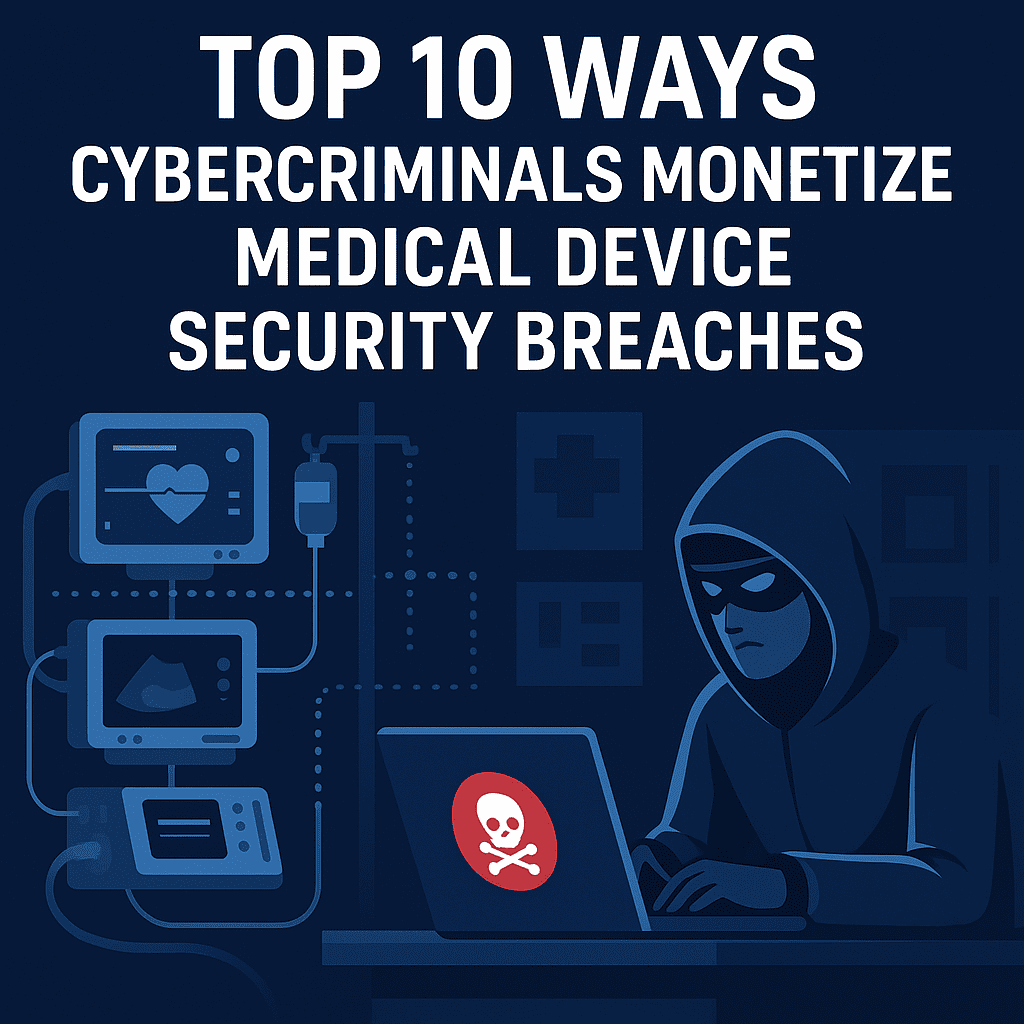
Cybercriminals monetize medical device breaches through ransomware and device lockout, selling stolen patient data on the dark web, phishing-driven network access, device hijacking, fraudulent billing, intellectual property theft, and denial-of-service extortion. Each tactic exploits real device and network weaknesses for financial gain. The FDA's February 3, 2026 guidance expects manufacturers to build lifecycle defenses that reduce these attack opportunities.
Cyberattacks on medical devices aren’t random-attackers strategically target healthcare to profit from device vulnerabilities. At Blue Goat Cyber, we specialize in safeguarding medical devices against these financially driven threats. Here are the ten most common ways cybercriminals monetize breaches-and practical steps your organization can take to stop them.
Why this matters
The monetization of medical device cybersecurity breaches poses significant risks to patient safety, healthcare operations, and organizational reputation. Compromised devices can lead to direct harm to patients through altered functionality or denial of service, while stolen protected health information (PHI) can result in identity theft and severe privacy violations for individuals. Healthcare providers face disruptions in care delivery, substantial financial losses from ransom payments, regulatory fines for data breaches, and eroded public trust.
According to the FDA's 'Cybersecurity in Medical Devices' Final Guidance dated February 3, 2026, medical device manufacturers are explicitly required to implement cybersecurity measures throughout the total product lifecycle. This includes addressing known vulnerabilities, ensuring appropriate security controls, and providing mechanisms for post-market security updates. Failure to comply can result in serious regulatory consequences, impacting market access and product viability. Relevant standards informing these requirements include IEC 81001-5-1, ISO 27001, and AAMI TIR57 / ANSI/AAMI SW96:2023, which provide frameworks for risk management, information security, and medical device security, respectively. Proactive defense against monetization tactics is not merely a technical necessity but a critical component of ethical patient care and operational resilience.
1. Ransomware & Device Lockout
Ransomware remains the number-one cyber threat in healthcare, with hospitals and medical device networks commonly targeted. Cybercriminals encrypt critical systems, forcing hospitals to pay enormous ransoms-totaling over $1 billion globally annually-to restore lifesaving medical services.
Defense: Regular patching, secure backups, and network segmentation reduce ransomware risk significantly.
2. Double-Extortion (Data Exposure & Lockout)
Criminals increasingly use double-extortion tactics, encrypting data and threatening to publicly disclose sensitive patient information unless paid. This compounds damage through regulatory fines and reputation loss ( LockBit ransomware).
Defense: Advanced endpoint detection, encryption of sensitive data, and clear incident response plans mitigate exposure risks.
3. Dark Web Sales of Patient Data (PHI)
Stolen patient health information (PHI) commands prices between $20-$40 per record on the dark web-higher than credit cards due to longer-lasting fraud potential. Breached medical devices offer direct access to valuable patient databases.
Defense: access controls, data encryption, and strong authentication protect sensitive patient records.
4. Phishing & Credential Theft Leading to Breach Access
Phishing remains a prevalent entry method, accounting for nearly 40% of breaches in healthcare. Cybercriminals trick healthcare staff into providing credentials, granting attackers direct access to medical device networks.
Defense: Employee cybersecurity training and multifactor authentication (MFA) reduce phishing success.
5. Medical Device Hijacking (MEDJACK)
MEDJACK malware specifically targets outdated medical devices, embedding attackers deep within hospital networks. MEDJACK attacks are stealthy, often undetected until severe harm occurs ( Wikipedia: MEDJACK).
Defense: Rigorous device updates, endpoint protection, and strict device management limit MEDJACK’s effectiveness.
6. Selling Network & Device Access
Attackers routinely sell access to compromised healthcare networks on dark web marketplaces, enabling secondary attacks, espionage, or data theft ( Health-ISAC Report).
Defense: Regular vulnerability assessments, threat modeling, and intrusion detection prevent unauthorized access sales.
7. Cryptojacking
Cybercriminals install malware to mine cryptocurrency secretly using hospital device resources. Cryptojacking degrades medical device performance and diverts critical resources ( Trustwave Report).
Defense: Advanced threat detection, monitoring network activity, and rapid malware response mitigate cryptojacking threats.
8. Billing, Insurance & Prescription Fraud
See also: Medical Device Incident Response Plan, MQTT Vulnerabilities in Connected, and CAN Bus Vulnerabilities in Medical Devices.
Criminals infiltrate compromised systems to generate fraudulent medical billing claims or illegally divert prescriptions. This tactic results in billions in financial losses annually ( Definitive Healthcare).
Defense: Rigorous audit trails, secure billing systems, and controlled prescription processes reduce fraud risks significantly.
9. IP Theft & Counterfeit Medical Devices
Stolen intellectual property from compromised devices enables attackers to create and sell counterfeit medical products, endangering patient safety and market integrity ( HealthTech Magazine).
Defense: Strong intellectual property safeguards, data loss prevention tools, and controlled manufacturing access mitigate IP theft risks.
10. Denial-of-Service (DoS) Extortion
Attackers target medical device networks with denial-of-service (DoS) attacks, disrupting critical healthcare services. They then demand payments to restore functionality ( Cybercrime Wikipedia).
Defense: Network redundancy, DDoS mitigation strategies, and incident response plans limit disruption impacts.
Why Medical Device Cybersecurity Is Crucial
Healthcare remains the most frequently targeted sector in critical infrastructure. Criminals constantly adapt tactics, targeting weaknesses in IoMT (Internet of Medical Things) and healthcare systems. Staying ahead of attackers requires proactive cybersecurity measures.
How Blue Goat Cyber Protects You
At Blue Goat Cyber, we defend your organization by:
- Implementing a Secure Product Development Framework (SPDF)
- Performing threat modeling and vulnerability assessments
- Providing continuous monitoring and proactive cybersecurity management
- Ensuring FDA regulatory compliance and cybersecurity best practices
Cybercriminals target vulnerabilities for profit-but your devices don’t have to be their next victim.
Contact Blue Goat Cyber Today to secure your medical devices, protect patient data, and safeguard your healthcare reputation.
How Blue Goat approaches this
Blue Goat Cyber's approach to medical device cybersecurity focuses on preventing the monetization of breaches by proactively identifying and mitigating vulnerabilities. Our team, comprising certified experts (CISSP, OSCP) and former military red team specialists, employs a structured methodology to assess and strengthen your security posture. We conduct thorough threat modeling, penetration testing, and vulnerability assessments tailored specifically for medical device ecosystems.
Our services ensure adherence to regulatory requirements, including those outlined in the FDA's guidance. We help you establish secure device architectures, implement effective data protection strategies, and develop incident response plans that minimize potential financial and operational impacts. For manufacturers seeking pre-market approval, our FDA Premarket Cybersecurity Services are designed to meet all submission requirements. If the FDA raises cybersecurity deficiencies after our submission, we resolve them at no additional cost. Our goal is to make medical devices inherently more difficult for cybercriminals to compromise and profit from, safeguarding both your assets and patient trust.
FAQ
What is double-extortion in medical device breaches?
Double-extortion involves encrypting data and simultaneously threatening to publicly disclose sensitive patient information. This tactic uses both data unavailability and reputational damage to coerce payment from victims beyond standard ransomware.
How do cybercriminals use stolen patient data?
Cybercriminals sell stolen patient health information (PHI) on the dark web for high prices. This data is exploited for identity theft, fraudulent medical claims, and other long-term financial crimes due to its complete nature.
Does the FDA require cybersecurity for medical devices?
Yes, the FDA requires medical device manufacturers to address cybersecurity. The February 3, 2026 final guidance outlines specific cybersecurity requirements for premarket submissions of medical devices, ensuring devices are designed with security in mind.
What is MEDJACK?
MEDJACK refers to medical device hijacking, where malware targets outdated medical devices to gain deep access into hospital networks. These attacks are often stealthy and can remain undetected for extended periods until significant harm occurs.
Can medical devices be used for cryptojacking?
Yes, medical devices can be compromised for cryptojacking. Cybercriminals install malware to secretly use the device's processing power to mine cryptocurrency, which degrades device performance and consumes critical hospital resources.
How does Blue Goat Cyber protect against these threats?
Blue Goat Cyber implements a Secure Product Development Framework, conducts threat modeling and vulnerability assessments, provides continuous monitoring, and ensures compliance with the FDA premarket cybersecurity guidance to protect medical devices and patient data.
About the author

Christian Espinosa, MBA, CISSP · Founder & CEO, Blue Goat Cyber
U.S. Air Force Academy graduate and veteran with 30+ years in cybersecurity. Founded Alpine Security in 2014 (acquired 2020), then Blue Goat Cyber in 2022. Has supported 250+ FDA medical device submissions; no client has failed to clear due to cybersecurity. Author of three books including The Smartest Person in the Room. Ironman triathlete and mountaineer.
Sources & references
Primary sources cited in this article. Links open in a new tab.
- 40% of breaches in healthcare- hhs.gov