
On this page

Published: · Updated:
Key Takeaways
- A Software Bill of Materials (SBOM) is required for every cyber device on covered pathways under Section 524B(b)(3); the final guidance provides nonbinding recommendations.
- The FDA recommends machine-readable SBOMs and encourages industry-accepted formats, without naming formats or minimum versions.
- Component identity and dependency data support vulnerability matching; hashes are included in CISA’s 2026 minimum elements, not an FDA-specific requirement.
- We recommend updating SBOMs for releases and retaining versioned records with the release documentation.
- The SBOM powers the postmarket vulnerability-management loop, treat it as a living artifact, not a submission checkbox.
What is an SBOM for medical devices?
A Software Bill of Materials for a medical device is a machine-readable inventory of every software component, library, and dependency shipping inside it, including firmware, OS packages, SDKs, and transitive dependencies. Section 524B(b)(3) requires one for covered cyber-device submissions, with machine-readable SBOMs recommended by the guidance, which names no format or version floor, and it underpins postmarket vulnerability management throughout the device's life.
Everything a medical device manufacturer needs to know about Software Bills of Materials in 2026 - what they are, why the FDA requires them, which format to pick, how to generate one that survives review, and how it feeds the postmarket vulnerability-management loop. Aligned to the February 2026 final premarket cybersecurity guidance and Section 524B of the FD&C Act.
Reviewed October 23, 2026 against the February 3, 2026 final guidance and Blue Goat Cyber's SBOM/SAST methodology, Rev B.
1. What an SBOM Actually Is
A Software Bill of Materials is a structured, machine-readable inventory of every software component that ships inside a product. For a medical device it covers:
- Application code and the dependencies it imports.
- Firmware, bootloader, RTOS, or embedded Linux distribution.
- OS packages (Debian, Yocto, Buildroot, Alpine, etc.).
- Third-party SDKs, drivers, and proprietary binaries.
- Transitive dependencies - the libraries your libraries pull in.
- Hashes, suppliers, license, and unique identifiers (CPE, PURL, SWID).
The NTIA 2021 minimum elements are supplier, component name, version, dependency relationship, unique identifier, author, and timestamp. The seven fields are the historical NTIA 2021 baseline referenced by the FDA guidance. CISA’s July 29, 2026 SBOM minimum elements supersede that baseline and add elements including author signature, SBOM version, component hash, and license information; these are not additional FDA-specific fields. The FDA expects an SBOM detailed enough to support CVE matching for the entire supported life of the device.
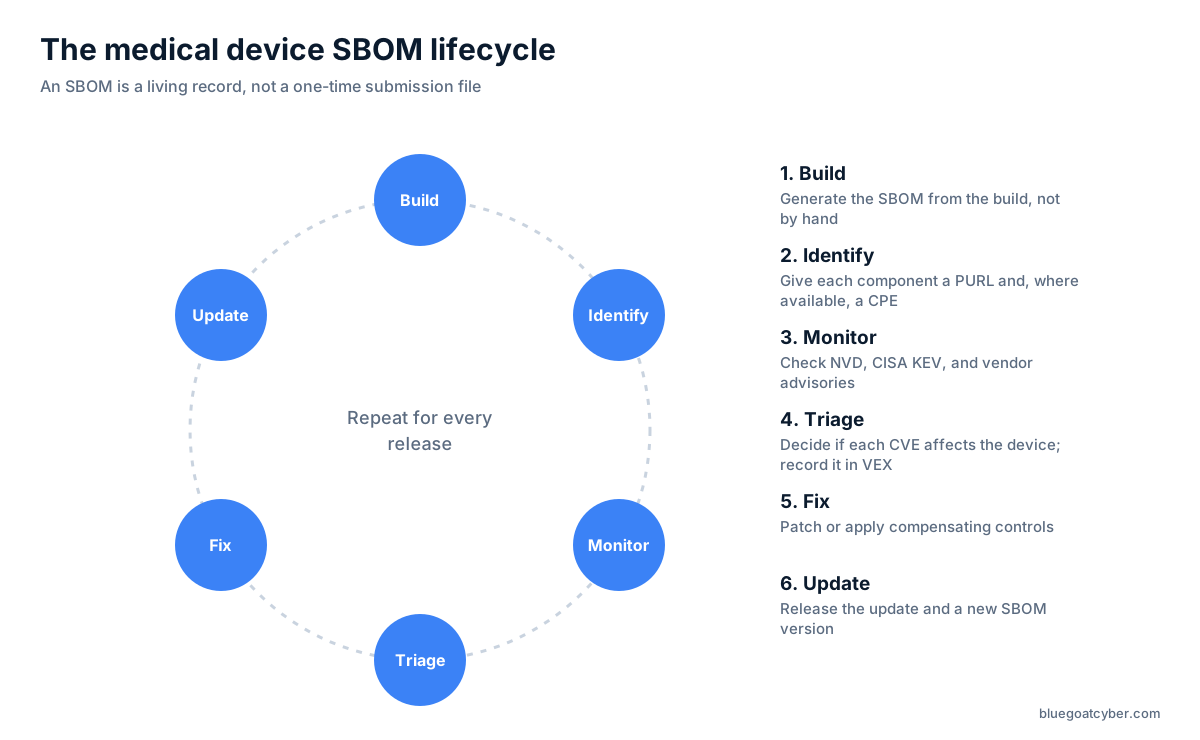
Free to share with a link to this page: <a href="https://bluegoatcyber.com/resources/infographics/medical-device-sbom-lifecycle">The medical device SBOM lifecycle (Blue Goat Cyber)</a> Full-size infographic and text version
2. Why the FDA Requires an SBOM
Section 524B(b)(3) of the FD&C Act requires every "cyber device" submission to include a software bill of materials, "including commercial, open-source, and off-the-shelf software components". The February 3, 2026 FDA guidance, §V.A.4(b), p. 17 says manufacturers "should provide machine-readable SBOMs" and that "Industry-accepted formats of SBOMs are encouraged". It names no format or version floor. It also recommends component support level and end-of-support date, which may be provided in a separate addendum. Build automation is useful practice, not a prescribed FDA generation method.
3. CycloneDX vs SPDX - Which to Pick
Both are industry-accepted options. The differences that actually matter for medical devices:
| Dimension | CycloneDX | SPDX |
|---|---|---|
| Origin | OWASP | Linux Foundation |
| Strongest at | Vulnerability + VEX workflows | License compliance |
| Native VEX support | Yes (CycloneDX VEX) | SPDX 2.3: external VEX; SPDX 3.0: native Security profile |
| Tooling for embedded | Excellent (Syft, cdxgen, cyclonedx-cli) | Strong (sbom-tool, SPDX tools, Yocto integration) |
Pragmatic guidance: if you're starting fresh, pick CycloneDX 1.5+ JSON for the tighter vulnerability/VEX workflow. If you already produce SPDX from your build (especially Yocto), keep producing SPDX 2.3 with external VEX, or use SPDX 3.0’s native Security profile. Either way, consider one canonical format per device and automated generation in CI. See our CycloneDX vs SPDX comparison for the deep dive.
4. Component Identifiers: CPE vs PURL vs SWID
Component names alone aren't enough to match CVEs reliably. You need identifiers:
- CPE (Common Platform Enumeration) - NIST's identifier scheme. Useful for NVD applicability matching; the NVD API also supports CVE-ID and keyword queries.
- PURL (Package URL) - origin-based identifier (npm, pypi, maven, deb, generic). Useful for ecosystem advisory matching, but not a prerequisite for all vulnerability searches.
- SWID (Software Identification Tags) - ISO/IEC 19770-2. Less common in medical devices.
A submission-grade SBOM carries both CPE and PURL where possible. Our CPE vs PURL guide covers the mapping pattern in detail.
5. Generating an SBOM (Without Lying to Yourself)
How to create an SBOM for a medical device, step by step
- Scope the device system. List every software-bearing part: device firmware, operating system, mobile app, cloud service, clinician portal, and any AI model and its runtime. Section 524B(b)(3) covers commercial, open-source, and off-the-shelf components, so include them all. See our Section 524B guide for the full requirement.
- Pick a format and identifiers. Choose CycloneDX or SPDX (section 3) and use PURL or CPE identifiers (section 4) so components match vulnerability databases.
- Generate from the build. Run a generator for each build context (table below) in your build pipeline, with manual enrichment and validation where needed.
- Add what tools miss. Binary-only firmware, vendor SDKs, and chip-level components need binary analysis or a supplier SBOM.
- Include AI components. Record ML frameworks, inference runtimes, pretrained or third-party models, and their versions. Our AI/ML medical device security page covers how those components are tested.
- Add support status. For each component, record the level of support and end-of-support date, which the FDA expects alongside the SBOM.
- Merge and review. Combine per-part SBOMs into one device SBOM per release, then have an engineer check for missing or wrong entries.
- Map to vulnerabilities. Check every component against known vulnerabilities and document patient-harm assessments (sections 6 and 7).
- Version and maintain it. Store the SBOM with each release and regenerate it on every software change for the supported life of the device.
Manual reconstruction can miss transitive dependencies or introduce version errors. Validate the inventory against the released software regardless of generation method.
Generate from the build, in CI, on every release candidate:
| Build context | Recommended tooling |
|---|---|
| Embedded Linux (Yocto) | meta-spdxscanner, create-spdx.bbclass, or cdxgen post-build |
| Buildroot | make legal-info + spdx-tools or CycloneDX wrappers |
| Containerized backend | Syft (CycloneDX or SPDX output) |
| Node / npm | cyclonedx-npm, @cyclonedx/cyclonedx-npm |
| Python | cyclonedx-py, pip-licenses |
| Go | cyclonedx-gomod, syft |
| Java / Maven / Gradle | cyclonedx-maven-plugin, cyclonedx-gradle-plugin |
| .NET | CycloneDX dotnet CLI |
| Mobile (iOS/Android) | cdxgen (covers Swift, Kotlin, Gradle) |
| Firmware binaries (no source) | Binary composition analysis: binwalk + cve-bin-tool, or commercial BCA |
| Proprietary third-party SDKs | Vendor-supplied SBOM, validated and merged |
Merge the per-component SBOMs into a single device SBOM per release. Store it as a versioned build artifact alongside the firmware image.
How Blue Goat Cyber verifies the SBOM before delivery
For the focused walkthrough of shipped-software reconciliation, support-date evidence, the enrichment gate, and second-person review, see SBOM verification before delivery. The overview below places that workflow in the broader SBOM and SAST lifecycle.
Our guide SW-002, Rev B, dated October 22, 2026, reconciles available source/build evidence with binary software composition analysis of the released artifacts in scope. Binary analysis can reveal statically linked libraries, vendored code, and components absent from a manifest. Neither method proves complete coverage on its own; inaccessible artifacts and other limits remain documented.
| Review step | Evidence retained | Decision or limit |
|---|---|---|
| Agree system and release scope | Source revision, manifests, lock files, firmware/binary versions, and supplied artifacts | The manufacturer identifies the software systems and release to assess |
| Reconcile component discovery | Supplier, version, identifiers, and direct/transitive dependency relationships | Investigate inconsistent entries and document gaps |
| Record reproducible methods | Tool names, versions, configuration, and discovery method | Independently review tool output before including it |
| Enrich support information | Support level, end-of-support date, and supplier evidence | Request unpublished dates; record unknown until answered, never an invented date |
| Apply the enrichment verification gate | Documented review of every component's support and end-of-support fields | Withhold a failed SBOM, correct it, and re-verify; unknown is not a confirmed date |
| Complete peer review | Review by a second qualified team member | Release only after the required gate and peer review are complete |
Blue Goat Cyber delivers SPDX by default under this methodology. CycloneDX remains an industry-accepted option where agreed; neither our default nor our verification gate is an FDA-mandated format or generation process. Existing manufacturer and supplier SBOMs can be inputs, but their accuracy, enrichment, and match to released software still need review.
What SAST adds, and what it cannot establish
Static Application Security Testing (SAST) examines the manufacturer's source code for software systems in scope, including third-party code the manufacturer has modified. Software Composition Analysis (SCA) identifies third-party components and their known published vulnerabilities. One does not replace the other, and SAST does not establish that the running device is secure or complete general software V&V.
SAST is configured for the language and platform. Its report records tool name, version, configuration, scope, and limitations. Checks include hardcoded, default, easily guessed, or easily compromised credentials, as discussed in Section V.C of the FDA's February 3, 2026 guidance; dynamic security testing and penetration testing provide different evidence about running software and attack paths.
Raw scanner output is not a confirmed finding. A reviewer confirms or rejects each result, records the evidence and rationale, and maps confirmed weaknesses to a Common Weakness Enumeration (CWE) category. Confirmed findings receive security-risk assessment and remediation recommendations; patient-safety assessment requires a supported pathway and manufacturer-provided hazard evidence, not an automatic inference from a CWE or CVSS score.
After the manufacturer fixes a confirmed finding, retesting checks the change and records closure evidence. Findings still present at submission connect to the Assessment of Unresolved Anomalies and Cybersecurity Risk Assessment, with CWE, device-specific implications, controls, and rationale. A security weakness may need remediation even when ordinary software defect review would tolerate it; a clean scan is not approval.
How component and code findings connect to lifecycle records
In a fictional patient-monitor example, binary analysis discovers a statically linked TLS library missing from the manifest, while SAST confirms a hardcoded service credential. These are illustrative weaknesses, not client findings or assigned risk ratings.
| Record | Illustrative connection |
|---|---|
| SBOM and support addendum | Add the library's supplier, shipped version, identifier, dependency parent, support level, and evidenced end-of-support date or explicit unknown |
| Vulnerability identification | Record advisory source and discovery method; confirm whether the released version and configuration are affected |
| Cybersecurity Risk Assessment | Assess reachable vulnerable functionality and the credential weakness; obtain manufacturer hazard evidence for any clinical pathway |
| SAST report | Retain tool details, manual confirmation, CWE, and remediation recommendation |
| Unresolved anomalies and retest | Record a deferred finding and rationale, or verify the fix and retain closure evidence |
| Configuration and maintenance | Connect component changes, tests, approved release, and version-specific monitoring |
The IEC 62304 cybersecurity deliverable map shows where this evidence supports the manufacturer's lifecycle records. It is not a conformity assessment.
Manufacturer responsibilities and confidential code handling
The manufacturer supplies agreed source/build/binary artifacts, existing SBOM/SOUP and anomaly records, architecture and data flow diagrams covering every external interface, configuration management and SOUP records, intended use, use environment, hazard analysis, and acceptance criteria. More complete inputs produce a more complete SBOM. Blue Goat Cyber provides the agreed inventory, enrichment, reviewed findings, SAST evidence, original third-party test reports for direct submission inclusion, recommendations, and one round of retest for remediated findings.
The manufacturer owns configuration management, the SBOM's connection to each approved release, remediation, risk acceptance, lifecycle approvals, and postmarket decisions. We support product cybersecurity, not general software V&V or full QMS certification. Procedure support in an existing QMS is separately scoped.
Source code, firmware, binaries, and test artifacts are handled in segregated, access-controlled environments, with access limited to assigned personnel. Processing and storage location is agreed before materials are sent.
Source code does not leave Blue Goat Cyber's environment during analysis and is not sent to any third party. Some vulnerability lookups send component names, versions, and identifiers to a tool vendor's service; this is different from sending source code. Clients requiring restrictions should settle them at scoping rather than assume offline-only analysis, a storage country, or an unagreed retention period.
6. Mapping the SBOM to CVEs
A submitted SBOM is the input to a continuous vulnerability-management process the FDA expects to run for the supported life of the device. The minimum feeds to subscribe to:
- NVD - canonical CVE source, CPE-matched.
- CISA KEV - known-exploited vulnerabilities, prioritized.
- GitHub Advisory Database (GHSA) - PURL-matched, often ahead of NVD.
- OSV.dev - aggregator, PURL-matched, fast.
- Vendor PSIRTs - chipset, OS, and SDK vendors directly.
Useful prioritization signals selected by the manufacturer's process, not mandated by the FDA:
- CVSS vectors and scores with version and device-specific assumptions documented. Blue Goat Cyber uses v4.0 under its own methodology; the FDA does not mandate that version.
- EPSS, a prioritization signal, not a device-specific probability of patient harm.
- CISA KEV, evidence of known exploitation that triggers applicability and control review, not automatic patient harm or a higher matrix exploitability rating.
For an affected KEV-listed component, record known exploitation (E:A), review whether a control is defeated, and re-score when evidence changes. Recommend remediation and, where needed, compensating controls and a timeline; the manufacturer owns acceptance. Our risk methodology keeps the CVSS base score separate from both matrices.
The depth of this loop is the subject of our companion pillar, SBOM Vulnerability Management for Medical Devices.
7. VEX: Closing the Noise Loop
A naive SBOM-to-CVE match will surface dozens of irrelevant vulnerabilities - components present but not reachable, code paths not compiled in, mitigations already deployed. A VEX (Vulnerability Exploitability eXchange) statement is how you document "we know about CVE-X, here's why it doesn't apply to this device". Document device-specific applicability and risk reasoning for known vulnerabilities. VEX is optional; the final guidance does not mention or require it.
See VEX Documents for Medical Device FDA Submissions.
8. Labeling and Customer Disclosure
Section 524B(b)(3) requires the SBOM to be provided to the FDA (the Secretary). Availability to device users is a labeling recommendation in the 2026 guidance, not that statutory obligation. Common patterns:
- A downloadable SBOM linked from the device's cybersecurity information page.
- An SBOM included in the technical file shipped to hospital biomed teams.
- A customer portal that pushes SBOM updates when components change.
The format and depth disclosed externally can differ from the submission SBOM - but it must be a true subset, not a different document.
9. SBOM Under EU MDR, IVDR, and the EU Cyber Resilience Act
If you sell into the EU, your SBOM is no longer just an FDA artifact:
- EU MDR / IVDR - software information-security provisions appear in MDR Annex I 17.2 and IVDR Annex I 16.2. An SBOM can support technical documentation and vulnerability management; neither regulation imposes a universal named SBOM format.
- EU Cyber Resilience Act (CRA) - products covered by the MDR or IVDR are excluded under Article 2(2)(a) (MDR) and (b) (IVDR). Separate companion products need their own applicability assessment. Do not apply CRA reporting duties to an MDR/IVDR-covered device merely because it is connected.
A shared SBOM pipeline can support documentation across jurisdictions, but applicability and evidence needs must be assessed separately. See EU MDR vs FDA cybersecurity crosswalk.
10. A 10-Item SBOM Submission Checklist
- SBOM is machine-readable, using an industry-accepted format appropriate to your tooling; no FDA version floor is specified.
- Reconciled against released artifacts using available source/build evidence, binary analysis, and supplier inputs; limitations are documented.
- Covers firmware, OS packages, app code, third-party SDKs, and transitive deps.
- Review supplier, version, and unique identifiers; CPE and PURL are useful where available. Hashes support the CISA 2026 baseline.
- Dependency relationships are encoded, not flattened.
- A build provenance / timestamp / build ID is captured.
- Consider automated regeneration in CI for reproducibility; this is engineering advice.
- A vulnerability-management plan references the SBOM as its input.
- Evidence-supported vulnerability assessments exist for CVEs triaged as not applicable; VEX may communicate them if chosen.
- The SBOM is provided to the FDA under Section 524B(b)(3); plan user availability under the labeling recommendation.
11. How Blue Goat Cyber Approaches Medical Device SBOMs
An SBOM is not a build artifact you ship once - it is a living deliverable that has to survive vulnerability triage, deficiency letters, and postmarket updates. Here is how we run it.
- Artifact-based discovery. Available source/build evidence, binary composition analysis, and supplier inputs are reconciled; tool output is independently verified before it enters a deliverable.
- Dual identifiers where they exist. Both
purlandcpeare emitted so vulnerability feeds line up regardless of which identifier the advisory uses. - Depth to transitive dependencies. First-level dependency lists can omit relevant transitive components. Every SBOM we ship resolves transitive components with declared licenses.
- Evidence-supported applicability. Known vulnerabilities are assessed against the product version; VEX can communicate the analysis when used, but is not an FDA-mandated companion file.
- Postmarket monitoring wired in. SBOMs feed into an automated vulnerability watch that flags new CVEs and routes them into your CAPA process.
- Standards alignment. Format, content, and traceability align with the FDA's February 3, 2026 guidance, AAMI SW96, and IEC 81001-5-1.
Our medical device SBOM service is the entry point.
Frequently Asked Questions
13. Where to Go Next
- Operational depth: SBOM Vulnerability Management for Medical Devices
- Format choice: CycloneDX vs SPDX for Medical Devices
- Identifiers: CPE vs PURL for Medical Device SBOMs
- VEX: VEX Documents for Medical Device FDA Submissions
- Premarket roadmap: FDA Premarket Cybersecurity Submission Checklist
- Section 524B explainer: FDA 524B Cybersecurity Requirements Explained
- Legal/compliance angle: Cleared a 510(k) but not doing postmarket cybersecurity? Am I breaking the law?
- Postmarket SBOM Maintenance for Medical Devices - keeping the SBOM accurate after clearance.
Need a hand productionizing your SBOM pipeline before your next FDA submission? Talk to Blue Goat Cyber.
Free tools for this
- SBOM Readiness Checker - check an SBOM against the FDA's expected fields before you submit it.
References
Primary sources cited or relied on in this guide:
- Cybersecurity in Medical Devices: Quality Management System Considerations and Content of Premarket Submissions (Feb 2026 final), U.S. FDA
- Section 524B of the FD&C Act (Consolidated Appropriations Act, 2023, §3305), U.S. Congress
- NTIA/NIST, The Minimum Elements For a Software Bill of Materials (SBOM), NTIA / U.S. Dept. of Commerce
- IMDRF Principles and Practices for Software Bill of Materials for Medical Devices, IMDRF
- ANSI/AAMI SW96:2023, Standard for Medical Device Security, AAMI/ANSI
Sources & references
Primary sources cited in this article. Links open in a new tab.