On this page

Published: · Updated:
Key Takeaways
- The current FDA cybersecurity guidance is the Feb 3, 2026 final, which supersedes the June 2025 and September 2023 finals.
- It recommends an SPDF as one approach to meeting QMSR expectations and references consensus standards such as AAMI SW96 and IEC 81001-5-1.
- Section 524B requires an SBOM and a postmarket vulnerability plan for cyber devices; the guidance recommends a machine-readable SBOM format and threat models with trust-boundary coverage.
- Postmarket cybersecurity is scoped inside premarket review: the FDA judges the plan before clearance, not just after.
- Missing statutory cybersecurity information can put a submission on hold during technical screening; other gaps are typically raised during substantive review.
What is the current FDA cybersecurity guidance for medical devices?
The FDA cybersecurity guidance for medical devices is the February 3, 2026 final guidance, Cybersecurity in Medical Devices: Quality Management System Considerations and Content of Premarket Submissions. It supersedes the June 2025 final, which superseded the September 2023 final, and it is the interpretation reviewers apply when they measure a submission against Section 524B of the FD&C Act. The guidance recommends secure development, justified security risk management, threat modeling, architecture views, component vulnerability assessment, and testing evidence. Section 524B separately imposes binding obligations on covered cyber-device submissions. AAMI TIR57 or ANSI/AAMI SW96 can support the risk-management process; neither a particular standard nor our document packaging is mandatory.
What the FDA cybersecurity guidance requires, how Section 524B fits on top of it, what changed across the 2023, 2025, and 2026 versions, and what manufacturers must do now.
Last reviewed: November 10, 2026 · Aligned to the FDA's February 2026 final guidance and Section 524B of the FD&C Act. For what changed this month, see our medical device cybersecurity news roundup.
The FDA's 2026 final guidance - Cybersecurity in Medical Devices: Quality Management System Considerations and Content of Premarket Submissions - is the most consequential cybersecurity document the agency has released for medical device manufacturers. It replaces the 2014 guidance, supersedes the September 2023 and June 2025 final guidance versions, and operationalizes the legal requirements Congress wrote into Section 524B of the FD&C Act in 2023.
This guide separates statutory obligations from recommendations and explains how manufacturers can organize device-specific evidence. The linked guides and official FDA sources provide detailed methods and the underlying text.
The February 2026 update primarily aligns the guidance with QMSR terminology and the updated quality system framework. It does not create a new statutory 18-item package or require a PCCP for security updates. Section 524B covers cyber devices in 510(k), PMA, PDP, De Novo, and HDE submissions; IDE recommendations are not Section 524B obligations.
Who the FDA cybersecurity guidance applies to
The guidance applies to any device with cybersecurity considerations, not only devices that connect to the internet. That includes devices with software, firmware, or programmable logic and any wired or wireless interface, SaMD, and the cloud and mobile parts of a system. It covers 510(k), De Novo, PMA, PMA supplement, HDE, IDE, and biologics submissions (BLA and IND) for devices.
Section 524B adds binding requirements on top for "cyber devices." If your device meets that definition, the SBOM, vulnerability management plan, CVD process, and patchability evidence are legal requirements, not suggestions. People search for this as "FDA cybersecurity guidelines" or "FDA guidance on cybersecurity"; they all point to the same February 3, 2026 document.
What manufacturers must do now
The guidance chain moves faster than most submission calendars. If your cybersecurity package was assembled against the September 2023 or June 2025 final, re-baseline it before you file. Here is the sequence we run with sponsors, in the order it pays off.
| # | Action | Why it matters now | Owner |
|---|---|---|---|
| 1 | Confirm whether your device is a "cyber device" under Section 524B(c) | Determines whether the covered submission has statutory cybersecurity obligations; the review stage and missing information determine how a gap is handled | Regulatory |
| 2 | Re-baseline documents to QMSR terminology | The QMSR final rule took effect February 2, 2026, amending 21 CFR Part 820 to incorporate ISO 13485:2016 requirements by reference, with FDA-specific provisions. This is the main reason the guidance title changed | Quality |
| 3 | Map your existing artifacts to the eSTAR cybersecurity attachment area (current template v7.1) | Reviewers open the slots, not your folder structure. Unmapped evidence reads as missing evidence | Regulatory |
| 4 | Align the security risk file to ANSI/AAMI SW96:2023 | SW96 is an FDA-recognized option. AAMI TIR57 or another justified method may also support the process | Security |
| 5 | Refresh the threat model against the current architecture | Threat models built pre-integration miss the interfaces that actually shipped | Engineering |
| 6 | Regenerate the SBOM and explain known vulnerabilities | The guidance expects an assessment of known vulnerabilities in your components. The FDA does not require VEX, but we recommend VEX statements as a clear way to show which CVEs do not affect your build | Engineering |
| 7 | Re-scope the penetration test to every live interface | Scope gaps can leave the adequacy of testing unclear | Security |
| 8 | If an optional PCCP is proposed, assess the cybersecurity effects of its planned changes | A PCCP covers only the modifications authorized by the FDA; changes outside it need a separate regulatory assessment | Regulatory |
Before filing, reconcile the device version, terminology, component inventory, and supporting evidence. SBOM vulnerability assessment and clear document placement were relevant before February 2026; the update does not establish a new ranking of likely deficiencies.
Section 524B is binding statute. The guidance contains nonbinding recommendations; a justified alternative approach may satisfy applicable requirements. Its cybersecurity design recommendations are broader than the covered cyber-device submissions subject to Section 524B, including recommendations relevant to IDE and device constituent parts in combination products.
The 18 deliverables in a 2026-ready cybersecurity submission
Our 18-deliverable map organizes recommended cybersecurity evidence for covered submissions; it is not a statutory checklist or a list of mandatory eSTAR fields. Section 524B requires a postmarket vulnerability plan, cybersecure development and maintenance processes with updates and patches, and an SBOM. Evidence and packaging depend on the device, submission, and any justified alternatives. Our groupings are:
- Risk management: Risk Management Report, Threat Model, Cybersecurity Risk Assessment, and Interoperability Risk Assessment. See our Threat Model Starter.
- Software components: SBOM (CycloneDX or SPDX, machine-readable, NTIA minimum elements), Component Support and End-of-Support, and Assessment of Unresolved Anomalies.
- Design: Security Requirements and Control Coverage (authentication, cryptography, patch and update, logging) and Security Architecture Views (trust boundaries, data flows, interface inventory).
- Testing: Static Application Security Testing, plus the penetration test plan, test cases, and test report.
- Metrics: Measures and Metrics.
- Labeling: Cybersecurity Labeling and Interoperability Labeling. An MDS2 can support hospital procurement, but neither the FDA nor eSTAR requires it.
- Postmarket: Cybersecurity Management Plan, covering vulnerability monitoring, coordinated disclosure, and patching.
For each deliverable's guidance section and exact eSTAR field, see our FDA premarket cybersecurity deliverables and eSTAR map.
Assess which evidence applies to the device and submission. A missing statutory item and an inadequately supported recommended artifact are not interchangeable, and neither establishes a universal review outcome.
What is a "cyber device" under Section 524B?
Section 524B applies if all three are true:
- The device contains software validated, installed, or authorized by the sponsor.
- The device has the ability to connect to the internet.
- The device contains technological characteristics that could be vulnerable to cybersecurity threats.
Assess the actual architecture against all three elements. SaMD, Bluetooth-enabled wearables, and cellular implantables may qualify, but their category or a wireless interface alone does not establish cyber-device status. Consider whether an intermediary provides internet-connect capability.
Use our Cyber Device Applicability tool to check whether a specific device triggers Section 524B obligations.
How 2026 differs from 2014 and 2023
| Topic | 2014 final / 2018 draft | 2023 final | 2026 final |
|---|---|---|---|
| SBOM | Suggested | Required for cyber devices under Section 524B (NTIA minimum elements) | SBOM required under Section 524B(b)(3); machine-readable form recommended by guidance |
| Threat model | Recommended design activity | Recommended submission evidence | Recommended device-specific threat model; architecture views are separate supporting artifacts |
| Patchability | Encouraged | Required to demonstrate | Statutory requirement under Section 524B(b)(2) |
| Postmarket plan | Sketch | Required | Required; AAMI TIR97 is a useful reference for postmarket risk |
| CVD | Encouraged | Required | Statutory requirement under Section 524B(b)(1) |
| Standards | Earlier risk-management references | TIR57 and secure-development references | AAMI TIR57 or ANSI/AAMI SW96 may support a justified method; no single standard is compulsory |
| AI/ML | Not addressed | Adjacent guidance | Handled in separate AI-enabled device guidance; cybersecurity of model updates still in scope |
| Submission format | Free-form | eSTAR for 510(k) | eSTAR required for 510(k) and De Novo |
Transition checklist: from the 2023 final to the Feb 3, 2026 final
If your team is updating an earlier package, use this evidence review. Most activities carry forward from earlier guidance; they are not all new February 2026 requirements:
- Review the security risk-management method and supporting evidence. AAMI TIR57 or ANSI/AAMI SW96 can support a justified process. A missing SW96 citation alone is not a deficiency.
- Package the submission into clear cybersecurity attachments in eSTAR (we use eight groupings; they are our packaging, not eSTAR field names). See the slot-by-slot mapping in our eSTAR Cybersecurity Attachments mapping guide.
- Review update and patch processes against Section 524B(b)(2). Document the justified regular cycle and the out-of-cycle process for critical vulnerabilities that could cause uncontrolled risks. Assess signing, rollback handling, and other update controls for the device; the statute does not set one universal CVE-to-patch SLA.
- Explain the known vulnerabilities in your SBOM. A bare CycloneDX or SPDX file leaves reviewers asking which CVEs matter. FDA guidance recommends an assessment of known vulnerabilities; it does not require a specific format. We recommend VEX-style "affected / not affected / fixed / under investigation" statements for every High or Critical finding.
- Make the CVD process operational. Document intake, triage, ownership, communication, and its relationship to the vulnerability management plan. A mailbox alone does not describe these activities.
- Assess planned model changes if a PCCP is proposed. A PCCP is optional. Review cybersecurity effects within its planned modifications and applicable change-control processes; not every security update needs a PCCP or a new submission.
- Justify the postmarket risk-management approach. AAMI TIR97 can support postmarket methods, while TIR57 addresses security risk management. Neither reference creates a mandatory citation format.
- Scope the pen test to actual interfaces, including hardware. Web/API-only pen tests against a device with BLE, NFC, USB-OTG, OTA, or debug ports draw scope-narrowness deficiencies.
eSTAR cybersecurity attachment checklist (8 groupings)
eSTAR (current version v7.1) keeps cybersecurity in one attachment area, so sponsors choose how to package it. We recommend these eight groupings; they are our packaging, not eSTAR field names. Missing required information can result in a technical-screening hold for an eSTAR submission. Do not apply the traditional 15-day RTA review description to every eSTAR submission.
| Slot | Attachment | What goes here |
|---|---|---|
| 1 | Cybersecurity Management Plan | Scope, QMS integration, SPDF alignment, postmarket commitments. See the Cybersecurity Management Plan guide. |
| 2 | Security Risk Management | AAMI SW96:2023-aligned risk file, traceable to ISO 14971. |
| 3 | Threat Model | Device-specific threat enumeration, controls, and traceability. We use STRIDE for classification; security architecture views remain separate artifacts. |
| 4 | Risk Assessment | Per-threat residual-risk argument with control traceability. |
| 5 | SBOM | Machine-readable SBOM (we use CycloneDX or SPDX) with NTIA minimum elements and support status for each component; we add VEX statements to explain which known vulnerabilities affect the device. See SBOM for medical devices. |
| 6 | Security Controls | Authentication, authorization, cryptography, code/data/execution integrity, confidentiality, event detection and logging, resiliency and recovery, updatability. See FDA security control categories. |
| 7 | Testing | SAST/SCA/DAST, fuzz testing, vulnerability scanning, penetration testing scoped to actual interfaces. See FDA cybersecurity testing requirements taxonomy. |
| 8 | Metrics and Unresolved Anomalies | Coverage metrics, VEX-justified unresolved findings, postmarket monitoring KPIs. |
Follow the current template instructions for labeling and cybersecurity attachments. MDS2 and HSCC procurement disclosures are optional supporting materials, not required eSTAR sections.
Standards stack the guidance expects
The 2026 guidance does not require any specific standard, but FDA guidance recommends evidence mapped to a coherent stack. The practical stack we use in cleared submissions:
- ISO 14971 - overall device risk management
- AAMI SW96:2023 - security risk management (FDA-recognized; recognition number 13-131)
- AAMI TIR57:2016 (R2023) - supporting security risk-management methodology
- AAMI TIR97:2019 - postmarket security risk management
- IEC 62304 - software lifecycle
- IEC 81001-5-1 - security activities in the software lifecycle
- NIST SP 800-218 (SSDF) - secure development practices
- NIST SP 800-53 / SP 800-30 - control catalog and risk assessment references where relevant
- OWASP ASVS / MASVS - scoping reference for SaMD pen tests
- NTIA minimum elements + CycloneDX or SPDX - SBOM format
Our MedTech Cybersecurity Standards Decoder covers each in depth, and the TIR57 vs TIR97 vs SW96 comparison explains how the three AAMI documents stack.
Real examples: what the FDA cybersecurity guidance is trying to prevent
The guidance can read as abstract until you line it up against public cases. Each of the three below has an FDA notice behind it, and each maps to a specific thing the guidance asks for.
Medtronic MiniMed insulin pumps (2019). On June 27, 2019, the FDA announced a recall of certain MiniMed 508 and Paradigm insulin pumps. Someone nearby could potentially connect wirelessly to the pump and change its settings, which could deliver too much insulin or stop delivery. The FDA said it knew of no confirmed patient harm, and the fix was to move patients to newer pumps rather than patch the old ones (CISA advisory ICSMA-19-178-01). What the guidance asks for: authentication on every wireless interface, a threat model that covers each one, and a design that can be updated. A device that can't be patched leaves replacement as the only fix.
Illumina sequencing instruments (2023). On April 27, 2023, the FDA warned that the Universal Copy Service software in several Illumina sequencers could let an unauthorized user take control remotely and alter settings, software, or genomic results. CISA rated the main flaw 10.0, the highest possible score. Illumina shipped a software patch, and the FDA classified the action as a Class II recall (FDA letter to health care providers, CISA advisory ICSMA-23-117-01). What the guidance asks for: least privilege for every software component, network services that listen only where they need to, and a postmarket plan that can deliver a patch quickly.
Contec CMS8000 patient monitors (2025). On January 30, 2025, the FDA warned that Contec CMS8000 monitors, also sold relabeled as Epsimed MN-120, had vulnerabilities that could let the device be controlled remotely and send patient data to an outside address. CISA found hidden functionality with a hard-coded IP address in every firmware version it looked at. The eventual patch removed networking altogether, leaving the monitors usable only at the bedside (FDA safety communication, CISA alert). What the guidance asks for: an SBOM and supply chain controls that show what is really in the firmware, and security testing that would find undocumented network behavior before release.
The pattern across all three: the problem was in the design, not a one-off bug. That is why the 2026 guidance puts its weight on threat modeling, architecture views, SBOMs, and testing during design, rather than on fixes after launch. For new advisories like these as they come out, see our medical device cybersecurity news page.
Common deficiency patterns under the 2026 guidance
Blue Goat track record: 275+ FDA submissions supported, zero cybersecurity rejections. In the deficiency letters we have reviewed, the most common deficiencies are:
- SBOM without a vulnerability assessment - components listed, but no analysis of whether known CVEs are exploitable in the device's context.
- Threat model that is not traceable - STRIDE entries with no link to controls, verification evidence, or residual-risk argument.
- Pen test scope too narrow - generic web/API pen test that does not exercise BLE, NFC, USB-OTG, OTA, or hardware debug ports.
- No documented patchability - no signed-update mechanism, or no justified regular update cycle or process for critical vulnerabilities that could cause uncontrolled risks. Section 524B(b)(2) does not prescribe a universal CVE-to-patch SLA.
- CVD policy missing or generic - a
security@mailbox with no SLA, no triage process, and no link back to the VMP. - Risk-management method insufficiently justified - missing rationale, evidence, or traceability for the chosen approach.
- Unassessed security effects of planned AI/ML changes - model-update documentation lacks a cybersecurity impact assessment. Review an optional PCCP only when proposed or authorized.
- SaMD with no responsibility split - "AWS handles it" treated as a control. Reviewers want the manufacturer-vs-platform-vs-operator RACI mapped to documented evidence.
For a deeper read on each, see 12 Reasons the FDA Rejects Medical Device Cybersecurity Submissions.
What reviewers actually look for
Three things separate a clean submission from a deficiency-prone one:
- Traceability. Threat → control → requirement → verification evidence → residual-risk rationale, in one auditable thread. SW96 makes this explicit.
- Operability. A postmarket plan that a real team can run, with named owners, SLAs, and tooling - not a paragraph of intent.
- Testing independence. Document who tested the device and their independence from its developers. The guidance identifies independent internal testers and external testers; third parties may be necessary in some cases. External testing is not a universal statutory condition.
Connect each material threat to the relevant control, test result, unresolved finding, and manufacturer decision. A polished narrative cannot substitute for those records.
How Blue Goat Cyber Approaches the 2026 FDA Cybersecurity Guidance
Blue Goat helps manufacturers organize device-specific cybersecurity evidence against the February 2026 final guidance. The manufacturer owns the submission, risk acceptance, and ongoing implementation of its processes.
- Evidence traceability. We connect scoped threats, controls, component assessments, and security test findings to the relevant submission evidence.
- Submission organization. We help map agreed deliverables to the current eSTAR template instructions. Our document groupings are not mandatory FDA field names.
- Postmarket planning. The scoped plan addresses monitoring, coordinated disclosure, updates, owners, and inputs. The manufacturer remains responsible for running the program.
- AI/ML change assessment. Threat modeling includes relevant model, data, and deployment threats. An optional PCCP is assessed only when it forms part of the manufacturer's change strategy.
- Reviewer-question support. We check consistency across the scoped evidence and help respond to cybersecurity questions raised by the FDA.
- Defined engagement scope. Agree on system boundaries, deliverables, dependencies, and responsibilities before work starts.
Our FDA Premarket Cybersecurity Services engagement is the standard entry point.
FAQ
What are the FDA cybersecurity guidelines for medical devices in 2026?
The current FDA cybersecurity guidelines are set by the Feb 3, 2026 final guidance Cybersecurity in Medical Devices: Quality Management System Considerations and Content of Premarket Submissions, layered on top of Section 524B of the FD&C Act. In practice that means: a Secure Product Development Framework (SPDF) tied into the QMS, a justified security risk-management file (AAMI TIR57 or ANSI/AAMI SW96 can support it), a STRIDE-grade threat model, a machine-readable SBOM (CycloneDX or SPDX are common) with an assessment of known vulnerabilities, a Vulnerability Management Plan and CVD policy, demonstrable patchability, and an independent penetration test scoped to the actual interfaces. Submissions are filed through eSTAR v7.1, which has a single cybersecurity attachment area; the eight groupings we use are our packaging recommendation, not an FDA requirement.
Where can I read the official FDA cybersecurity guidance?
The FDA publishes the full text on its guidance documents site under the title Cybersecurity in Medical Devices: Quality Management System Considerations and Content of Premarket Submissions. The official FDA page links the PDF. Make sure you are reading the February 3, 2026 version. Many search results still point to the 2023 or 2025 versions, which the FDA has superseded.
When did the FDA's new cybersecurity guidance take effect?
The final guidance was issued on February 3, 2026 and provides nonbinding recommendations for premarket submissions. It supersedes the June 2025 final guidance, which itself superseded the September 2023 final. Sponsors with packages built against either earlier version should re-baseline against the deltas in the transition checklist above before filing.
What's the latest medical device cybersecurity news from the FDA?
The biggest 2026 updates: (1) the February guidance aligns terminology with QMSR while allowing a justified risk-management approach such as AAMI TIR57 or ANSI/AAMI SW96; (2) eSTAR (current version v7.1, September 2026) keeps cybersecurity in a single attachment area, so sponsors choose how to package the deliverables; (3) the guidance recommends a machine-readable SBOM and vulnerability assessment, while VEX remains optional; (4) missing required eSTAR information can result in a technical-screening hold, distinct from traditional RTA review. For ongoing coverage, see our medical device cybersecurity news roundup, the daily Goat Feed, or subscribe to the Blue Goat Pulse.
What is the FDA's 2026 cybersecurity guidance?
It is the final version of Cybersecurity in Medical Devices: Quality Management System Considerations and Content of Premarket Submissions, issued in February 2026. It replaces the 2014 guidance and supersedes both the September 2023 and June 2025 finals, and operationalizes Section 524B of the FD&C Act for premarket submissions.
Is the 2026 guidance legally binding?
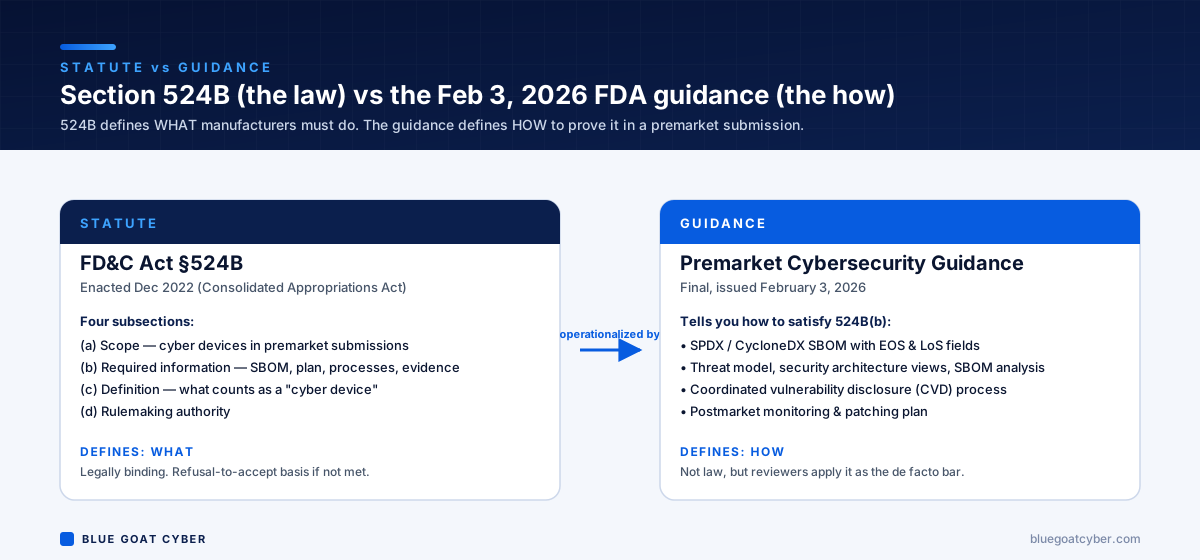
The guidance contains nonbinding recommendations. Section 524B of the FD&C Act imposes binding duties on covered cyber-device submissions. Manufacturers may use an alternative approach that satisfies applicable law. Distinguish missing statutory information from a disagreement about recommended evidence.
What is the difference between Section 524B and the FDA guidance?
Section 524B is the law (signed December 2022, with FDA RTA authority effective March 2023 and active enforcement beginning October 1, 2023). The 2026 guidance is the FDA's interpretation of how to meet Section 524B's core obligations (postmarket plan, secure design and patchability, SBOM). The guidance is broader than 524B: it covers devices with cybersecurity considerations generally, including ones that are not "cyber devices" under the statute (such as 510(k)-exempt devices, IDE, BLA, and IND submissions). Cyber devices under 524B are a subset of the devices the guidance covers. For how device cybersecurity content lands in a BLA or IND for combination products, see combination products in the FDA pathway cybersecurity guide.
Did the February 3, 2026 version change what 524B requires?
No. The substantive 524B obligations are unchanged from the September 2023 and June 2025 versions. The February 3, 2026 update is mainly alignment to QMSR: the QMSR final rule took effect February 2, 2026, amending 21 CFR Part 820 to incorporate ISO 13485:2016 requirements by reference while retaining FDA-specific requirements, which is why the guidance title shifted from "Quality System Considerations" to "Quality Management System Considerations." The 524B requirements, the SPDF expectation, the SBOM format, and the architecture-views structure carry through. New submissions should reference QMSR terminology and the Feb 3, 2026 guidance.
Which standards does the 2026 guidance reference?
Primarily AAMI SW96:2023, AAMI TIR57:2016 (R2023), AAMI TIR97:2019, IEC 81001-5-1, IEC 62304, NIST SP 800-218 (SSDF), and the NTIA minimum elements for SBOM (with CycloneDX or SPDX as common machine-readable formats).
Does the 2026 guidance apply to legacy devices?
The premarket guidance applies to new submissions. The 2016 postmarket guidance provides recommendations for fielded and legacy devices, with TIR97 as the standard reference for postmarket security risk management. Section 524B(c) defines a cyber device; it does not impose a blanket retrofit requirement on every previously marketed device.
Do I need an SBOM if my device doesn't connect to the internet?
Section 524B requires an SBOM for covered submissions only when all three cyber-device elements are met, including internet-connect capability. Direct connectivity is not the only possible connection path. Devices outside that definition may still need component information as recommended submission evidence; assess the device and pathway rather than assuming all wireless devices qualify.
How do I know if my device triggers Section 524B?
Use our free Cyber Device Applicability tool - it supports a preliminary review of the three Section 524B elements. The manufacturer must confirm the architecture, submission pathway, and applicable evidence.
Medical device cybersecurity services by FDA need
Match your situation to the service that covers it.
- Preparing a 510(k), De Novo, PMA, or IDE submission: FDA Premarket Cybersecurity Package
- Answering a refuse-to-accept, deficiency, or hold letter: FDA Cybersecurity Deficiency Response - 48-Hour Gap Analysis
- Penetration testing for a submission: Medical Device Penetration Testing for FDA Submissions
- Threat modeling and risk analysis: Medical Device Threat Modeling Services
- Building an SBOM: Medical Device SBOM Services for FDA Premarket Submissions
- Building security into design as a startup: Secure Product Development Framework (SPDF) Consulting
- Managing devices on the market: FDA Postmarket Cybersecurity Services for Medical Devices
- Ongoing vulnerability monitoring: Postmarket SBOM Monitoring & VEX Automation
- Protecting older devices: Legacy Medical Device Cybersecurity & Protection
- Common questions: Medical Device Cybersecurity FAQs
Where this fits
-
Pillar guide: The MedTech Cybersecurity Standards Decoder
-
Submission checklist: Premarket FDA Cybersecurity Submission Checklist
-
Standards comparison: AAMI TIR57 vs TIR97 vs SW96
-
SBOM deep dive: SBOM for Medical Devices
-
Postmarket plan: Postmarket Cybersecurity Readiness Plan
-
Service: FDA Premarket Cybersecurity Services
-
Premarket Cybersecurity Deliverables to eSTAR Map - which guidance artifact lands in which eSTAR section.
-
Premarket FDA Cybersecurity Submission Checklist - turn the guidance into a packing list.
-
FDA cybersecurity news and guidance tracker - every FDA guidance, rule, and draft with a short summary.
-
Medical device cybersecurity news - weekly updates on FDA changes and vulnerabilities.
-
FDA cybersecurity FAQ - short answers to the questions clients ask most.
Primary FDA sources
- Cybersecurity in Medical Devices: Quality Management System Considerations and Content of Premarket Submissions (February 2026 final)
- Section 524B of the Federal Food, Drug, and Cosmetic Act
- FDA Recognized Consensus Standards Database - search "SW96"
- Postmarket Management of Cybersecurity in Medical Devices (2016)
Sources & references
Primary sources cited in this article. Links open in a new tab.
- February 2026 final guidance- U.S. FDA
- CISA advisory ICSMA-19-178-01- CISA
- FDA letter to health care providers- U.S. FDA
- CISA advisory ICSMA-23-117-01- CISA
- FDA safety communication- U.S. FDA
- CISA alert- CISA
- FDA Recognized Consensus Standards Database - search "SW96"- U.S. FDA
- Postmarket Management of Cybersecurity in Medical Devices (2016)- U.S. FDA