

Published: March 3, 2024 · Last reviewed: May 1, 2026
Updated July 14, 2025
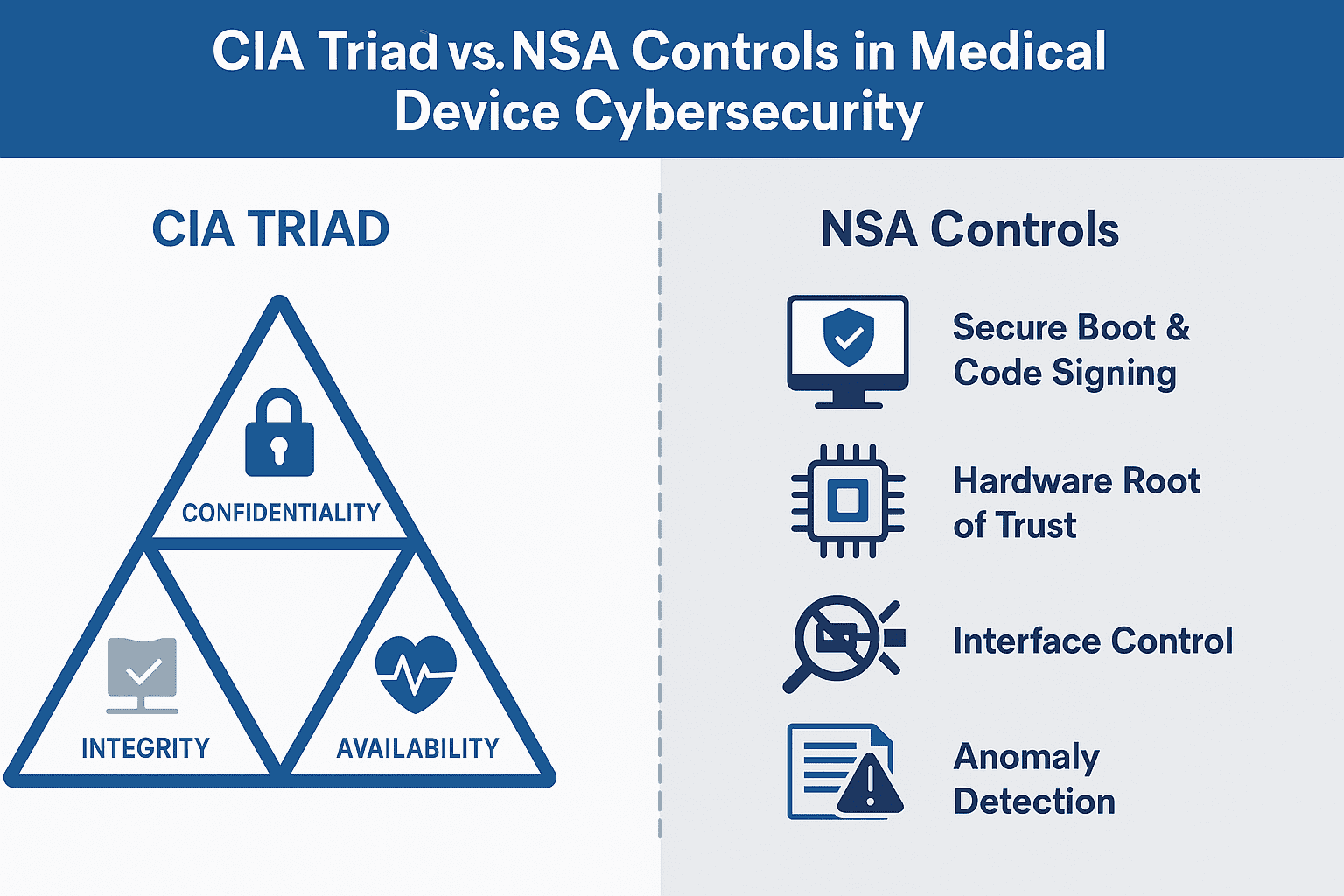
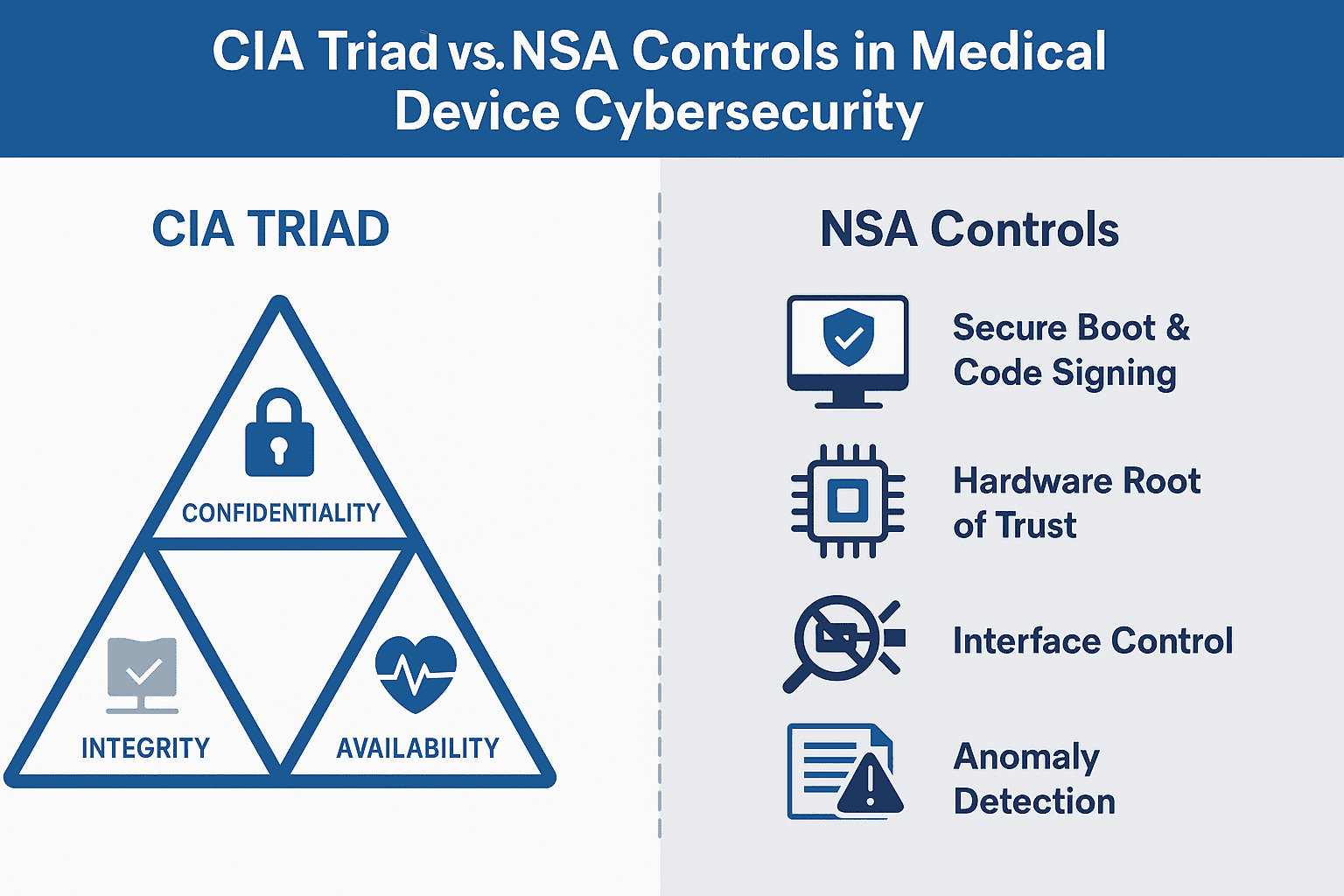
The CIA Triad (Confidentiality, Integrity, Availability) represents foundational information security objectives for medical devices, ensuring basic data protection and system operational continuity. NSA controls offer more granular, technical mitigation strategies, incorporating principles like zero trust and hardware-backed security, crucial for defending medical devices against sophisticated threats. Both frameworks are essential for establishing a strong security posture, meeting current regulatory requirements, and safeguarding patient well-being.
When it comes to securing medical devices, buzzwords like “CIA Triad” and “NSA recommendations” often get thrown around-but what do they really mean? More importantly, how do they apply to actual device design, software architecture, and regulatory approval?
This article breaks down the CIA Triad, examines the NSA’s cybersecurity principles, and explains how both are critical to developing safe, secure, and FDA-compliant medical devices.
Key Takeaways
- CIA Triad is a high-level security objective.
- NSA controls offer specific technical implementations.
- Both are critical for FDA compliance.
- NSA guidance enhances device resilience.
- Failure to implement both risks regulatory issues.
- Integrate controls throughout the development lifecycle.
Table of Contents
- Key Takeaways
- At a glance
- What Is the CIA Triad?
- NSA Controls and How They Extend the CIA Triad
- Why Both Frameworks Matter to Medical Device Manufacturers
- Case Study: Combining CIA and NSA Tactics
- Best Practices for Implementation
- Final Thoughts
Why this matters
Ignoring either the CIA Triad or NSA controls in medical device cybersecurity can lead to severe consequences, including patient harm, data breaches, regulatory non-compliance, and significant financial penalties. The FDA's 'Cybersecurity in Medical Devices' Final Guidance, dated February 3, 2026, emphasizes the critical need for manufacturers to integrate security throughout the total product lifecycle, necessitating adherence to both foundational principles and advanced technical safeguards. Failure to protect confidentiality could expose sensitive patient data, violating privacy regulations. Lack of integrity might allow unauthorized modification of device functions or data, leading to incorrect diagnoses or treatments. Inadequate availability could render essential medical devices inoperable during critical moments. NSA controls, which address threats like advanced persistent threats (APTs) and supply chain vulnerabilities, further underpin the security required by standards such as IEC 81001-5-1 and AAMI TIR97. Manufacturers must demonstrate due diligence in adopting a holistic security approach that combines the strategic objectives of the CIA Triad with the tactical implementations informed by NSA guidance to ensure product safety, efficacy, and regulatory approval.
At a glance
| Dimension | CIA Triad | NSA (CSI) Controls | | :--- | :--- | :--- | | Definition | Conceptual framework for Information Security (Confidentiality, Integrity, Availability). | Technical security principles and actionable mitigation strategies/best practices. | | Typical Use Case | Baseline architectural design and risk assessment for IoMT devices. | Hardening specific systems, network protocols, and cryptographic implementations. | | Range/Scope | High-level data and service protection objectives. | Defense-in-depth, zero-trust architecture, and technical configuration guidance. | | Security Posture | Focuses on organizational goals and data protection outcomes. | Focuses on proactive defense, incident response, and threat hunting. | | Common Attacks | Data breaches (C), tampering (I), and DoS/outages (A). | Advanced Persistent Threats (APTs), supply chain attacks, and lateral movement. | | FDA Relevance | Foundational requirement for Pre-Market Submissions (PMA/510k) and risk management. | Reference frameworks (e.g., NIST) often incorporate NSA-recommended cryptographic standards. | | Key Tradeoff | Simple to understand but lacks specific implementation instructions. | Highly technical and intensive to implement across legacy device fleets. |
What Is the CIA Triad?
The CIA Triad stands for:
- Confidentiality
Protect patient data-especially Protected Health Information (PHI)-from unauthorized access.
→ Example: Encrypt telemetry between an insulin pump and cloud platform using TLS 1.3.
- Integrity
Ensure data and firmware remain unaltered, whether stored or transmitted.
→ Example: Use signed firmware updates to prevent unauthorized code changes.
- Availability
Devices must be accessible and operational when needed.
→ Example: Ensure pacemakers or hospital ventilators aren’t vulnerable to Denial of Service (DoS) attacks.
These principles form the foundation of most cybersecurity frameworks, including the FDA’s premarket cybersecurity guidance.
NSA Controls and How They Extend the CIA Triad
The NSA’s cybersecurity recommendations go a step further. While they build upon the CIA Triad, they emphasize resilience, zero trust, and hardening-elements particularly valuable for safety-critical devices.
NSA-Aligned Cybersecurity Tactics for Medical Devices
- Secure Boot and Code Signing
Guarantee that only trusted firmware runs on your device.
- Hardware Root of Trust
Use a secure element or TPM to anchor trust at the silicon level.
- Interface Control
Disable or secure unused interfaces (e.g., UART, USB debug) that attackers could exploit.
- Anomaly Detection & Logging
Log authentication failures, unexpected inputs, or abnormal telemetry behavior for forensic analysis and postmarket surveillance.
- Encryption with Key Management
See also: Why Medical Device Cybersecurity Is Nothing Like Enterprise, How Can Medical Device Manufacturers Support Operational, and Navigating the Cybersecurity Landscape for MedTech.
Go beyond basic encryption-implement lifecycle-aware key rotation and storage in hardware-protected areas.
Why Both Frameworks Matter to Medical Device Manufacturers
- CIA Triad ensures the minimum baseline for data protection.
- NSA recommendations help future-proof devices against sophisticated and evolving threats.
- Both are baked into FDA expectations through the Secure Product Development Framework (SPDF), eSTAR templates, and postmarket guidance.
Failing to implement both sets of practices could mean:
- Submission delays
- Recall risks
- Cybersecurity deficiencies in FDA reviews
Case Study: Combining CIA and NSA Tactics
A Bluetooth-enabled cardiac monitor uses:
- Confidentiality: Encrypts all wireless communication
- Integrity: Applies signed firmware validation at boot
- Availability: Monitors battery voltage and wireless signal health to prevent unexpected shutdowns
- NSA Hardening: Disables unused debug ports, includes anomaly detection for telemetry variance, and enforces secure firmware update keys
Together, these practices strengthen the device’s security posture-and align it with both compliance and real-world resilience.
Best Practices for Implementation
- Map the CIA Triad to your product’s architecture.
- Review NSA control recommendations during early-stage threat modeling.
- Incorporate hardening and anomaly detection into your SPDF documentation.
- Validate implementation with firmware testing and penetration testing.
- Document controls clearly in your eSTAR cybersecurity section.
Final Thoughts
Securing medical devices isn’t just about ticking boxes. It’s about integrating proven cybersecurity principles-like the CIA Triad-and enhancing them with robust, real-world controls, such as those from the NSA.
For manufacturers, embracing both frameworks means better risk management, faster regulatory approvals, and most importantly, safer devices for patients.
Need Help Applying These Frameworks?
Blue Goat Cyber helps medical device manufacturers implement, document, and validate cybersecurity architectures that meet FDA, NSA, and global regulatory expectations.
👉 Schedule a consultation to audit your device against CIA and NSA-aligned security controls.
How Blue Goat approaches this
Blue Goat Cyber's approach to medical device cybersecurity integrates the strategic objectives of the CIA Triad with actionable, threat-informed NSA controls to build resilient devices. Our methodology involves a meticulous analysis of confidentiality, integrity, and availability requirements, translating them into specific architectural and implementation safeguards. We leverage our team's deep expertise, including credentials like CISSP and OSCP, and ex-military red team experience, to identify and mitigate vulnerabilities that might evade less rigorous assessments. We don't just identify risks; we engineer solutions aligned with regulatory expectations and real-world threat landscapes. Our services, including FDA premarket cybersecurity services, focus on proactive defense, secure-by-design principles, and continuous assurance. This structured approach ensures systems are inherently more secure. If the FDA raises cybersecurity deficiencies after our submission, we resolve them at no additional cost.
FAQ
What is the CIA Triad in medical device cybersecurity?
The CIA Triad stands for Confidentiality, Integrity, and Availability. These are foundational principles guiding information security, ensuring patient data privacy, preventing unauthorized data modification, and guaranteeing device functionality when needed.
How do NSA controls apply to medical device security?
NSA controls build on the CIA Triad by providing technical principles such as secure boot, hardware roots of trust, and strong encryption. These measures defend medical devices against sophisticated cyber threats and enhance overall resilience.
Does the FDA require both CIA Triad and NSA controls?
The FDA's premarket cybersecurity guidance expects manufacturers to implement strong security principles that encompass both the high-level objectives of the CIA Triad and the specific technical safeguards aligned with NSA recommendations, often through frameworks like NIST.
Why are secure boot and code signing important for medical devices?
Secure boot and code signing ensure that medical devices only execute trusted and untampered firmware. This prevents unauthorized software from running, protecting device integrity and patient safety as recommended by NSA-aligned practices.
What is a hardware root of trust?
A hardware root of trust is a dedicated, unchangeable hardware component, like a TPM or secure element, that serves as the foundation of trust for a device's security functions. It anchors the secure boot process and protects cryptographic keys.
How do these frameworks impact FDA submission timelines?
Thoroughly implementing and documenting cybersecurity controls derived from both the CIA Triad and NSA principles can streamline the FDA review process. Deficiencies in these areas can lead to significant delays in premarket submissions.
Related: The Rising Tide of Cyber Threats in Medical Devices: Understanding the Risks
About the author
Christian Espinosa, CISSP, Founder, Blue Goat Cyber. Christian leads a team focused exclusively on medical device cybersecurity for FDA premarket submissions and postmarket compliance. Read more about Christian.
Sources & references
Primary sources cited in this article. Links open in a new tab.
- FDA- U.S. FDA