
On this page
Published: · Updated:
Key Takeaways
- H-ISAC delivers sector-specific, TLP-coded threat intelligence and runs the Medical Device Security Council, the only working group focused on manufacturer-side concerns.
- CISA's KEV catalog and ICS advisories surface actively exploited vulnerabilities faster than NVD and are the FDA's de facto signal for what counts as an urgent postmarket risk.
- NVD and CVE.org are the baseline machine-readable feeds your SBOM monitoring tooling consumes, but they lag exploitation reality by days to weeks.
- MITRE ATT&CK for ICS and CAPEC give you the adversary technique vocabulary reviewers expect to see in threat models and postmarket plans.
- Upstream vendor PSIRTs (Linux kernel, OpenSSL, BusyBox, chipset vendors) are the only authoritative source for component vulnerabilities before they reach NVD.
- A defensible §524B(b)(1) plan names each source, the monitoring cadence, and the trigger criteria that move a finding into your CAPA or expedited update process.
Section 524B(b)(1) requires manufacturers to maintain a written postmarket monitoring plan naming their intelligence sources, review cadence, and responsible owners. For medical devices, that plan should include H-ISAC threat sharing, CISA KEV and ICS medical advisories, NVD and vendor advisories covering SBOM components, and coordinated disclosure intake generated by the manufacturer's own CVD policy, combined into one traceable, auditable process.
The FDA does not let manufacturers say "we monitor for threats" and stop there. Section 524B(b)(1) requires a written postmarket plan that names where you watch, how often, and who acts on what you find. Reviewers increasingly ask for that list by source, and a plan that only cites NVD draws deficiencies because NVD alone misses the sector-specific exploitation chatter that hits health delivery organizations first.
The Health Information Sharing and Analysis Center (H-ISAC) is the anchor most mature programs build around, but it is one feed in a stack. This guide walks through the authoritative sources, what each one actually delivers, and how to wire them into your SBOM and vulnerability management workflow without drowning the team.
Why this matters
The FDA's February 3, 2026 final premarket cybersecurity guidance ties premarket approval to a credible postmarket monitoring plan, and Section 524B(b)(1) of the Federal Food, Drug, and Cosmetic Act makes that plan a statutory obligation for cyber devices. Reviewers want named sources, not "industry feeds." A 2024 CISA fact sheet on the healthcare and public health sector notes the sector is among the most-targeted critical infrastructure verticals, and CISA's Known Exploited Vulnerabilities catalog is the operational signal federal agencies use to prioritize remediation. AAMI TIR97 explicitly calls for documented threat intelligence inputs to postmarket security risk management, and IEC 81001-5-1 §9.4 ties continued monitoring to the secure development lifecycle. A submission that lists only NVD as the monitoring source ignores all of this and reads, to a reviewer, as a paper exercise.
What is H-ISAC and what does it deliver?
The Health Information Sharing and Analysis Center is the sector ISAC for healthcare, serving the healthcare sector; Presidential Policy Directive 21 was superseded by National Security Memorandum 22 in 2024. Membership is paid and tiered, and the value is in what the public feeds do not show: pre-disclosure indicators, TLP:AMBER and TLP:RED briefings, peer-to-peer incident sharing, and the Medical Device Security Council (MDSC), a working group focused specifically on manufacturer obligations.
For device manufacturers, the high-value outputs are the Daily Cyber Headlines and Threat Bulletins, the monthly Hacking Healthcare report, and MDSC working sessions where peers discuss in-the-wild exploitation against medical equipment before CVEs are public. H-ISAC also operates a 24x7 Threat Operations Center that members can query directly.
If your postmarket plan claims to monitor "industry threat sharing," reviewers expect a named ISAC. For healthcare devices, that is H-ISAC. Naming it, and documenting that you triage its bulletins on a defined cadence, is the cleanest way to satisfy the sharing-and-coordination expectation in the FDA's 2026 guidance.
What does CISA provide that H-ISAC does not?
CISA is the federal operational arm for critical infrastructure cybersecurity, and three of its feeds are non-negotiable for medical device monitoring.
The Known Exploited Vulnerabilities catalog lists CVEs with confirmed active exploitation in the wild. The FDA treats KEV listings as a strong indicator that a vulnerability warrants out-of-cycle patching under §524B(b)(2)(B). If a component in your SBOM appears in KEV, you have a clock running.
CISA's ICS Advisories (formerly ICS-CERT) are where the vast majority of medical device CVEs are formally disclosed, often co-authored with the FDA and the manufacturer. Subscribing to the ICS advisory feed catches device-specific disclosures that never appear in the general CISA bulletin.
CISA also publishes Binding Operational Directives and sector-specific alerts that, while not binding on manufacturers, telegraph what the federal government considers urgent and frequently foreshadow FDA Safety Communications.
Where do NVD, CVE.org, and MITRE fit?
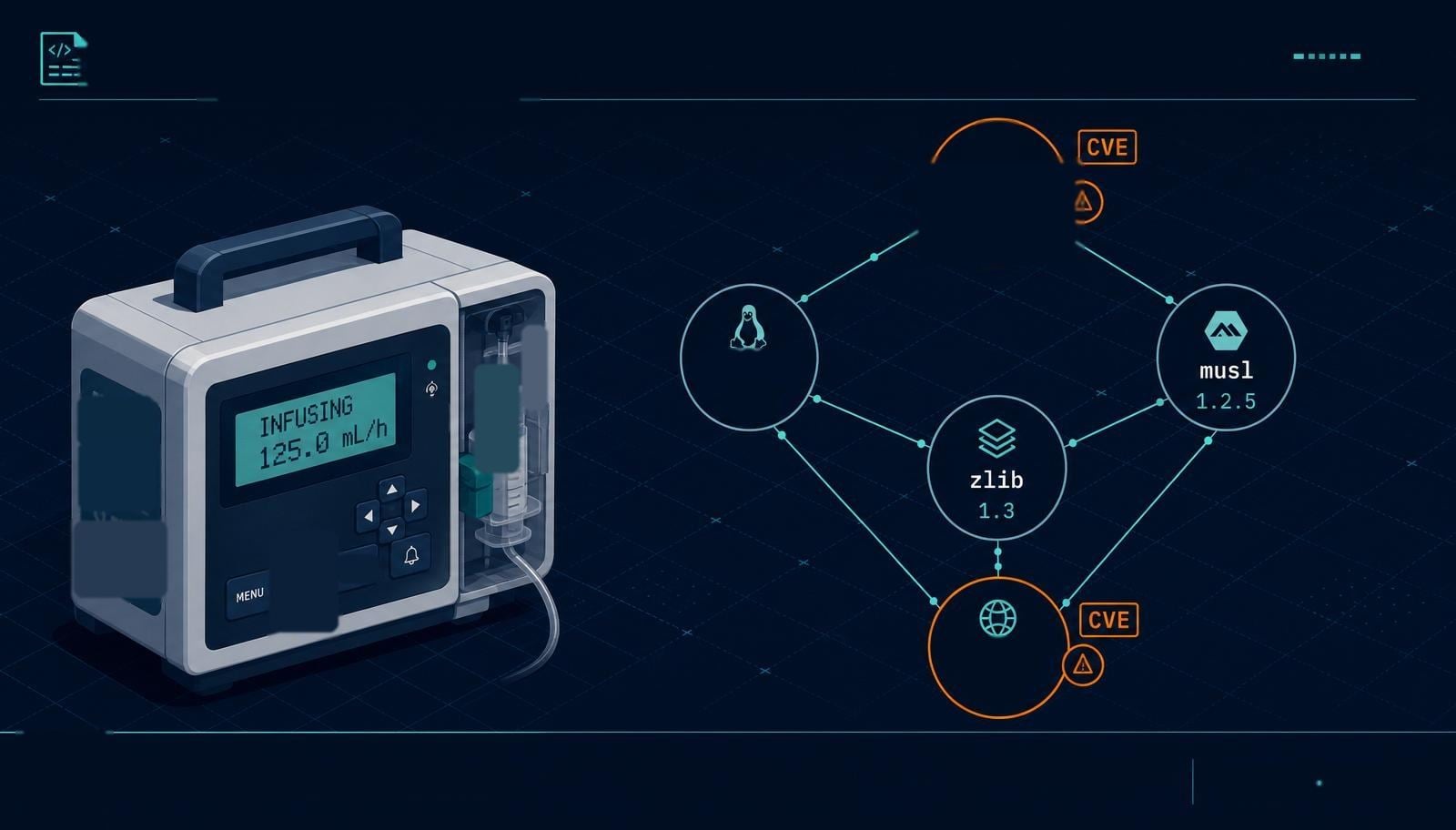
These are the baseline machine-readable feeds that automated SBOM monitoring tooling (Dependency-Track, OWASP DC, commercial SCA) consumes.
| Source | What it gives you | What it does not |
|---|---|---|
| NVD | CVSS scores, CPE matching, CWE mapping | Lags CVE publication; no exploitation signal |
| CVE.org | Authoritative CVE records as published by CNAs | No scoring, no exploitation context |
| MITRE ATT&CK for ICS | Adversary technique taxonomy reviewers expect in threat models | Not a vulnerability feed |
| MITRE CWE | Weakness taxonomy used in IEC 81001-5-1 traceability | Not exploitable findings |
| MITRE CAPEC | Attack pattern catalog used in threat enumeration | Not real-time |
NVD is necessary but not sufficient. Treat it as the SBOM correlation feed and pair it with KEV for prioritization and H-ISAC for sector context.
Which vendor and community sources matter for medical devices?
The components in your SBOM are disclosed by their owners first and reach NVD second. If you only watch NVD, you are days or weeks behind.
- Linux kernel security mailing list and distribution PSIRTs (Red Hat, Debian, Yocto) for the OS layer
- OpenSSL Security Advisories and BusyBox project notices for ubiquitous embedded components
- Chipset and SoC vendor PSIRTs (NXP, STMicro, Qualcomm, Intel) for firmware-level disclosures
- Open Source Vulnerabilities (OSV.dev) for a normalized cross-ecosystem feed
- FDA Medical Device Safety Communications at fda.gov for device-specific alerts the agency issues directly
- MAUDE for adverse event reports that may indicate cyber-related malfunction patterns
- Your own Coordinated Vulnerability Disclosure intake - required under §524B(b)(1), and one of the highest-quality intelligence sources you will ever operate because the reports come pre-targeted to your product
Map each component class in your SBOM to a named upstream source. "We watch upstream vendors" without enumeration is the most common §524B(b)(3) deficiency pattern we see.
How should these feeds map to your §524B postmarket plan?
See also: Medical Device Incident Response Plan, 510(k) Cleared, No Postmarket Cybersecurity: Legal?, and FDA PCCP Beyond AI: Cybersecurity & Firmware Uses.
A defensible plan has four columns for every source: what feed, who owns it, what cadence, and what triggers action. A minimal worked example:
Source              Owner          Cadence      Trigger
H-ISAC bulletins    Security PM    Daily        TLP:AMBER+ on device class
CISA KEV            SBOM tooling   Continuous   Any SBOM component listed
CISA ICS adv.       Security PM    Daily        Any advisory naming our class
NVD (via SCA)       SBOM tooling   Continuous   CVSS >= 7 on SBOM component
Vendor PSIRTs       Eng leads      Per release  Any advisory on shipped version
CVD intake          PSIRT          Real-time    Any valid report
Triggers should route to either your CAPA system, your expedited out-of-cycle update process under §524B(b)(2)(B), or your acknowledged risk register, with the routing decision documented per finding. Reviewers ask for evidence of the process, not the queue.
Talk to our team about a §524B postmarket plan review - we'll benchmark your current source list against what the FDA is currently flagging in deficiency letters.
How Blue Goat approaches threat intelligence integration
We build postmarket monitoring plans the way reviewers grade them: by source, cadence, and trigger. Our team holds CISSP and OSCP credentials, includes ex-military red team operators, and works exclusively on medical device cybersecurity. We map every component class in your SBOM to a named authoritative source, write the trigger logic into your QMSR procedures, and tie the routing into your CAPA system so a KEV listing or H-ISAC bulletin produces a documented decision, not an email thread.
Where clients lack H-ISAC membership, we help build the business case and document the interim compensating sources. Learn more at Postmarket SBOM and optional VEX Monitoring. If the FDA raises a cybersecurity question, we answer it at no extra cost until the cybersecurity portion is closed.
FAQ
What is H-ISAC and do medical device manufacturers need to join?
H-ISAC is the Health Information Sharing and Analysis Center, the federally-recognized ISAC for healthcare. Manufacturers are not required by statute to join, but the FDA's 2026 guidance points to ISAC participation as evidence of credible sharing and coordination, and H-ISAC's Medical Device Security Council is the only working group focused on manufacturer obligations.
Is CISA KEV the same as NVD?
No. NVD catalogs all CVEs with CVSS scores. KEV is a curated subset of vulnerabilities with confirmed in-the-wild exploitation. KEV is the prioritization signal; NVD is the baseline catalog. A vulnerability can sit at CVSS 6.5 in NVD and still warrant emergency patching if it lands in KEV.
Where are most medical device CVEs disclosed?
The majority of medical device CVEs are published through CISA's ICS Advisories feed, typically co-authored by CISA, the FDA, and the manufacturer. Subscribing to that specific feed catches device disclosures the general CISA bulletin omits.
Does monitoring NVD alone satisfy §524B(b)(1)?
No. NVD lags exploitation reality and provides no sector context. A plan that names only NVD reads as a paper exercise and routinely draws deficiencies. Add H-ISAC, CISA KEV, CISA ICS advisories, and upstream vendor PSIRTs at minimum.
How often should we review threat intelligence feeds?
Automated feeds (NVD via SCA, KEV) run continuously. Human-curated sources (H-ISAC bulletins, ICS advisories) should be triaged daily by a named owner. Monthly cadence is too slow and is a common deficiency pattern reviewers cite.
What is the role of vendor PSIRTs?
Upstream component owners disclose vulnerabilities to their security advisory channels before records reach NVD. For SBOM components like the Linux kernel, OpenSSL, or chipset firmware, the PSIRT is the authoritative first source and the only way to catch issues in time for an out-of-cycle update decision.
Ready to harden your postmarket monitoring?
Schedule a discovery session to map your SBOM to a named-source monitoring plan that holds up under FDA scrutiny. If the FDA raises a cybersecurity question, we answer it at no extra cost until the cybersecurity portion is closed.
About the author

Christian Espinosa, MBA · Founder & CEO, Blue Goat Cyber
U.S. Air Force Academy graduate and veteran with 30+ years in cybersecurity. Founded Alpine Security in 2014 (acquired 2020), then Blue Goat Cyber in 2022. Blue Goat track record: 275+ FDA submissions supported, zero cybersecurity rejections. Author of three books including The Smartest Person in the Room. Ironman triathlete and mountaineer.
Sources & references
Primary sources cited in this article. Links open in a new tab.
- CISA fact sheet on the healthcare and public health sector- CISA
- Known Exploited Vulnerabilities catalog- CISA
- ICS Advisories- CISA
- NVD- NIST
- CVE.org- CVE.org
- MITRE ATT&CK for ICS- MITRE
- MITRE CWE- MITRE
- MITRE CAPEC- MITRE
- fda.gov- U.S. FDA