
On this page

Published: · Updated:
Key Takeaways
- Reviewers expect full-attack-surface coverage: firmware, hardware interfaces, wireless, mobile companion app, APIs, and cloud backend.
- White-box is the default. Reviewers explicitly expect testers to use source code, threat models, and architecture documentation.
- Reviewer-ready testing produces a traceable Test Plan, Test Cases, and Test Report.
- Scope depth differs by pathway: 510(k) maps to the predicate, De Novo and PMA require architectural justification, IDE focuses on study-subject safety.
- Write the scope statement before testing starts and attach it to the report, with explicit exclusions and rationale.
What should a medical device penetration test cover for the FDA?
Scope FDA penetration testing across the full attack surface (firmware, hardware interfaces, wireless, mobile companion app, APIs, and cloud backend) using a justified, risk-based approach informed by the threat model and architecture documentation, with source access where appropriate, then document tester independence, scope, duration, methods, findings, and retest evidence in the Test Plan, Test Cases, and Test Report.
Penetration testing is where a cybersecurity submission is either believed or doubted. The technical work is rarely the problem. What draws deficiencies is scope: an interface nobody tested, a mobile app assessed without source, a cloud backend covered by a scanner, or a report with no statement of what was and was not exercised. This guide covers how to scope the engagement, how depth differs by submission pathway, and what a reviewer-ready report has to contain.
This guide assumes you already know what a medical device penetration test is. If you do not, start with Penetration Testing for Medical Devices: A 2026 Explainer, which covers the four FDA-expected test categories and how a pen test differs from a scan, a threat model, and a red team. This guide picks up from there and deals only with scope.
What "full attack surface" means
The the FDA's February 2026 final premarket cybersecurity guidance expects the test report to demonstrate coverage of every interface a threat actor could reach. In practice, that means six distinct test domains.
| Domain | What must be exercised | Common reference |
|---|---|---|
| Firmware | Secure boot, debug interfaces (JTAG/SWD/UART), update integrity, key storage, runtime integrity | OWASP IoT Top 10 |
| Hardware | Chip-level attack surface, side channels, fault injection where relevant to the threat model | Threat-model driven |
| Wireless | BLE, Wi-Fi, cellular, NFC, proprietary RF. Pairing, encryption, GATT permissions, rogue-AP scenarios | NIST SP 800-115 |
| Mobile companion app | iOS and Android storage, transport, IPC, biometric handling, jailbreak/root checks | OWASP MASVS |
| APIs | REST/GraphQL authn, authz, IDOR, mass assignment, rate limiting, BAA-relevant logging | OWASP API Security Top 10 |
| Cloud backend | Tenancy isolation, IAM configuration, key management, logging integrity, data export paths | OWASP ASVS |
White-box vs black-box: why white-box wins for FDA
The 2026 guidance says reviewers expect testers to use source code, threat models, and architecture documentation. That is white-box testing by definition. Black-box testing simulates an external attacker but consistently misses logic flaws in firmware update validation, key management, secure boot, and inter-component trust assumptions - exactly the controls that matter for patient safety. Default to white-box for premarket, reserve black-box for adversary-simulation scenarios after clearance.
Scope by submission pathway
| Pathway | Coverage expected | What changes the scope | Where the evidence lands |
|---|---|---|---|
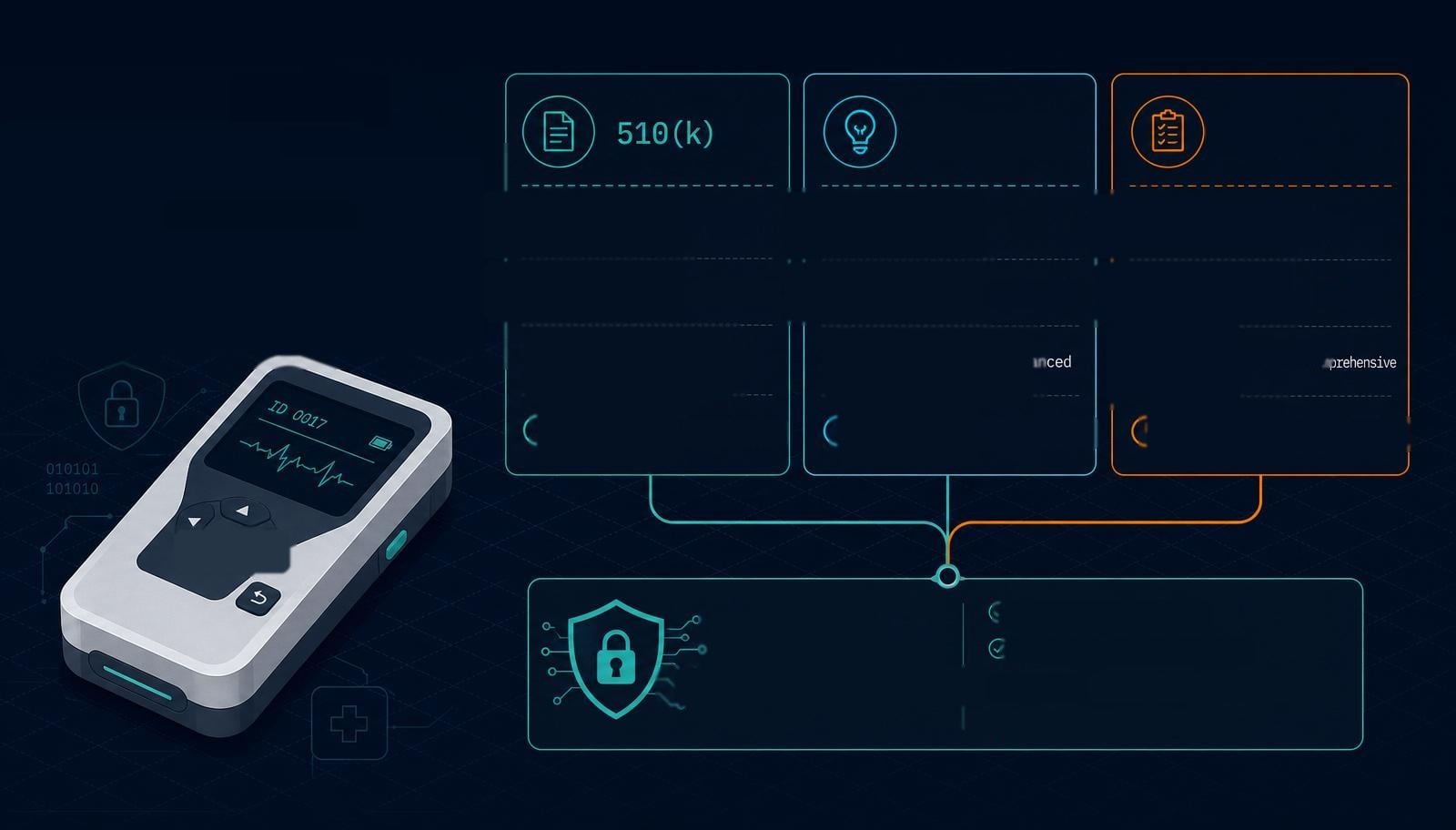
| 510(k) | Full attack surface, white-box | Comparison to the predicate's cybersecurity attack surface | Cybersecurity section of the eSTAR submission |
| De Novo | Full attack surface, white-box | Architectural justification, since there is no predicate | Security architecture of the classification request |
| PMA | Full attack surface, white-box, deepest documentation | Traceability into the design history file and safety risk file | DHF, security risk assessment, ISO 14971 file |
| IDE | Scoped to study-subject risk | Sufficiency of compensating controls in the clinical environment | IDE application risk analysis |
510(k)
Full attack surface, white-box. Test plan should explicitly compare the cybersecurity attack surface to the predicate device, especially where you have added connectivity, mobile, or cloud beyond the predicate's footprint. Reviewers cite 'predicate divergence not addressed' often.
De Novo
Full attack surface, white-box, plus an architectural-justification section because there is no predicate. The pen test report should map findings against the security architecture you proposed in the De Novo classification request.
PMA
Deepest documentation requirement. Pen test evidence flows into the design history file with full traceability. PMA reviewers frequently coordinate with non-cyber reviewers (risk management, human factors) so the pen test report should be cross-referenced from the security risk assessment and the ISO 14971 risk file.
IDE
Scope focuses on whether unresolved cybersecurity risks could expose study subjects to unreasonable risk under 21 CFR 812.42. Validate clinical risk controls through appropriate development testing. The February 2026 guidance does not establish a universal pre-enrollment penetration-testing gate; for IDE submissions, testing could be helpful but is not specifically recommended, subject to device-specific recommendations and requests. See FDA IDE Cybersecurity Requirements for Connected Investigational Devices (2026) for the full application picture.
The three testing deliverables
FDA penetration testing does not need a letter of attestation. The Test Plan defines scope and methods before testing, the Test Cases link execution to threats and security requirements, and the Test Report documents tester independence and expertise, scope, duration, methods, findings, and retest results.
What a reviewer-ready report contains
The scope decisions above only matter if the report makes them visible. These six elements are what a reviewer uses to judge whether the scope was adequate:
- Executive summary with risk-rated findings and references to the Test Plan and Test Cases.
- Methodology section documenting white-box approach, tools, and standards (NIST SP 800-115, OWASP MASVS, OWASP ASVS, OWASP API Security Top 10).
- Attack surface inventory with coverage notes per interface, including anything tested with limitations and why.
- Findings written with severity (CVSS + clinical impact under ISO 14971), reproduction steps, evidence (screenshots, packet captures, code references), remediation, status.
- Traceability appendix linking findings back to threat-model entries.
- Tester independence and expertise, test duration, and documented retest results.
For the full anatomy of a credible deliverable, including how findings should be written and what separates a submission-ready report from a generic IT-security one, see what a credible pen-test deliverable contains.
Scope mistakes that get cited
- Mobile app tested but not in source-used white-box mode (jailbreak detection bypassed in 30 minutes during reviewer follow-up).
- Cloud testing limited to OWASP API Top 10 scan - no tenancy or IAM validation.
- Wireless tested in protocol stack only, not at the radio layer.
- Firmware tested via released binary - secure boot and key storage not exercised.
- No documented scope, exclusions, or basis for tester independence in the Test Report.
Writing the scope statement so it survives review
The scope statement is the first thing a reviewer reads in your test report and the most common place a package loses credibility. A weak statement names a product ("the XYZ System"); a strong one enumerates targets, versions, and access levels.
A workable structure:
- Targets, individually named. Firmware version and build ID, mobile app versions for each platform, cloud API endpoints and environment, service and debug interfaces, wireless protocols in use, and any hardware interfaces physically accessible on the device.
- Access level per target. Whether testers had source, credentials, design documents, and hardware samples. State the number of physical units provided; hardware attacks that require destructive analysis are impossible with a single loaner.
- Explicit exclusions with rationale. Anything not tested, and why. An exclusion with a reason is a scoping decision. An exclusion discovered by the reviewer is a gap.
- Traceability to the threat model. The scope should reference the threat IDs the test was designed to exercise, which is what turns a generic security assessment into evidence for this submission.
Depth of evidence, not just breadth
Reviewers increasingly distinguish between a scan and a test. Automated vulnerability scanning, fuzzing, and static analysis are separate expectations from penetration testing, and a report that presents scanner output as penetration testing draws a deficiency for missing manual assessment.
What manual testing looks like in the report: attack narratives with the steps taken, the observed behavior, and the evidence captured; attempts that failed and why they failed, because negative results are how a reviewer knows a control was actually exercised; and reproduction detail sufficient for your own engineers to replicate the finding.
The most useful section in a mature report is the one describing controls that held. "Attempted firmware downgrade to v1.8 via the update channel; rejected by rollback protection with signature version check; see evidence 4.3" does more for a submission than five informational findings.
Independence, and what it actually requires
The guidance expects testing independent of the design team. Independence is not only about hiring an outside firm. An internal team can qualify if it does not report to engineering leadership, did not participate in design decisions, and has authority to publish findings without design-team approval. Document which arrangement you used and how independence is preserved, because reviewers ask when the tester shares a company name with the manufacturer.
Retesting matters as much as the original test. When findings are remediated, a focused retest of those findings, documented separately, is what closes the loop. A remediation table with no retest evidence leaves the reviewer with your word for it.
How Blue Goat Cyber approaches FDA penetration testing scope
We scope from the interface inventory and the threat model, not from a price sheet. The engagement is built so the report reads as submission evidence rather than a generic security assessment.
- Scope statement written before testing. Targets, versions, access levels, and explicit exclusions with rationale, agreed in writing and attached to the final report.
- White-box by default. Source code, architecture documentation, and the threat model are inputs to the test plan, as our company practice, not a universal source-access requirement in the February 2026 guidance.
- Threat-model traceability. Every test maps to a threat ID, so a reviewer can trace a claim in the submission to the test that exercised it.
- Manual testing, documented as narratives. Attack paths attempted, what happened, and the controls that held, with evidence. Scanner output is reported separately as vulnerability testing, never presented as penetration testing.
- Retest included. High and critical findings are retested after remediation and the retest is documented in the same report.
- Three traceable deliverables. Test Plan, Test Cases, and Test Report documenting scope, methodology, standards, and remediation status.
Our Medical Device Penetration Testing engagement is the entry point, with BLE & RF, firmware, and cloud backend work scoped in as the attack surface requires.
Frequently asked questions
Where to go next
Scoping is where penetration testing budgets are won or lost. A test scoped too narrowly produces a clean report that a reviewer does not believe. A test scoped without reference to the threat model produces findings nobody can tie to a claim. Both cost more than getting the scope right the first time.
Start from the interface inventory, not the price. List every way data or commands enter and leave the system: wireless radios, physical ports, the mobile application, the cloud API, the clinician portal, the update channel, the service and diagnostic interface, and any hardware debug path that ships enabled. For each one, decide tested, not tested, or tested with limitations, and write the reason. That table becomes your scope statement, and it is the single artifact reviewers use to judge whether your testing was adequate.
Then match depth to the interface. A BLE pairing implementation needs radio-level testing with real hardware, not a protocol review. Firmware needs extraction and analysis, including a look for hardcoded credentials, debug interfaces, and signature verification on the update path. A cloud backend handling PHI needs authenticated and unauthenticated testing plus authorization boundary work between tenants. Applying the same generic web-application methodology to all of them is the most common way a report ends up looking thin.
Sequence testing so remediation fits. Findings arrive, get fixed, and get retested, and the retest has to appear in the final report. Teams that book a single test window with no retest budget end up filing a report with open findings and a promise, which invites questions.
Establish independence explicitly. The tester should not be the person who wrote the code being tested, and the report should state the basis for that separation. Internal teams can satisfy this if the organizational separation is real and documented.
Finally, write the scope statement before testing begins and attach it to the report. A scope agreed after results exist always reads that way.
- Medical Device Penetration Testing Service - full-system manual testing scoped from your threat model, with remediation retest included.
- BLE & RF Penetration Testing - radio-level work on pairing, key handling, and traffic protection for wireless devices.
- Firmware Penetration Testing - extraction, binary analysis, secure boot and update chain verification.
- PHI Cloud Backend Penetration Testing - API authorization, tenant isolation, and data protection testing for the backend the device talks to.
- Submission Pathway Selector - work out whether the device fits 510(k), De Novo, or PMA.
Sources & references
Primary sources cited in this article. Links open in a new tab.
- the FDA's February 2026 final premarket cybersecurity guidance- U.S. FDA
- OWASP IoT Top 10- OWASP
- NIST SP 800-115- NIST
- OWASP MASVS- OWASP
- OWASP API Security Top 10- OWASP
- OWASP ASVS- OWASP
- ISO 14971- ISO