


Published: February 24, 2024 · Last reviewed: May 1, 2026
Steganography in medical devices involves concealing malicious data within seemingly innocuous files or transmissions, such as firmware updates or imaging data (e.g., DICOM). This technique disguises the presence of hidden code, allowing attackers to inject backdoors, exfiltrate protected health information (PHI), or alter device functions without triggering standard security alerts, making detection challenging for manufacturers. It exploits the fact that encryption obscures content, but steganography obscures its very existence.
Most medical device manufacturers understand the risk of malware, ransomware, or unsecured APIs-but a more insidious threat often flies under the radar: steganography. Unlike traditional exploits, steganography doesn’t break into systems overtly. Instead, it hides malicious code or data inside normal-looking files or transmissions, making detection extremely difficult.
In this post, we explore how attackers could use steganography to infiltrate connected medical devices, compromise patient safety, and evade traditional security controls-and what manufacturers can do to stay ahead.
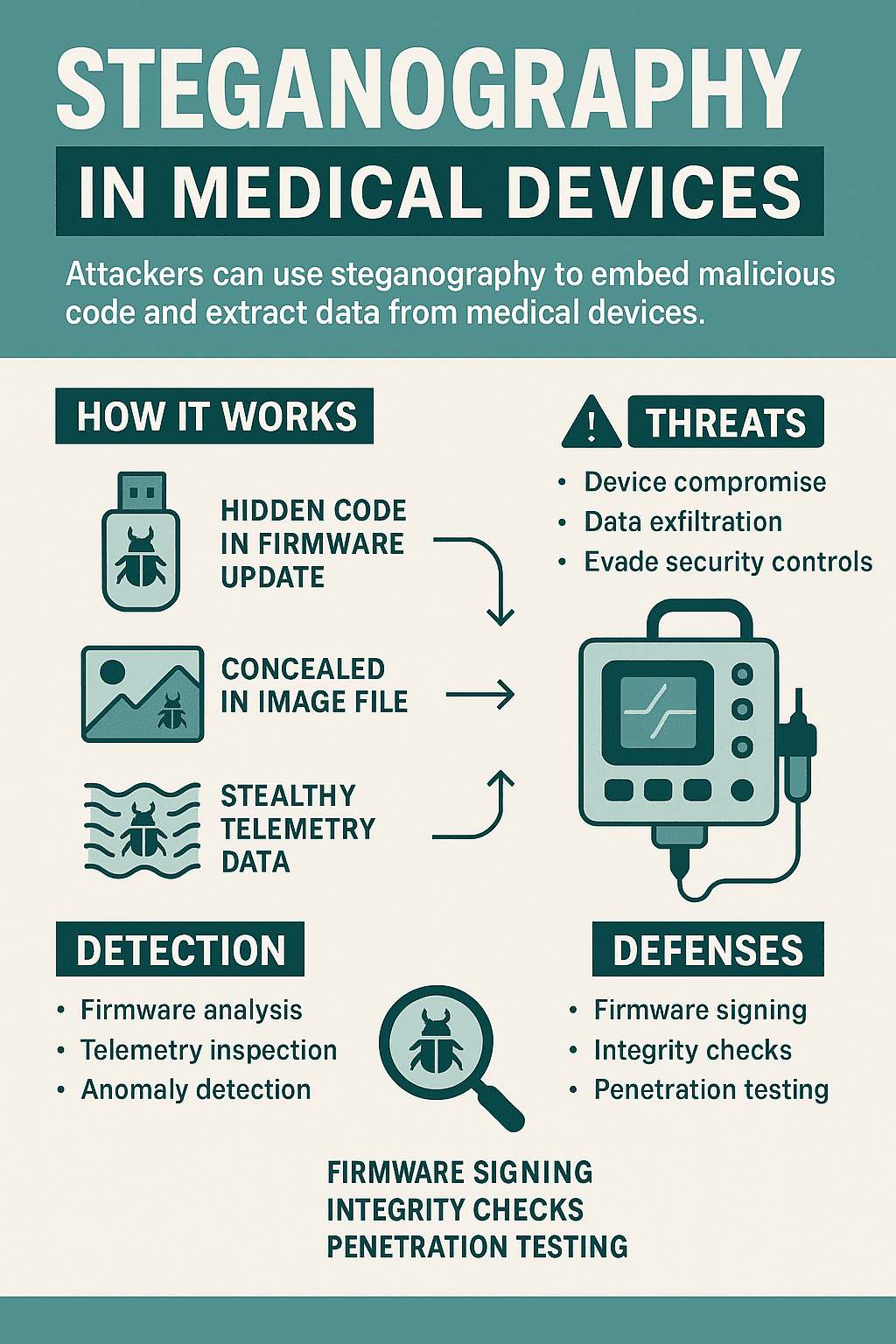
Key Takeaways
- Steganography hides data within ordinary files, making detection difficult.
- Attackers can use steganography to infiltrate medical devices.
- Detection involves binary comparison and anomaly monitoring.
- Defenses include signed firmware and integrity checks.
- The FDA expects steganography to be addressed in risk assessments.
- Consider covert channel testing in pen testing.
Table of Contents
- Key Takeaways
- What Is Steganography in Cybersecurity?
- How Steganography Targets Medical Devices
- Detection & Defense: How to Secure Your Devices
- FDA Compliance: Why It Matters
- Final Thoughts
Why This Matters
Steganography - hiding data or executable payloads inside otherwise legitimate files such as DICOM images, firmware blobs, or configuration archives - is one of the easiest threat vectors to underestimate in a medical-device threat model. The FDA's February 3, 2026 final premarket cybersecurity guidance expects manufacturers to enumerate threats against every interface that can carry attacker-controlled data, including imaging interfaces (DICOM, HL7 attachments) and the device's update channel. A threat model that does not address covert-channel and steganographic payloads in those interfaces is incomplete on its face.
CISA and the HHS Health Sector Cybersecurity Coordination Center (HC3) have both published advisories on adversaries embedding malicious payloads in DICOM headers (the so-called "PE-in-DICOM" pattern documented since 2019), and on update-channel abuse where attackers smuggle code through firmware images that pass naive signature checks. Each of these is a real, in-the-wild pattern - not a theoretical one - and reviewers increasingly expect to see them addressed in the security risk file.
The standards stack reviewers expect here is AAMI SW96 (FDA Recognized Consensus Standard 13-122) for security risk management, IEC 81001-5-1 for the secure software lifecycle, ISO 14971 for the risk file, and the NEMA PS3 / DICOM standard for handling of imaging objects. Steganographic threats have to be traceable across all of them.
What Is Steganography in Cybersecurity?
Steganography is the practice of hiding information inside other non-suspicious data. While encryption disguises content, steganography disguises the presence of content itself.
📦 Common Steganographic Techniques:
- Embedding code in image files (e.g., PNG, JPEG, DICOM)
- Hiding payloads in audio, video, or waveform files
- Inserting commands or identifiers in metadata fields
- Concealing scripts in firmware update binaries
In the context of medical devices, these techniques can be used to:
- Inject backdoors during firmware updates
- Steal protected health information (PHI) without triggering alerts
- Alter or spoof telemetry data
How Steganography Targets Medical Devices
Connected medical devices are ideal targets due to their:
- Regular use of firmware and software updates
- Constant streaming of patient telemetry
- Integration with imaging systems and PACS
- API-driven cloud reporting systems
Let’s examine specific attack vectors:
🛠️ Firmware Modification
Attackers embed hidden instructions in firmware binaries. Since these updates often bypass deep inspection, malicious code can reside undetected for long periods.
Example: A rogue update file for a surgical robot contains a few extra kilobytes-hiding a beacon that connects the device to a command-and-control server.
📤 Data Exfiltration via Telemetry or Imaging
Data embedded in standard device telemetry, such as waveform packets, or inside diagnostic imaging files (DICOM), allows attackers to smuggle patient data past monitoring systems.
Example: A compromised device encodes stolen patient info inside image metadata and uploads it to a legitimate PACS.
🕳️ Hidden Command Channels
See also: When to Hire a Device Security Consultant vs. Build In-House, Cybersecurity Is Now a QMS Requirement, and Why Medical Device Cybersecurity Is Nothing Like Enterprise.
Attackers may encode signals in wireless transmissions or telemetry headers. These covert commands can trigger specific behaviors (e.g., deactivate alerts, delay logs) without detection.
Example: An attacker sends a subtle variation in Bluetooth signal patterns to activate hidden routines in a cloned device.
Detection & Defense: How to Secure Your Devices
🔎 Detection Strategies
- Use binary comparison tools to analyze firmware for hidden bytecode
- Monitor image, telemetry, and metadata anomalies
- Employ machine learning models to flag abnormal packet patterns
🛡️ Defense Mechanisms
- Sign and hash all firmware and update packages
- Implement secure boot and run-time integrity checks
- Limit metadata exposure and sanitize inputs/outputs
- Include covert channel and cloning simulation in your pen testing
FDA Compliance: Why It Matters
The FDA’s 2025 Cybersecurity Guidance requires manufacturers to:
- Address integrity and authenticity of all software and communication pathways
- Include supply chain verification of firmware and software
- Validate defenses in the Secure Product Development Framework (SPDF)
If you fail to account for steganographic or covert channel risks in your threat modeling, SBOM, or cybersecurity documentation, your submission could face deficiencies or postmarket scrutiny.
How Blue Goat approaches this
Blue Goat Cyber's approach to thwarting steganography in medical devices is grounded. Our team, comprised of certified experts (CISSP, OSCP, ex-military red team), focuses on deep analysis and specialized testing. We scrutinize device firmware, software, and communication protocols for subtle anomalies indicative of hidden data.
Our service includes binary comparison, entropy analysis, and anomaly detection in data streams to uncover covert channels that steganography might exploit. We implement secure design principles from concept to post-market surveillance. Our penetration testing services, particularly focused on covert channel analysis, are designed to expose vulnerabilities often overlooked by generic security assessments. We ensure your devices meet stringent security requirements before and after market release. If the FDA raises cybersecurity deficiencies after our submission, we resolve them at no additional cost. Learn more about our specialized penetration testing at Medical Device Penetration Testing.
FAQ
Q: Is steganography used in real attacks today?
A: Yes. Nation-state actors and cybercriminals use steganography in espionage and APTs. Healthcare is a top target.
Q: What devices are most at risk?
A: Devices with OTA updates, telemetry, or cloud-linked diagnostics-such as monitors, insulin pumps, or imaging hardware.
Q: Can these threats be detected in regulatory testing?
A: Only if explicitly tested for. Standard scans and validations often overlook hidden payloads unless steganography is included in test plans.
Final Thoughts
Medical devices face increasingly sophisticated attacks-and steganography is one of the most difficult to detect. If your device can receive updates, send data, or interact with cloud services, it may already be a target.
Addressing this threat isn’t optional. It’s essential for protecting patients, meeting FDA expectations, and building lasting trust in your product.
Blue Goat Cyber: Pen Testing for the Hidden Threats Others Miss
We simulate advanced attack vectors-including steganography and covert channels-as part of our medical device cybersecurity assessments. Whether you’re preparing an FDA submission or hardening your postmarket defenses, we help you uncover what’s hidden.
👉 Schedule a cybersecurity consultation today.
About the author
Christian Espinosa, CISSP, Founder, Blue Goat Cyber. Christian leads a team focused exclusively on medical device cybersecurity for FDA premarket submissions and postmarket compliance. Read more about Christian.
Sources & references
Primary sources cited in this article. Links open in a new tab.
- FDA’s 2025 Cybersecurity Guidance- U.S. FDA