
On this page

Published:
Key Takeaways
- CWE describes a category of weakness; CVE identifies a specific disclosed vulnerability in a named product or version.
- Findings from manufacturer source code usually carry a CWE, while third-party component vulnerabilities usually carry a CVE.
- A CVE record often references one or more CWEs that describe its root cause.
- Neither a CWE number nor a published CVSS score is a device-specific risk rating.
- FDA submission evidence ties each identifier to device context, risk reasoning, remediation status, and verification.
What is the difference between CWE and CVE for medical device cybersecurity?
CWE (Common Weakness Enumeration) names a type of software or hardware weakness. CVE (Common Vulnerabilities and Exposures) identifies one specific, publicly disclosed vulnerability in a named product or version. In medical device work, CWE usually classifies weaknesses confirmed in the manufacturer's own code, and CVE usually identifies known vulnerabilities in third-party components listed in the SBOM. Neither identifier sets device risk; the manufacturer's risk assessment does.
Reviewed October 23, 2026.
Both identifiers are maintained under MITRE programs and appear throughout security reports, SBOM vulnerability assessments, and premarket cybersecurity documentation. They answer different questions. CWE asks "what kind of mistake is this?" CVE asks "which known, published vulnerability is this?"
Why this matters
Mixing the two identifiers causes real problems in submissions. A test report that lists CWE numbers as if they were known vulnerabilities, or an SBOM assessment that treats a published CVSS score as the device rating, invites reviewer questions. Using each identifier for its job keeps findings traceable from discovery through remediation and into the submission.
CWE vs CVE at a glance
| CWE | CVE | |
|---|---|---|
| What it identifies | A weakness type | One disclosed vulnerability |
| Example | CWE-798, Use of Hard-coded Credentials | A CVE ID for a flaw in a specific library version |
| Tied to a product? | No | Yes, a named product and affected versions |
| Typical source in device work | SAST review, code review, penetration testing | SBOM component monitoring, vendor advisories |
| Carries a score? | No | Records often include a published CVSS score |
How CWE supports findings
When a SAST review or penetration test confirms a weakness in manufacturer code, the finding is classified with the most specific CWE that fits. The CWE gives developers a shared vocabulary, links to known fix patterns, and lets the manufacturer spot repeated weakness types across releases.
A CWE does not say how serious the weakness is on a given device. An out-of-bounds write in an unreachable test routine and the same weakness in a network-facing parser share a CWE but not a risk. The finding record carries the device-specific reasoning separately.
How CVE supports findings
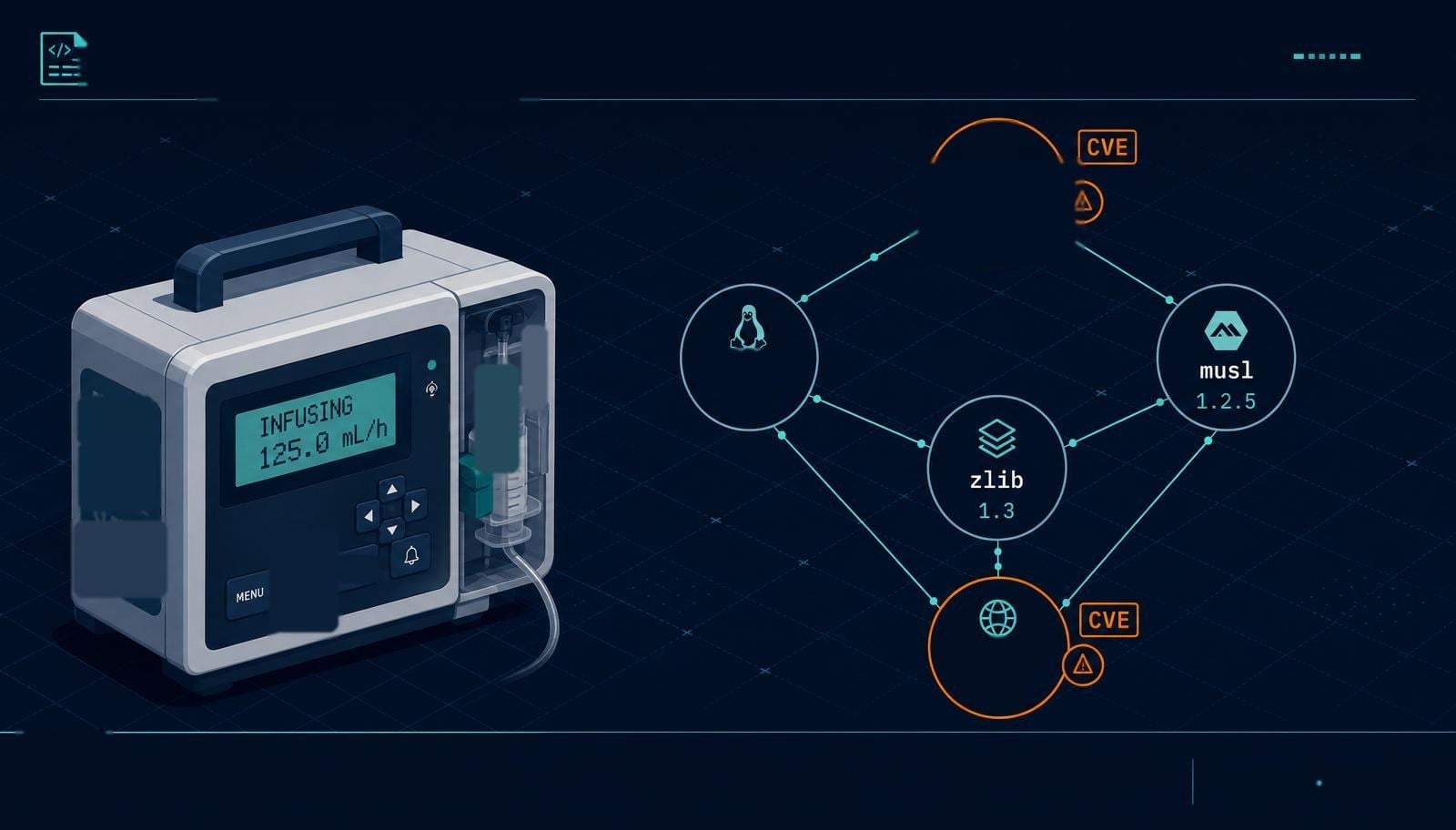
A CVE applies when a component in the device, usually third-party or open-source software, matches a published vulnerability record. Matching starts with an accurate SBOM: component names, versions, and identifiers such as PURL or CPE. Our SBOM verification workflow checks the SBOM against shipped software before the match is trusted.
A matched CVE is a candidate, not a confirmed device vulnerability. The assessment records whether the affected code is present, reachable, and exploitable in the device configuration. A published CVSS score describes the vulnerability in general; it is recorded but is not the device risk rating.
Many CVE records reference a CWE describing the root cause. That link helps connect a component vulnerability to the same remediation patterns used for first-party findings.
Remediation
- CWE-classified findings: the manufacturer changes its code. Remediation guidance addresses the weakness pattern, not only the single line flagged, and the fix is retested.
- CVE-identified vulnerabilities: the usual options are updating or patching the component, removing it, or adding compensating controls where an update is not available. The manufacturer documents the decision and its rationale.
- Both: a clean rescan alone does not prove a fix works. Retest evidence and any unresolved items are recorded, and the manufacturer owns risk acceptance and release.
FDA submission evidence
The FDA's premarket cybersecurity guidance recommends that submissions include an SBOM with an assessment of known vulnerabilities in its components, and security testing results such as static analysis and penetration testing. In practice:
- CVE identifiers appear in the vulnerability assessment that accompanies the SBOM, with each item's applicability, risk reasoning, and remediation or control status.
- CWE identifiers appear in testing reports and unresolved-anomaly records, classifying confirmed weaknesses and their resolution.
- Both feed the security risk assessment, where the manufacturer evaluates exploitability and impact for the specific device. See our risk scoring methodology for how this fits together.
Identifiers make evidence traceable. They do not replace the reasoning a reviewer looks for: why the item applies or does not, what the risk is, and what was done about it.
How Blue Goat approaches this
In our SAST reviews, every confirmed weakness carries the most specific CWE that fits, device-specific risk reasoning, remediation guidance, and retest results. In SBOM work, we verify the SBOM against shipped software before matching components to CVEs, then record whether each match applies to the device. Scores come from our risk scoring methodology, not from the identifier alone. The manufacturer owns fixes, risk acceptance, and release. See our FDA premarket cybersecurity services.
FAQ
Can one issue have both a CWE and a CVE?
Yes. A published vulnerability in a library is identified by its CVE, and the CVE record often names a CWE for its root cause.
Do weaknesses found in our own code get a CVE?
Not automatically. A CVE is assigned when a vulnerability is publicly disclosed through the CVE program, for example through coordinated disclosure after release. Internal findings before release are normally tracked by CWE and the manufacturer's own finding ID.
Does a high CVSS score on a CVE mean high device risk?
No. The published score describes the vulnerability in general. Device risk depends on whether the code is present and reachable, the device's exposure, and the potential impact, assessed by the manufacturer.
- SAST review: confirmed findings, CWE, remediation, and retesting
- SBOM verification before delivery
- SBOM requirements and formats
- CPE vs PURL for medical device SBOMs
- Medical device penetration testing
Talk to us about your findings and SBOM evidence.
About the author
Christian Espinosa, Founder, Blue Goat Cyber. Christian leads a team focused exclusively on medical device cybersecurity for FDA premarket submissions and postmarket compliance. Read more about Christian.
Sources and boundaries
- MITRE Common Weakness Enumeration and CVE Program.
- FDA, Cybersecurity in Medical Devices: Quality System Considerations and Content of Premarket Submissions, February 3, 2026. Recommendations in this guidance are not statutory requirements unless they restate one.
- This page explains general practice. It does not determine risk for any specific device.
Sources & references
Primary sources cited in this article. Links open in a new tab.
- MITRE Common Weakness Enumeration- MITRE
- CVE Program- CVE.org