On this page

Key Takeaways
- eSTAR v7.0 expands the cybersecurity section to align with the Feb 2026 final premarket guidance, new prompts cover SBOM machine-readability, CVD policy, and postmarket monitoring cadence.
- v7 splits the security risk assessment attachment from the threat model attachment, so uploading them as a single PDF now fails the technical screen.
- Postmarket cybersecurity management plan is a required attachment in v7; in v6 it was frequently embedded in the SPDF narrative and accepted.
- v7 introduces explicit fields for third-party component vulnerability disclosure processes, align these to AAMI TIR97 language.
- Any submission drafted against v6 after October 1, 2026 must be migrated to v7 or it will be returned before review.
An honest, template-level diff of FDA eSTAR v6.2 and v7.0 for cybersecurity content: what the new template actually adds, the August 3, 2026 retirement date, and what's guidance expectation vs. template-enforced.
On June 1, 2026 the FDA released eSTAR v7.0 (nIVD and IVD) and PreSTAR v3.0; v6.2 - the prior Updated Version - will be retired on August 3, 2026. If you read other write-ups, you may see claims that v7.0 introduced "8 named cybersecurity attachment slots", a "Metrics slot", or required "Architecture Views" fields. That overstates what the template actually does. We diffed the two templates field-by-field. This is the honest version.
Last reviewed: June 2026 against the FDA eSTAR Program page, the v6.2 and v7.0 nIVD eSTAR PDFs, and the FDA February 2026 final guidance.
Source documents
The two PDFs below are the recommended starting point. They contain only the cybersecurity portions of each eSTAR template - every non-cyber section (clinical, biocompatibility, sterility, labeling logistics, etc.) has been stripped out, and the remaining content is grouped into clearly named buckets (Overview, Threat Modeling, SBOM, Security Controls, Testing, Patching, Risk Assessment, Labeling, Interoperability, Standards). Both open directly in any browser.
- nIVD eSTAR v6.2 - Cybersecurity Section (readable extract, PDF) - cyber-only content from the retiring v6.2 template, grouped by topic.
- nIVD eSTAR v7.0 - Cybersecurity Section (readable extract, PDF) - cyber-only content from the current v7.0 template, grouped by topic.
If you need the surrounding template (every section, not just cyber) or the official files for filing, the long-form sources are still available:
- Cybersecurity structural diff - v6.2 vs v7.0 (PDF) - the side-by-side subform diff (the new
Controlschild in v7.0, the Digital Health Resources bullet change, etc.). - FDA nIVD eSTAR v6.2 - original XFA PDF and v7.0 - the official FDA templates. Required for actual filing; only Adobe Reader/Acrobat will render them.
Cybersecurity section at a glance
Each card below summarizes one cybersecurity topic area inside the eSTAR template - what reviewers expect, and whether v7.0 actually changed anything at the template level versus v6.2. Jump to a card:
Controls free-text field inside the Cybersecurity subform for an inline summary.Cybersecurity | Metrics label exists in both; no new dedicated KPI field added in v7.0.Cybersecurity | Change Impacts and | Level of Support labels in both; captions unchanged.The headline
| Dimension | eSTAR v6.2 | eSTAR v7.0 |
|---|---|---|
| Status | Retiring August 3, 2026 | Updated Version (current) |
| Released | Earlier 2026 | June 1, 2026 |
| Submission types | 510(k), De Novo, PMA (nIVD and IVD) | 510(k), De Novo, PMA (nIVD and IVD) |
| Cybersecurity subform structure | Cybersecurity (single block) |
Cybersecurity → Controls (new nested child with one text field) |
| Digital Health Resources list | "…Software as a Medical Device; and Cybersecurity." | "…Cloud Computing; Cybersecurity and Interoperability, and; Wireless Technologies." |
| Human Factors content | Pre-May 2026 guidance | Incorporates May 29, 2026 Human Factors Content Guidance (effective Aug 1, 2026) |
| FDA Recognized Consensus Standards list | Pre-2026 refresh | Updated 2025/2026 entries (e.g. AAMI CR515:2025 ML cybersecurity) |
What we verified by diffing the templates
We extracted the XFA form definitions from both nIVD eSTAR PDFs and compared them directly. The actual changes inside the Cybersecurity area are:
- New
Controlschild subform inside Cybersecurity. v6.2 has<subform name="Cybersecurity"/>followed by a sibling<subform name="Interoperability"/>. v7.0 nests a newControlsblock inside Cybersecurity containing one new free-text field. In practice this is a place to describe security controls inline rather than only via attachment. - Digital Health Resources bullet list reorganized. The list that used to end "Software as a Medical Device; and Cybersecurity." is now broader and pairs Cybersecurity with Interoperability ("Cybersecurity and Interoperability, and; Wireless Technologies."), and adds MMA, SaMD, AI/ML, MDDS, CDS, and Cloud Computing as explicit categories.
- Recognized Consensus Standards list refreshed. v7.0 updates several cybersecurity-relevant standards entries (for example AAMI CR515:2025 on ML cybersecurity, IEEE 11073-40101/40102 vulnerability assessment and mitigation entries reformatted). These are dropdown list updates, not new question fields.
That is the full template-level cybersecurity diff between v6.2 and v7.0.
What did not change at the template level
- The Cybersecurity section is not broken into 8 named attachment slots in v7.0. There is one Cybersecurity subform with attachments, the same packaging model as v6.2.
- There is no new Metrics field dedicated to postmarket KPIs.
- There is no Architecture Views field.
- There is no separate VEX upload field next to the SBOM.
- AAMI SW96:2023 is not explicitly named in a template caption as the required risk-management standard.
These are all reasonable expectations under the FDA's February 3, 2026 final premarket cybersecurity guidance - but they live in the guidance, not in v7.0 template fields. Submissions get held when those expectations aren't met regardless of whether the template asks for them.
What did change outside the Cybersecurity subform
These v7.0 changes still affect cybersecurity teams even though they are not in the Cybersecurity section:
- Human Factors subsection added to Performance Testing. Cybersecurity-relevant human-factors content (usable authentication, alarm/notification handling, secure-update UX) now has a home in the Performance Testing section per the May 29, 2026 Human Factors Content Guidance (effective August 1, 2026).
- Standards / Additional Information ordering adjusted in several sections, including Cybersecurity-adjacent ones.
- PMA Facility Information added (relevant if your cybersecurity package is going into a PMA).
- Adobe-specific rendering bug fix so attachments behave more consistently - useful when you have many cybersecurity attachments.
Transition timing
- v7.0 released: June 1, 2026
- v6.2 retirement date: August 3, 2026
- After August 3, 2026, v6.2 submissions are still accepted but the FDA says they may draw additional information requests for content covered by v7.0 changes
- Grandfathering: once you receive an FDA acknowledgment letter, your submission is locked to the eSTAR version you submitted on. AI and Technical Screening responses must use that same version
Should you refile?
| Scenario | Recommendation |
|---|---|
| Submission already acknowledged on v6.2 | Do not refile. Grandfathered to v6.2. Respond to deficiencies in the v6.2 template. |
| Drafted on v6.2, not yet submitted before Aug 3 | Migrate to v7.0 unless you can file in days. The new Controls free-text field is trivial to populate, and the Recognized Standards list is fresher. |
| New submission starting now | Use v7.0. |
| In RTA hold on v6.2 | Resolve on v6.2. The submission is grandfathered. |
| AI or Technical Screening response on v6.2 | Must respond on v6.2. |
Cybersecurity migration checklist (v6.2 → v7.0)
If you are moving an in-progress v6.2 package to v7.0:
- Populate the new Controls free-text field inside the Cybersecurity subform with a one-paragraph summary of your security-controls attachment (auth, crypto, patch/update, logging) so reviewers see the map inline.
- Re-check Recognized Consensus Standards selections. Some cybersecurity-relevant entries were refreshed in v7.0 - re-pick your standards in the new dropdowns rather than carrying over assumed values.
- Move any human-factors content that touches authentication, alarms, or secure-update UX into the new Performance Testing → Human Factors subsection and reference it from your cybersecurity controls write-up.
- Keep your attachment package intact. v7.0 did not change the Cybersecurity attachment slot - your existing Management Plan, Security Risk file, Threat Model, SBOM, Controls, Testing, and Postmarket Plan attachments all still go in the same place.
- Build to the Feb 2026 guidance, not just to the template. The template will let you submit a thin package; the guidance is what reviewers grade against.
How Blue Goat Cyber approaches the v6.2 to v7.0 migration
We migrate active submissions from eSTAR v6.2 to v7.0 as a fixed-fee, two-week engagement. Your existing cybersecurity artifacts get re-mapped to the v7.0 subform fields, gaps are flagged against the February 3, 2026 final guidance, and the updated package ships back ready to attach. If the FDA raises cybersecurity deficiencies after our submission, we resolve them at no additional cost.
For teams starting a new v7.0 submission from scratch, our FDA premarket cybersecurity service authors the full package to the v7.0 template.
Frequently asked questions
Is eSTAR v7.0 mandatory now?
The FDA has published v7.0 as the current template and expects new submissions to use it. Submissions authored on v6.2 are still accepted through the FDA's stated transition window, but net-new packages should be built on v7.0. Confirm the current mandatory date in the FDA's eSTAR resource page before finalizing your submission plan.
Do the cybersecurity artifacts themselves change between v6.2 and v7.0?
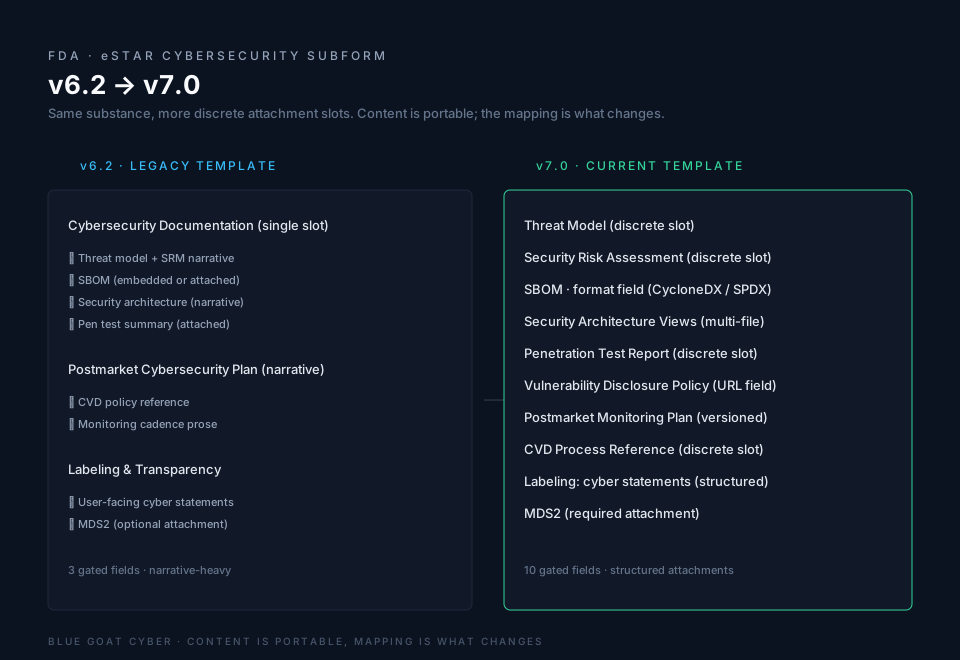
The underlying artifacts (threat model, SBOM, security risk assessment, pen test report, postmarket monitoring plan) do not change in substance. What changes is how they are attached and cross-referenced inside the eSTAR subform. Content built to the February 2026 guidance is portable across versions; the mapping just needs re-work.
Will content built for v6.2 be rejected if we submit on v7.0?
Not for content reasons, but the v7.0 subform expects specific attachments in specific slots. If your v6.2-era package uses a single monolithic cybersecurity document, v7.0 will require you to split it into the discrete files the new subform expects. Otherwise the RTA screen will hold the submission on missing subform entries.
How long does a v6.2 to v7.0 migration typically take?
Two to four weeks for a submission with a complete v6.2-era package. Most of the time goes into re-splitting the security risk assessment, threat model, and SBOM into the specific attachment slots v7.0 expects, plus updating labeling and MDS2 references. Migrations that also require closing 2026-guidance gaps take longer.
Does v7.0 require anything new that was not in v6.2 at all?
Yes on emphasis, not on substance. v7.0 explicitly surfaces fields for SBOM format (CycloneDX vs SPDX), vulnerability disclosure policy URL, and postmarket monitoring plan version, all of which were expected under v6.2 but not always required as discrete fields. If those were embedded in narrative in a v6.2 package, they need to be pulled out.
Should we resubmit a cleared v6.2 device to bring it onto v7.0?
No. eSTAR version applies to new submissions and material changes. A cleared device does not need to be resubmitted just because the template updated. Your postmarket cybersecurity obligations under Section 524B(b)(2) run against the current guidance regardless of which template your original submission used.
Where to go next
- For our recommended packaging of the 15 February 2026 guidance deliverables into the eSTAR Cybersecurity attachment area, see the eSTAR v7.0 Cybersecurity Attachments mapping guide.
- For the underlying guidance, see The FDA's February 2026 Premarket Cybersecurity Guidance, Summarized.
- For an RTA-prevention walkthrough, see the FDA cybersecurity RTA prevention checklist.
- For the Management Plan deliverable, see the Cybersecurity Management Plan guide.
Need help migrating an in-flight v6.2 package to v7.0? Talk to Blue Goat Cyber - we resolve any FDA cybersecurity deficiency raised on a submission we authored, at no additional cost.
References
Primary sources cited or relied on in this guide:
- eSTAR Program (FDA), U.S. FDA
- Cybersecurity in Medical Devices: Quality System Considerations and Content of Premarket Submissions (Feb 2026 final), U.S. FDA
- Section 524B of the FD&C Act (Consolidated Appropriations Act, 2023, §3305), U.S. Congress
- ANSI/AAMI SW96:2023, Standard for Medical Device Security, AAMI/ANSI
Sources & references
Primary sources cited in this article. Links open in a new tab.