On this page

Published: · Updated:
Key Takeaways
- Section 524B(b)(1) requires a plan including CVD and related procedures for covered cyber-device submissions; the February 2026 guidance provides nonbinding recommendations.
- A public VDP URL, safe-harbor terms, and response targets are recommended program design choices, not individually prescribed by Section 524B.
- Align to ISO/IEC 29147:2018 (disclosure) and ISO/IEC 30111:2019 (handling), both are cited by FDA and AAMI TIR97.
- The CVD process must feed the postmarket monitoring loop and the patch-delivery cadence.
- Devices without a public CVD channel are frequently reported directly to the FDA or CISA, escalating scrutiny.
What does a medical device vulnerability disclosure program need?
Section 524B(b)(1) requires a plan to monitor, identify, and address postmarket vulnerabilities and exploits, including coordinated vulnerability disclosure. A public VDP URL, safe-harbor language, and response SLAs are recommended implementation choices, not separate statutory requirements. ISO/IEC 29147:2018 and ISO/IEC 30111:2019 provide disclosure and handling guidance.
A practical, ungated guide to standing up a Vulnerability Disclosure Program (VDP) and a Coordinated Vulnerability Disclosure (CVD) workflow that satisfies the FDA's February 2026 premarket cybersecurity guidance, aligns to ISO/IEC 29147 (vulnerability disclosure) and ISO/IEC 30111 (vulnerability handling), and actually works for a small MedTech security team.
The workflow and SLA examples below are recommendations, not mandatory conformance to ISO standards. A 30-day target is illustrative, not a safe waiting period: address critical vulnerabilities with uncontrolled risk as soon as possible out of cycle, and communicate urgent mitigation advice before a patch when needed. Publish security.txt at /.well-known/security.txt in accordance with RFC 9116.
VDP vs. CVD - they are not the same thing
These two terms get used interchangeably. They should not be.
- VDP (Vulnerability Disclosure Program) is the external-facing policy: how researchers and customers report a vulnerability to you, what they can expect in return, what is in scope, what is out of scope, and what safe-harbor protections you offer. It lives on a public URL.
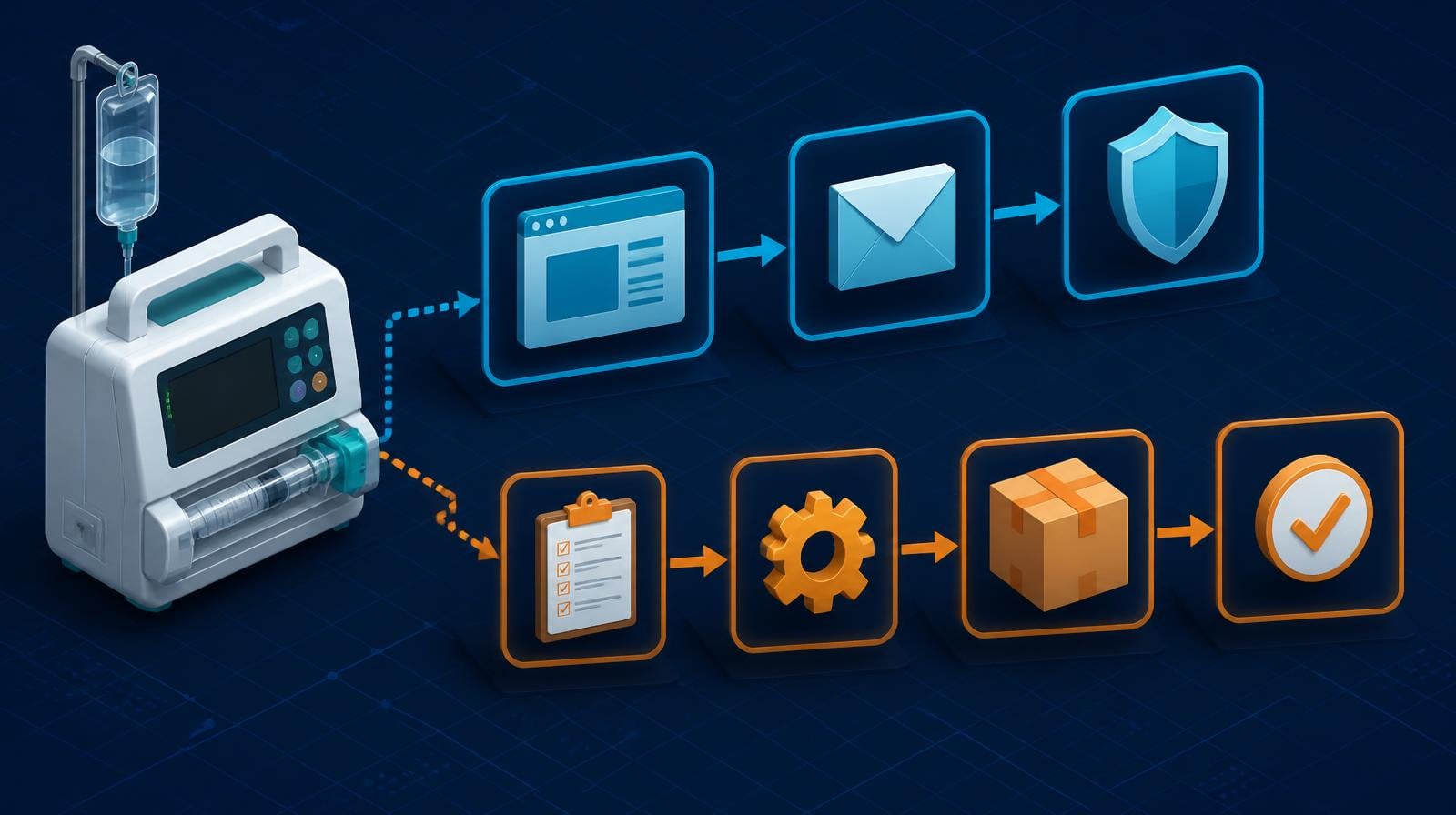
- CVD (Coordinated Vulnerability Disclosure) is the internal workflow: triage, ownership, risk assessment, fix development, validated patching, customer communication, and (when appropriate) public disclosure - coordinated with the reporter and any affected third parties.
A VDP without a CVD workflow is a 404-in-waiting. A CVD workflow without a VDP gives no one a way in.
Section 524B requires the postmarket plan, including coordinated vulnerability disclosure. The FDA’s February 3, 2026 guidance provides nonbinding implementation recommendations; it does not make every VDP design choice a statutory obligation.
Statutory CVD duty and implementation choices
Section 524B(b)(1) requires a plan including CVD and related procedures for covered cyber-device submissions. The following are recommended implementation choices, not individually prescribed statutory requirements:
- A published CVD policy at a stable URL, referenced from device labeling.
- An intake mechanism (email, web form, or both) that does not require an account to submit.
- Acknowledgment of reports within a defined window.
- A triage and response workflow that ties vulnerabilities back to your SBOM, security risk file, and postmarket cybersecurity plan.
- Validated patch deployment with signature, integrity, and rollback, the same mechanism evaluated in the premarket submission.
- Customer communication for vulnerabilities that meaningfully affect safety, performance, or security posture.
Gaps may prompt questions; adequacy depends on the device, evidence, and applicable requirements. See our FDA Cybersecurity Deficiency Letter Examples for the exact phrasing reviewers use.
The reference VDP policy (use this as a starting point)
The published policy should cover, at minimum:
- Scope - which products, firmware versions, mobile apps, cloud endpoints, and APIs are in scope.
- Out of scope - corporate IT systems, marketing sites, physical security, social engineering, denial-of-service against production patient-facing endpoints.
- Submission channel - email alias (e.g.
cvd@yourcompany.com) and/or a web form that does not require account creation. - Information requested - device model, firmware version, reproduction steps, impact, evidence (logs, screenshots, PoC), reporter contact.
- Safe harbor - commitment not to pursue legal action against good-faith research that stays within scope and avoids patient harm.
- Coordination model - your default disclosure timeline (e.g. 90 days), willingness to credit reporters, and how you handle disagreements.
- Reference standards - ISO/IEC 29147 and 30111, plus CISA's Coordinated Vulnerability Disclosure Process.
The CVD workflow (eight stages)
-
Intake. Report arrives via email or form. Auto-acknowledge within 1 business day with a tracking ID.
-
Triage. Security on-call assigns severity using CVSS v4.0 and patient-safety impact. Open a tracking record linked to the affected SKU, firmware version, and SBOM entries.
-
Validation. Reproduce in a controlled environment. If non-reproducible, request additional information from the reporter. Document the negative result if validation fails.
-
Risk assessment. Map the vulnerability to your ISO 14971 risk file and your security risk assessment. Update exploitability-to-harm. If the vulnerability changes residual risk, the change goes through QMS change control.
-
Fix development. Engineering owns the patch. Security pairs on the threat model update. Verification includes regression testing and, for safety-critical fixes, a targeted re-test from your penetration testing partner.
-
Validated patching. Patch deploys through the same validated update mechanism evaluated in the premarket submission (signature, integrity, atomic install, rollback). Document the deployment in the postmarket cybersecurity plan.
-
Customer communication. For vulnerabilities affecting safety, performance, or security posture: a security bulletin / advisory goes out to affected customers. Use VEX to communicate the status to downstream SBOM consumers.
-
Disclosure & closure. Coordinate public disclosure timing with the reporter (if applicable). Close the tracking record with: root cause, fix description, affected versions, and any standards (NVD CVE, CISA KEV) referenced. Update the SBOM and security risk file.
A reference SLA model
Most MedTech teams cannot run a 24-hour SOC. They do not need to. They need predictable SLAs scaled to severity.
| Severity | Acknowledge | Validate | Patch / Mitigate | Customer Comms |
|---|---|---|---|---|
| Critical (active patient harm path) | 1 business day | 5 business days | 30 days | Immediate mitigation advice as needed; coordinated patch advisory |
| High | 1 business day | 10 business days | 90 days | Earlier mitigation advice as needed; patch advisory at release |
| Medium | 3 business days | 20 business days | Next scheduled release | Release notes |
| Low | 5 business days | 30 business days | Next scheduled release | Release notes |
Publish the SLAs in the CVD policy. Reviewers look for them; reporters trust you more when they exist.
How VDP / CVD ties into the rest of the SPDF
A working CVD workflow is downstream of the rest of the Secure Product Development Framework:
- SBOM tells you which component a CVE affects.
- Threat model tells you whether the affected component is exposed at a trust boundary that matters.
- Security risk file tells you whether the new vulnerability changes residual risk.
- Validated update mechanism is how the fix actually reaches devices in the field.
- Postmarket cybersecurity plan is the operational umbrella that all of the above lives under.
Teams that try to bolt a CVD program onto a device that lacks one or more of those pieces end up with a policy URL and no workflow behind it. That is the failure mode FDA flags hardest.
The most common deficiencies (and how to avoid them)
-
Policy URL 404s or redirects. Use a stable URL. Test it monthly.
-
No safe harbor language. Security researchers will not engage with you if a good-faith report could expose them to legal risk.
-
No defined SLAs. "We will respond as quickly as possible" is not an SLA. Use the table above.
-
CVD policy decoupled from SBOM. If a reporter cites CVE-2025-XXXX in OpenSSL, you should be able to identify every affected device, firmware version, and patch path within hours, not weeks.
-
No customer communication channel. Even a simple security advisory mailing list (opt-in at device registration) is enough. Silence is the worst option.
-
Patch path not validated. If your update mechanism cannot ship a signed, rollback-safe patch in 30 days, your Critical SLA is fiction.
Where this fits in the cluster
This page sits inside our postmarket and SPDF clusters:
- The SPDF Playbook for FDA-Ready Medical Devices
- Postmarket Cybersecurity Readiness Plan
- SBOM Vulnerability Management for Medical Devices
- VEX Documents for Medical Devices
- eSTAR Cybersecurity Readiness Checklist
- HHS HPH CPGs for Medical Device Manufacturers - disclosure obligations in the HPH performance goals.
Related from Blue Goat Cyber
- FDA Postmarket Cybersecurity Services
- Postmarket SBOM & VEX Monitoring
- Medical Device Penetration Testing
- Submit a vulnerability via our CVD intake
FAQ
Is a VDP required for FDA cybersecurity submissions?
Section 524B requires a postmarket plan that includes CVD. A public VDP is a recommended way to support intake, but a public URL and safe harbor are not separately prescribed by that statute.
What is the difference between ISO/IEC 29147 and ISO/IEC 30111?
29147 covers disclosure - how an organization receives information about vulnerabilities and publishes resolutions. 30111 covers handling - the internal processes for investigating, triaging, and resolving them. Together they describe the full VDP + CVD picture.
Do I need a bug bounty for a VDP?
No. A VDP and a bug bounty are different things. A VDP is the disclosure channel and policy. A bug bounty adds monetary rewards. The FDA does not require a bug bounty; many MedTech companies run a VDP without one.
How do I scope a VDP for medical devices safely?
Out-of-scope clauses matter. Exclude any testing that could degrade patient-facing production endpoints, attempts to access PHI, physical attacks on installed devices, and social engineering of clinical staff. Define a non-production / lab-device path for high-value testing.
What if a vulnerability requires a recall instead of a patch?
The CVD workflow escalates to the QMS recall process. Cybersecurity does not bypass quality - the postmarket cybersecurity plan and the recall procedure are linked. See our FDA Postmarket Cybersecurity Services for the full operational model.
Sources & primary references
- Cybersecurity in Medical Devices: Quality Management System Considerations and Content of Premarket Submissions (FDA, February 2026 final guidance)
- ISO/IEC 29147:2018 - Vulnerability Disclosure
- ISO/IEC 30111:2019 - Vulnerability Handling Processes
- CISA Coordinated Vulnerability Disclosure Process
- CVSS v4.0 Specification (FIRST.org)
- FDA Postmarket Management of Cybersecurity in Medical Devices
Free tools for this
- CVD Policy Generator - generate a coordinated vulnerability disclosure policy and intake workflow.
Sources & references
Primary sources cited in this article. Links open in a new tab.